
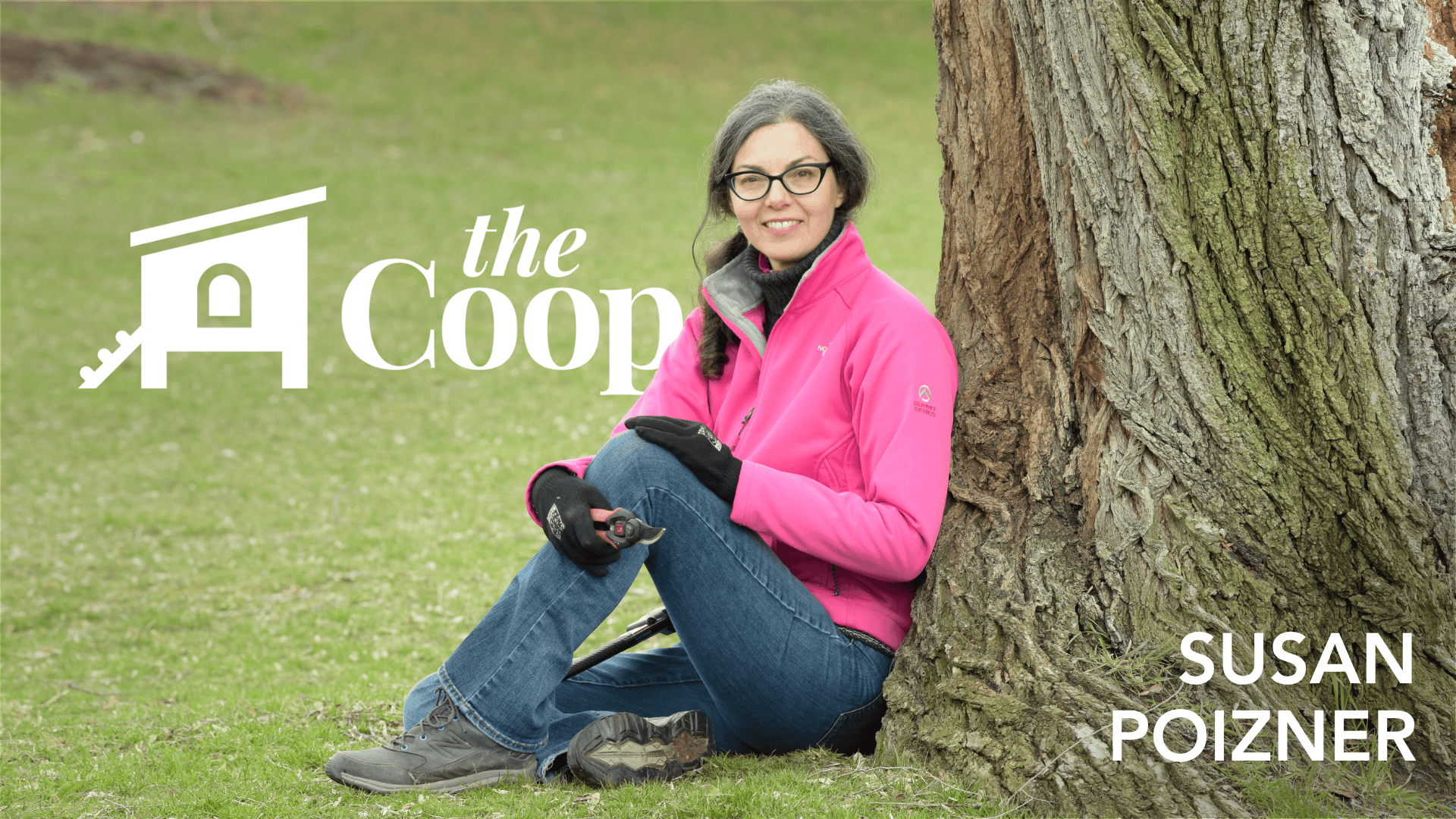



If you’ve ever dreamed of stepping outside and picking fresh, juicy fruit straight from your own trees (but felt intimidated by pruning, rootstocks, pollination, or where to even begin) this episode is for you.
In Episode #19 of The Coop, Anna sits down with Susan Poizner, orchardist, author, educator, and founder of OrchardPeople.com, for a warm, practical conversation that takes the mystery out of growing fruit trees.
Susan shares why most big-box store trees set beginners up for disappointment and explains how choosing the right variety and rootstock for your climate and space can eliminate up to 60% of future problems. She walks through the advantages of starting with bare-root trees, proper planting techniques, and why the first 3 to 5 years are critical for shaping a strong, productive tree.
The conversation dives into cross-pollination (why some trees need a partner and others don’t), the difference between open-center and central-leader pruning, and how timing your pruning cuts makes a big difference in tree health and fruit production. Susan also explains why grafted trees are the norm and how they allow us to grow exactly the fruit we want … without waiting 5 to 7 years to see what a seedling produces.
Whether you have room for just one small dwarf tree in your backyard or you’re dreaming of an orchard on your homestead, this episode gives you the knowledge and confidence to get started the right way. Susan’s passion is contagious, and her straightforward advice makes growing fruit trees feel exciting and totally doable … even for complete beginners.
If you’re ready to move beyond “someday” and actually plant your first fruit tree this season, don’t miss this conversation.
In this episode, Anna Sakawsky discusses:
- How to choose the right fruit tree varieties and rootstocks for your climate and space
- Why most big-box store trees set you up for disappointment
- Cross-pollination basics and when you actually need more than one tree
- Proper planting techniques (including bare-root trees and the first few critical years)
- Pruning strategies (open center vs. central leader) and why timing matters
- Common beginner mistakes and how to avoid them
About Susan Poizner
Susan Poizner is an orchard educator, author, and the founder of Orchard People. A former journalist and documentary filmmaker, Susan discovered her passion for fruit trees after moving back to North America and planting a community orchard in her local park. She now teaches gardeners and orchardists worldwide how to grow healthy, productive fruit trees through online courses, workshops, books, and her popular Orchard People podcast and radio show. Susan is the author of several books on fruit tree care, including Fruit Tree Pruning and Fruit Tree Grafting for Everyone, and helps home growers choose the right varieties, prune effectively, and solve common problems. She lives in Toronto, where she continues to grow and teach about fruit trees with enthusiasm and practical wisdom.
The show notes …
00:00:00 – Intro
00:05:37 – Susan’s Journey from Journalist to Orchardist
00:08:02 – Why Fruit Trees are Grafted
00:14:33 – Sacrificing Early Fruit for Long-Term Growth
00:16:33 – What to Know Before Buying a Fruit Tree
00:21:49 – How to Choose Your Variety
00:28:34 – Fruit Tree Spacing
00:35:49 – Guiding Tree Hormones
00:39:03 – Finding the Perfect Location
00:44:31 – The Rules of Cross-Pollination
00:50:04 – When and How to Plant Bare-Root Trees
00:56:02 – The First Pruning Cut
00:57:44 – Open Center vs. Central Leader
01:02:13 – Ongoing Pruning for Older Trees
01:07:20 – Summer Pruning vs. Winter Pruning
01:15:58 – Tree Maintenance
01:19:41 – Susan’s New Book & Resources
Susan Poizner:
Seeing that you can grow your own food changed me completely. Sit and decide, first of all, what type of fruit you want to grow. That’s important. Are you going to cook with it? Do you want to eat it raw? Do you want to make it into cider? Because different cultivars shine in different ways. And just choosing the right tree will get rid of 60% of the problems that you would’ve had. If you had planted trees from the big box store and just waited to see what happens, you have an ongoing relationship with the tree to ensure it’s partnership between you and the tree. You want to ensure that it gets everything it needs so that it can produce yummy fruit for you. And then it’ll give you lots of fruit and it’ll be so happy and healthy. Okay? So yes and the first three to five years are the most important time when you are building and sculpting the tree into the ideal structure.
Anna Sakawsky:
This episode is brought to you by Azure Standard. Family owned since the 1970s, Azure Standard is on a mission to make real food more accessible by delivering it straight to your doorstep or to a convenient local drop point near you. Everything they offer is completely organic, non- GMO, and free from junk additives you don’t want in your home or in your body. With more than 13,000 carefully vetted products, Azure Standard makes it easy to stock up on what really matters from bulk grains, nuts, and healthy oils to fruits and vegetables, frozen meats, pantry staples, and even clean household goods. And the best part is you skip the grocery store markup. You can order exactly what your family actually needs, save big on high quality food and pick it up alongside neighbors who care about the same things you do. Health, sustainability, and supporting ethical producers.
You head to azurestandard.com right now to get started. Again, that’s azurestandard.com. Well, hello everyone and welcome to episode number 19 of The Coop. I’m your host, Anna Sokowski, editor-in-chief of Homestead Living Magazine, the magazine for Homesteaders Buy Homesteaders. And today we are talking about something that I think many homesteaders dream about, and that is growing your own fruit. So there’s something deeply satisfying about stepping outside and picking a fresh apple pear or cherries straight from your own tree. Not to mention harvesting enough fruit to enjoy fresh and preserve for the rest of the year. But for many people, fruit trees can feel a little intimidating. There’s a lot to think about when it comes to choosing the right varieties, understanding pollination, knowing when and how to prune, figuring out how to properly care for trees throughout the seasons, dealing with problems as they come up.
And for beginners, it can be hard to know where to start. And I know that myself because I am a beginner fruit tree grower as well. I just planted my very first fruit tree last year, a cherry tree, and I did so actually with the help of our guest today. So today’s episode is all about breaking down the basics of growing fruit trees, especially for those who are just getting started. We’ll be talking about how to choose the right fruit tree varieties for your property, when and how to plant them, how long it typically takes before you can expect a harvest, and what sort of care fruit trees need to stay healthy and productive for many years. And to help guide us through all of this, I am joined by someone who has dedicated much of her work to helping people grow fruit successfully. Susan Poisner is an orchardist, educator, and the founder of orchardpeople.com.
She teaches gardeners and orchardists around the world how to grow healthy, productive fruit trees. She’s the author of several books on Fruit Tree Growing, the host of the Orchard People Radio Show and podcast, and she teaches fruit tree care through workshops and courses designed for gardeners of all experience levels. Plus, she’s a contributor to Homestead Living Magazine. So you know she’s been vetted and is truly an expert in her field. Susan has spent years helping people gain the knowledge and confidence to grow fruit trees successfully, even if they are just starting with a single tree in their backyard. So I’m so excited to have her here with me today and share some of her knowledge with us. So Susan, welcome to the show.
Susan Poizner:
I’m so happy to be here with you. Thank you, Anna.
Anna Sakawsky:
Well, I’m so happy to have you here with me because I have already gained so much knowledge from you. Just from the articles that you’ve written, I know you’ve written a couple articles for the magazine already on … One was on pruning, which I found fascinating because pruning, I feel like goes against our instincts as gardeners and growers. We think we want to produce things. We want things to grow. We don’t want to cut and remove things, right? So that I found really interesting learning about how to properly prune fruit trees. And then you did another one on, I think, fall fruit tree care, and then kind of getting ahead of some common problems before they start. And then we actually got the chance to sit down, just you and I, and my husband joined this conversation last year when we planted our first fruit tree because we had no idea what we were doing.
And I was like, “I know who we need to talk to. We got to get Susan on the phone.” Because our situation is a little bit unique too, and we’ll get into this, but we planted a cherry tree with … It’s got six different varieties grafted onto it. And so we were like, “Oh, what do we do with this? Does this follow the normal rules? What do we do? ” So having your help was … I think we’re on the right track because it looks like everything’s looking healthy and butting out now. And so I’m excited to see what happens with our tree this year. But before we get into all this, I always just like to ask a little bit about your background because I think you have a really unique story of how you got into growing fruit trees and became an orchardist because you were a journalist before you were an orchardist, correct?
Susan Poizner:
Yeah. I was a journalist for many, many years and a radio producer, a television producer. I did documentary films and the world of media changed. I had also been living in the UK. I had been living in Russia. I had a very interesting career, but when I came back to North America, I was like, “Okay, what am I going to do now?” I started a production company. I love education. I’ve always been very interested in teaching people stuff. So long story short, I ended up marrying my husband who is originally from Trinidad and loved gardening. And I’m like, “Listen, I don’t do that stuff. I don’t get my hands dirty. This is not my thing.” And he wanted to plant up the garden with this, that, and the other. And I’m like, “You know what? It’s going to be a mess and it’s all going to fall on me and I’m not doing it.
” And I gave him such hassle. In the end, it was magical. When seeing how things grow, seeing that you can grow your own food changed me completely and it put me on a different trajectory completely. So I ended up going to a landscape design school, learning about landscape design, falling in love with trees and falling in love with fruit trees because it’s food, one of my passions and nature, one of my passions. I planted a community orchard in my local park. That was a whole challenge in itself. There was some opposition interestingly, but we got through all the hurdles. We planted this orchard. I was already a gardener and I had no idea what I was doing. And I just thought you’re going to water the trees and they’ll be just fine. They take care of themselves and it could not be further from the truth when you’re planting fruit trees.
Even regular trees, they need watering, especially when they’re establishing themselves. They only need a minimal amount of pruning, but they do need a little tenderness and love and care. Fruit trees are twice as … I don’t want to say challenging. They’ve cut so many opportunities, but they do have challenges that come with it. And part of that is because they are not exactly the kind of trees you would find in nature. You talked about your multi-fruit cherry tree, right? When you go out in nature, and if you’re going on a hike wherever you live, are you going to come across a tree that grows five or six different types of fruit on it? Absolutely not. Right? I wish. And that illustrates how fruit trees are made. They are all grafted. Your tree is super grafted. It’s supercharged, but almost every fruit tree that you’re going to grow, whether it’s like a Macintosh apple tree or a bing cherry or whatever you’re growing is a grafted tree.
So it has roots from one type of tree and it has the top part is a different type of tree. That’s your fruiting wood. And they are carefully matched so that they will produce a tree that produces the fruit that you want to grow and grows the size that you need. So you don’t necessarily want your little multi-fruit cherry tree to be 60 feet tall and not … You can’t climb to go and harvest it and it all goes to waste and then the squirrels get it all or whatever.
So grafted trees were kind of developed for a reason so we can customize our fruit trees saying that they need help. In order to produce a healthy, delicious, and quality harvest, they need help. And we can talk about why.
Anna Sakawsky:
I find that really interesting. I’ve always wondered about grafted trees and the fact that you kind of mentioned that they’re all basically grafted nowadays. I think of that because I am a gardener. I’m new to fruit trees, but I know gardening and seeds and that sort of thing. And so I think of them almost like planting hybrid seeds where they’re kind of developed specifically to have certain traits. But there are also open pollinated seeds. We have heirlooms, that sort of thing. So are there trees still out there that you can get that are not grafted? When you have kids, for example, that’ll eat an apple and they go, “Oh, here’s the seed. Can I plant the seed?” And you’re like, “Well, no, it doesn’t really work that way.” Does it work? They’re like, “Can it work that way still? Why doesn’t it work that way?”
Susan Poizner:
It does. It absolutely works that way. And it’s a wonderful project. It’s a multi-year project because apples are such a great example. An apple will, let’s say, have five seeds. Each seed is a genetically unique individual, just like you and your partner may have five children. They are not clones of you. They’re unique. They’ve got their own, they might have different hair color and different eye color. They might have some similar traits, but there’ll be a combination. The same thing happens with an apple tree. So the mother and the father tree both contribute sort of genetic material and you get a completely unique apple tree. So it’s still an apple tree. It will still grow fruit if you grow a seedling tree. The problem is the fruit might not actually taste very good. So in American history, they talk about Johnny appleseed. He collected all these seeds.
He planted all these apple trees and he collected or the people who then lived wherever he planted them would collect those apples and turn it into cider. Those weren’t yummy and delicious crunching on apples. Those were great for juicing, for cider, for fermenting, and that was an important part of life at that time. But in society today, we want our apples to taste good fresh or we want to bake with them and you are rolling the dice when you’re planting an apple seed, whether the fruit will taste good. Now, if you have five to seven years to wait to see, go for it. It’s an awesome project.
Interestingly, a lot of the ideas about pruning you’ll still want to do to improve the quality of the fruit, but yes, you can do that. But most gardeners, like you were saying in the beginning, they’re excited about planting fruit trees. They don’t want to wait five to seven years to see if the fruit tastes good. They want to know that this fruit is going to be the same fruit that Melissa next door was growing and it was awesome. I really enjoyed that fruit. It was maybe a special cultivar, maybe whatever her grandmother gave her this apple clipping from her apple tree. You love it. You want to propagate it, you clone it with grafting. I’ve even written a book called Fruit Tree Grafting for Everyone, which actually tells you how simple it is to take a cutting from a tree that produces fruit that you love to eat and to graft it to create your own tree for your backyard where you will get that exact type of fruit.
Anna Sakawsky:
Right. Okay. That actually makes a lot of sense. And especially in the context of the fact that it can take a number of years to get a harvest. So it’s a little bit different than when you’re growing an annual garden and you may want to take a chance at a seed that you’ve saved that may have cross-pollinated with something else and you go, “Oh, well, we’ll try it. And if it’s not great, then oh well.” But that’s only one season and one small plot in your garden that you have dedicated to that and that’s it. But when you’re growing a fruit tree, rolling the dice on that and not knowing what you’re going to get and then waiting, like you say, five to seven years to see is probably not in most people’s best interest. Although, like you say, if you have a lot of land, if you have the space to do it and you can dedicate a little bit of space to experimentation, then it’s cool to know that you can.
Susan Poizner:
Yeah. And it’s
Anna Sakawsky:
Also cool to know that you can graft your own. I remember my mom saying that my, I think it was my great-grandfather, my grandfather’s grandpa used to do that a lot. She’s like, “Oh yeah, he used to graft apple trees and that sort of thing.” So I always thought that was really cool because that’s beyond my skill level at this moment in time, but maybe someday.
Susan Poizner:
You know what though, Anna? I’m the biggest, I see myself as the biggest doofus in the world. I don’t know if that’s a word you use. That’s a word my husband talks about. I’m like, I’m not good at stuff, but if I manage to teach myself grafting, anybody can learn it. I promise you that.
Anna Sakawsky:
Totally.
Susan Poizner:
But there’s also something I want to say. We talked earlier about root stocks. They contribute quite a lot. And I said to you that when you plant a seed, you’re probably going to have to wait five to seven years for the tree to fruit. If you buy a grafted tree, you’re not going to have to wait five to seven years. And partly because sometimes the rootstock will contribute a quality of early fruiting. In fact, what I ask people to do when they plant a new fruit tree, cherries not so much though you could still do it with cherries. You plant a new fruit tree, whether you, hopefully you got a bear root tree from a specialist fruit tree nursery, maybe you got it from the big box store. I’m not a big fan and we can talk about why. But either way, for the first two years, I would suggest you remove every single piece of fruit that forms on that tree because they are precocious.
They do want to produce fruit, especially if they’re grafted onto a good root stock, but you want a tree that will last a long time and be healthy and productive. So instead of the little young tree pushing its energy into the little fruitlets, you want that tree to push its energy into expanding its root system, right? So that’s what you want. It’s a short-term sacrifice, but long-term benefit.
Anna Sakawsky:
Yeah, that makes total sense. And again, having some gardening under my belt, I mean, we do that. We even do that with annuals. We pinch off the flowers from our tomato and pepper plants at the beginning of the season before they take roots so that they can put their energy into that. And then later on, we let them do that. I don’t know why the fruit trees and berry bushes and that sort of thing, it’s like more hesitant about. I’m like, I don’t want to damage them because they’re perennials and that sort of thing. This is actually the first year that I really gave my blueberry plants, like a really proper pruning because we’ve had them for a few years now and they’re just like a little. And now that I’ve learned actually a lot of this from you and the fruit trees, and then we did this with our elderberry plants last year where we cut them almost all the way down.
I’m like, oh my God, they were the most productive they’ve ever been. But still, I go now and I’ve pruned them right back again and I’m like, “Oh no, what if I killed them?” And I’m sure that they’ll take off again. You always have this hesitation, but with pinching off the fruits and everything, again, with blueberries, with other plants, that’s recommended as well until they get established, right? Okay. Before we get into all that, because we will cover all this, but I do want to back up a little bit and just kind of talk about like, we’re just getting started. So if somebody is interested in growing fruit trees, has never done it before, they’re excited about it, they want to go buy a fruit tree, plant it in the ground, what are the first things they need to know or decide before they just go like a kid in a candy shop to the garden center and buy a fruitry?
Susan Poizner:
Absolutely. And by the way, I’ve been there, done that, bought the t-shirt, so please don’t run to the garden center or the big box store and get the trees that are on sale. They’re so pretty and there’s so much love and hope connected to them. But if you take your time and do your research first, it doesn’t take a long time. It would take a weekend. Then what you can do is sit and decide, first of all, what type of fruit you want to grow. That’s important. Are you going to cook with it? Do you want to eat it raw? Do you want to make it into cider? Because different cultivars shine in different ways. Once you decide what you want, then you decide, how much care do I want to give this tree? Because some fruit trees are easier to grow than others. So fruit trees have a series of diseases like just a number of diseases that they get.
And I always say again and again, fruit trees are like kids in kindergarten. When one tree gets sick, it goes from tree to tree, spreads around the neighborhood. So you want to get, if possible, disease resistant cultivars, and they exist, but you’re not going to get them at the garden center and you’re not going to get them at the big box store. Where I would suggest is going to find your local fruit tree nursery and downloading their catalog on orchardpeople.com/nursery or something like that. I have a list of nurseries across North America and the UK and Ireland, but there may be more and look carefully at what they have and have a look. In the description, if a tree is resistant to common diseases, it’ll say, they will shout it from the rooftops, “This tree is resistant to fire blight or black knot or powdery mildew.” They will say that.
If it doesn’t say anything, it’s not resistant. So that’s another thing you want to think about. You want to think about cross-pollination. I’ve had people come up to me and say, “Oh my gosh, I planted like a plum tree seven years ago and it flowers, but I’ve not gotten any fruit at all. ” And it turns out that they don’t have a pollination partner for that tree. So they have a beautiful, healthy tree they’ve loved and cared for, but no fruit. So it’s a little adventure as you go through step by step to figure out what is the right tree for you. So just to say that this year, this spring, I’m publishing my next book, which is called Designing a Fruit Tree Garden: How to Choose Fruit Trees That Thrive in Your Climate and Space. And it’s kind of fun. I did it as an interactive adventure as I take you guys through step by step, choosing your tree and then figuring out, okay, will it produce fruit?
Is it disease resistant? Maybe I want to swap it out with something else. And then, how am I going to plant it? Do I want a high density planting with lots of trees in a small space, which is by the way, a really cool idea or do I want it decorative where you get less fruit, but it’s kind of beautiful. There’s so many options and it really doesn’t take a lot of time to think about it. By the end of the book, you know exactly what trees you want, you know they will produce fruit, you know they will be easier to grow and you know how you’re going to plant them and you know what kind of root stock you need. So that research is essential and just choosing the right tree will get rid of 60% of the problems that you would have had if you had planted trees from the big box store and just waited to see what happens.
Anna Sakawsky:
Makes sense. I mean, what do they say, right? An ounce of prevention’s worth a pound of cure. Oh
Susan Poizner:
God,
Anna Sakawsky:
Yes. I mean, I imagine that’s like tenfold with fruit trees because they take a while to establish and to produce everything, right? I know one of the banes of my existence is having to move perennials when you’re like, “Oh man, I planted this in the wrong spot or it’s
Susan Poizner:
Competing
Anna Sakawsky:
With this or whatever.” And then you kind of have to do this bit of a restarting process. I can imagine that that’s like, again, tenfold with fruit trees, right? If you have to move a fruit tree or you do something wrong off the bat or plant in the wrong space or whatever. Okay. So when it comes to actually choosing fruit trees, I mean, obviously there’s different types of fruit trees, right? There’s your apples, your pears, your plums, your cherries, depending on where you live, maybe peaches, that sort of thing. So outside of choosing, I mean, I would imagine the first choice you want to make is like, what fruit do you actually like to eat? Don’t plant a cherry tree if you don’t like cherries, but then there are many different varieties as well. And a lot of them are not necessarily varieties everybody’s familiar with because they’re not always the type of varieties that we see in the supermarkets, right?
The Macintosh apples and Granny Smith’s and that sort of thing. So how do you know what types of fruit trees to choose for your property? How do you start that research or figure that out?
Susan Poizner:
Well, I love how you said that because we can start with what not to choose. Don’t go for the ones in the supermarket. That is a no-brainer. People love Honeycrisp apples. They are so hard to grow. And that’s why, by the way, they’re very expensive because professional growers don’t like growing them either and they’re very fiddly. But don’t go for the ones in the supermarket. And I know that, oh, I’m familiar with how it tastes and therefore I don’t want to take a chance. I get that. But the reason those trees, those fruits are in the supermarket is because they’re easy to ship, because they stay, I don’t know, good for longer. There’s lots of reasons, but they have nothing to do with your own homestead. They have to do with big industrial farming. So don’t go for those. Again, when you have your fruit tree nursery catalog in front of you, you will see descriptions of all different types of fruit.
And I get it if people say, “It’s not enough for me to read a description saying that this is crunchy, juicy and sweet. Everybody loves it because you may not love that particular flavor or it says tart with a little bit of blah, blah, or whatever it is. ” What I like to do is every fall, I look around for apple tastings at local fruit tree nurseries. Lots of them do it where you go, you line up and you have a little piece of the various different apples. So you talk about cultivars nobody’s ever heard of Liberty Apple, pristine apple, freedom apple, those three, sweet 16, those are cultivars that are easier to grow because they’re disease resistant, but you’re not going to get them in the supermarket. So how do you know if you’re going to like the taste? I would say if you’re in a rush this year and you’ve got some space and you want to start planting one or two trees and then continue on later, that’s fine.
Still do your research, but make sure in the fall that you go to some fruit tastings to taste. Also in the fruit, in the catalogs, for instance, under cherries, they’re going to describe, is this a pie cherry? That means basically in code that you’re not going to want to eat this cherry right off the tree, right? Or is it a sweet cherry? Is it a dessert apple, which means it’s a fresh eating apple. All of this, and in my book I talk about, but it’s all kind of code. In a compact little paragraph, they’re telling you a lot about the fruit. So with apples, I would say it’s great to taste them, though I will tell you my favorite disease resistant apple is a pristine apple, flat out, okay? Though there’s lots of other great ones. Cherries, like you did, you took a chance. I think they’re all great.
You know what I mean? They’re all great as long as you know that the tart cherries are for baking and the sweet cherry. Peaches, there is not as much genetic diversity in peaches as there are in apples. So while I think it would be wonderful if people did their research in advance, figured out which are disease resistance, which are firmer, which are free stone, whatever, whatever they’re looking for, but there’s a little less diversity and flavors, but it’s the area where you’re going to get a lot of diversity as apples and plums and other types of fruit too.
Anna Sakawsky:
Yeah. Interesting that you mentioned the apple tastings. I don’t know if we have something like that here, but where we live, so just for anybody listening, so Susan, you are in the Toronto area, is that right?
Susan Poizner:
Yep.
Anna Sakawsky:
And I’m on Vancouver Island, but we have something in our community that is basically a gleaning organization. So a lot of people here have fruit trees in their backyard, that sort of thing. A lot of people have bought houses that already had established fruit trees and they don’t really want to deal with the harvest when it comes on. There’s all this fruit that comes and then if it falls, then it attracts animals into the yard and all. So they just want somebody, a lot of them are maybe elderly and they don’t want to deal with it. They just want somebody to come and take it. So we have this awesome organization called Lush Valley here that I have volunteered with before and they go around and they glean. So gleaning is basically gathering the harvest, the extra or unwanted harvest. And a lot of that has to do with the fruit trees around here.
So they go, people can call up and be like, “Hey, I got a fruit tree. I don’t want to deal with it. Can you come take it? ” And the way it works, if this works for the homeowner is the volunteers go out, they gather the fruit, the homeowner gets a third if they want it. The volunteers get to divvy up about a third of the harvest between them, and then a third goes to the food bank or all the excess, because we get so many apples in our area, they process it into cider and then they sell it and then the money goes towards the food bank and local food initiatives and that sort of thing. So that’s just a really cool thing that we have in our area. But I have looked this up and I know that those type of organizations exist across North America too.
So it’s worth looking into. Not only can you get a bit of a harvest out of that yourself, usually for free if you go just volunteer your time, but then you get a chance to taste a bunch of these different types of varieties that are more kind of backyard varieties. And usually, like I know with this organization, they’ll tell you, “We’ve got a Grabenstein pick coming up or whatever.” And then you get to go and you get to try some of those apples and go, “Oh, I really like this one or that’s not my favorite.” So maybe if you get the chance to do that as well, it’s a way to kind of get a bit of a harvest, volunteer in your community, and then also get to taste some of these things. And they do this again with all cherry trees, pear trees, plum trees, all the different fruit trees around here, and you get to kind of taste it that way too.
So something we’ll look into.
Susan Poizner:
That’s a lot of fun. And also near you, you have the Salt Spring Island Apple Festival. And if you can get away from your homestead, that’s worth a trip that you get to taste all sorts of fantastic cultivars. And I know in the United States there’s probably also some big ones. So if you guys want to do a little tourism and take a trip somewhere fantastic and just try all those cultivars. I love doing that. It’s one of my favorite things.
Anna Sakawsky:
Oh, that’s really cool. I didn’t know about the Salt Spring Island one. I haven’t been to Salt Spring in years.That’d be very fun one to go
Susan Poizner:
To. Oh, it is. I know it is. I’ve spent time there. I didn’t go to the festival, but they have such a wide range of apples there. It’s a very good climate for apple growing and they’re proud of what they have and you’ll get to taste everything.
Anna Sakawsky:
Awesome. Okay. So the next thing I want to touch on is kind of just the space, right? So before we go planting any fruit trees, you had mentioned that you can actually plant fruit trees quite close together. How much space do fruit trees actually need and what should people consider when it comes to spacing and location on their property?
Susan Poizner:
Such a good question. And again, it’s a brilliant question to think about before you plant your tree and even before you order the tree. So how much space your tree needs depends on the root stalk that it’s grafted onto. So root stocks are generally called like dwarfing root stocks. That’s a little small tree that won’t get bigger than maybe seven or 10 feet tall. It also probably won’t be super strong. So if you have kids or pets running around in your garden and they knock into the tree, it could break it. So you often have to support those or use them in specific situations where you have a trellis for them. So that’s dwarfing trees. Then there’s semi-dwarfing trees and dwarfing trees could be planted maybe if they’re freestanding, just let them spread out maybe 10 feet apart, less if you’ve put them in a high density situation.
We can talk about that in a minute. Then they’re semi-dwarfing trees and they sound like they’re also going to be small, but they’re not. They’re bigger and they are great. For instance, in our park where I planted our community orchard, we wanted trees that kids could climb, but we On a trees that weren’t going to be 40 feet high so that we couldn’t harvest and prune them. So that’s semi-dwarfing. They might be 20 feet tall depending on what you’re growing. They could be less, they could be more. And you’d want to plant those 15, 16 feet apart, something like that. Then there is standard trees. And standard trees are on a tough root stock. So if you’re in an environment with a lot of wind or with soil that’s a little bit too hard clay, you need roots that are going to push their way out into that soil.
You need tough roots. So you might want to go for a standard tree. Now standard trees can get really big. And so they will be hard to climb, but to harvest and spray and stuff. But with correct pruning, you should be able to keep them more compact depending on where you live. Anyways, standard trees are good for long-lasting trees. They can live a hundred years, for instance, because they’re so tough. So if you have a space somewhere and you want to maybe get a beautiful crab apple tree that will pollinate your other trees, something that you can leave as a legacy to your kids, grandkids, and to nature, because nature, certain insects love older trees. So those have a place in a garden too if you’ve got enough space. Now, they would need to be much further apart because they grow so big and tall.
When you think about how far apart your trees are going to be planted, you need to think about how wide the canopy is going to get. And the bigger your rootstock, the wider the canopy. You don’t want trees side by side to be fighting each other for space and light. You don’t want the branches to rub up against each other. So those are the reasons that freestanding trees need to be spaced very thoughtfully. Just to say that if you did go for a standard tree and you lived in an incredibly rugged environment with wind and high elevation, you may find that that standard tree is so busy standing up to the elements, it won’t get to be that huge size. So all of this is guidance. It depends on warmer climates, maybe they grow bigger and stuff like that. And again, that’s all in my book, Designing a Fruit Tree Garden.
I talk about that. So in terms of spacing as well though, those little dwarfing trees we talked about, they don’t live as long, but they are really flexible. So you could grow them as a freestanding tree, or there are a couple of other options. You could grow them high density like many modern orchards grow their fruit trees. So these days, orchards are growing their fruit trees almost like grapes in a vineyard. They are supported against a trellis. There’s not a lot of pruning, but you can plant your apple trees on a dwarfing rootstock, maybe even four feet apart. You could have, in the same space, you might have two larger trees, you could have 10 or more different cultivars ensuring that the harvest is available at different times in the growing season. Sometimes people call this like a cider orchard because they used to do this for cider apples, but that gives you so much flexibility.
And instead of pruning your trees, there is some pruning, but there’s more training. You are pulling the branches downwards and tying them to the trellis. And you do have to prune to make sure that the trees don’t fight with each other because they’re all side by side. You don’t want them rubbing up to each other. So high density plantings are really interesting. In a proper orchard, these trees would only be left for 15 years and then their fruitfulness declines and they would replace them with another tree. I don’t know if anybody has tested and could you leave them for 25 years? Yes, they would be less fruitful, but that might be fine. You maybe don’t need all that fruit all the time. So that’s an option. And then of course, there’s the fun option of Espalier, which is beautiful decorative plantings also with dwarfing trees, also tying them up to a trellis or a wall.
And it’s very beautiful, but it’s fiddly. You need to be somebody who loves puttering in the garden, you’ll prune it like three times a year or something.
Anna Sakawsky:
Okay. We’re thinking about doing that with an apple. We haven’t bought our apple yet, so this is good actually because we would like to buy it this spring. And we’re thinking of a door variety. We don’t have a large property. We only have a quarter acre and our whole garden, everything is in the front yard because that’s where we get all of our sun. And we’ll have two septic tanks in our yard, one for our house and one for our rental. So we’re limited as to what we can plant as far as fruit trees and things that have extensive root systems. So we have our little cherry in one area and we have a grapevine that we are training along a fence along our yard. And then we would like to do a dwarf apple variety that we want to espelier or train along the fence from the other side.
And it’s funny because I’ve always wondered that when we travel into the interior of the province, there’s a lot of vineyards and orchards. And I always see these apple trees, like you mentioned, that are really high density, only a few feet apart, and they’re like six feet tall. But they’re loaded with apples. And so I’ve always wondered, well, what are they doing? You don’t see apple trees grow like that in the wild. So are those dwarf varieties that then they’re also pruning to keep them that short and then they’re just really high density fruit production in that little space?
Susan Poizner:
It’s fabulous. There’s science there. Okay. So yes, this is a newfangled way to grow. Fruit trees, yes, it’s only possible because we now have so many different amazing dwarfing root stocks, but it is incredible. Their goal is fruit production. They need to make money. They don’t want to pay a lot of money to have people on ladders harvesting. They don’t want to spend a ton of time pruning. They do have to do some pruning, but it’s not very specialist. It’s just pruning between the trees to make sure they don’t fight with each other. But what they’re doing by pulling branches down, the fruitfulness of a branch depends on the angle that it grows at. Okay? It has to do with a hormone called oxen. So oxon is a hormone that sort of gathers at the tips of branches and it tells that branch, grow outward, give me more branch.
And it suppresses the lateral buds or the side buds on that branch, which by the way, would’ve been fruit, especially with apples. So it’s dominating. The oxen is saying, “Hey, grow longer, don’t grow more fruit.” So oxen, those branches, they kind of aspire to reach to the sky sometimes or to reach out. But by pulling each branch a little bit below horizontal, you’re tricking the oxen and the oxen sort of diminishes and it maybe redistributes itself along the branch so that it no longer suppresses the lateral buds. So all of a sudden these lateral buds are not being dominated by oxens who say, “Do not do anything. I’m growing longer. That’s what I need to do. ” And instead, you get lots of blossoms. You get branches, you get blossoms, you get fruit. So the whole philosophy behind high density plantings is pull those branches down to just a little below horizontal.
Keep pulling them down. You don’t even prune very much. Whereas when you have a beautiful freestanding tree, you need a really open canopy for various reasons, for good air circulation, to prevent disease, and to make sure that sunlight reaches every branch so each fruit can grow and ripen properly. So this is a different technique. And again, you’re tricking the hormones so that it would be heavy with fruit. And it will be heavy with fruit starting from year, let’s say three or four, going to year 15. And then after that, it will be little less fruitful as the years go on. So you may decide to replace in a staggered manner if you always want lots of fruit or you may leave some of the oldies and see what happens as long as they’re healthy.
Anna Sakawsky:
Okay. Yeah. I mean, there’s obviously a lot of science that’s fascinating. I don’t want to overwhelm any listeners thinking like, “Oh my God, tricking hormones. I got to do this. ” So again, let’s get back to, if somebody’s new to this and they’re just wanting to plant a fruit tree or two, right? We can talk about cross pollination just a sec, but we want to get it in the ground. So we obviously have to think about spacing and whether it’s a dwarf, semi-dwarf, standard tree, that sort of thing. What other things should we think about when it comes to the location of where we want to plant a fruit tree on our property?
Susan Poizner:
Absolutely. Great point. Okay. So fruit trees, like the conventional ones we’re talking about, apples, pears, apricots, peaches, cherries, they need full sun. They love full sun. So sometimes whenever I see a fruit tree planted in a shady garden, they always look really sad and they don’t ever produce terrific fruit. And I’ve even seen this in our own orchard now. It is a park and there are some trees that were younger at the time that we planted our trees in the only space that we could. And now those other trees are shading our trees. And so our trees are less productive some of them in those locations. So that’s kind of sad. Saying that, if you live in a really, really hot climate like Arizona or somewhere really hot, then what happens is you grow these fruit trees in full sun. Let’s say it’s an apple tree and the actual apples will cook on the branches because it’s way too hot for them.
So there are certain situations where you might even want a little bit of shade for your tree. It’ll be dappled shade, not full shade. It’s not under an oak tree, maybe under something like a Kentucky coffee tree with little tiny leaves or something like that. But mostly in most cooler climates, full sun. And the less sun your tree gets, the less fruit you will get. Just know that. And the less luscious and lovely your tree will look. You need access to water. You need to be watering those trees, especially when they’re young. And I know that other community orchards in Toronto, they’d say, “Hey, we want to plant an orchard in our local ravine. It’s fantastic. We got this space.” And I’m like, “Great. Where’s the water going to come from?” Because fruit trees don’t have teeth. They can’t take nutrition in or liquid in from the soil, first of all, if the liquid isn’t there, but they can’t chew on the nutrition in the soil.
They need everything in liquid form to come into its roots. So if a tree doesn’t have water, it will be starving basically. So you need irrigation and you need, I always say room for roots to grow. If it’s a freestanding tree and it’s not a dwarfing tree, give the tree room. Don’t plant. I really don’t like it when people plant hostas and stuff around their fruit trees or even strawberries because young fruit trees do not compete well for water and nutrition. They just don’t. Again, they’re these little frankin trees. They’re made up of two trees. They’re grafted. Give them the best start that you can. And yeah, those are a few tips.
Anna Sakawsky:
Okay. Yeah. Well, and I would just say one other thing that I know we considered, because we are working with a pretty small space, like I said, we have two septic tanks. We’ve got a raised bed garden, we’ve got an in- ground guard bed. There’s all these things, the factors that we need to consider. We couldn’t just necessarily put a fruit tree anywhere, but we kind of have this space along the side. And we had to also consider, we were thinking about placing a little bit closer to the front of our property, but we also thought, but when this tree grows in, it’s also going to provide shade. And if it’s near the front of the property and the sun’s coming up near the front, then that’s going to shade the garden beds behind it. So we decided to move it back. So now that shade hopefully won’t shade the garden bed, right?
The shade will be cast towards the house. So that’s just another factor is it’s not just for the fruit tree, you want to make sure that you have full somebody you also have to consider. It might be small when you’re putting it in, but it’s going to get bigger and it’s also going to provide shade. So where is that shade going to be cast and is that going to be a problem as well?
Susan Poizner:
Exactly. And that’s why some people do opt for a spalier or high density because those are not trees that are going to shade anything. They would actually make a nice boundary for a big, even veggie garden like they did in the old days. So smaller trees are really important to consider if you don’t want it to overshade your whole garden. And that’s the beauty of root stocks. Again, when you go to a garden center, they often don’t even tell you what rootstock your tree is on. It’s just a big surprise when you take it home. Is it going to be a little tree or is it going to be a huge tree? You have no idea. Whereas with fruit tree nurseries, under the cultivar you want, let’s say you want a liberty apple tree, it’ll say, “This comes on two different root stocks. The M9 is the dwarfing rootstocks or whatever it is, the B9, and they will tell you, which size do you want?
And we’ll give you the size you need.” Yeah.
Anna Sakawsky:
Okay. If the thought of raising chickens has ever intimidated you, consider this your sign to stop putting it off. Murray McMurray Hatchery has been helping first time chicken keepers succeed for over a hundred years. They offer the widest selection of day old chicks and poultry, super low minimum orders, sometimes as few as one bird, and the best guarantees in the business, live arrival, 48 hour livability, and 90% sexing accuracy. Plus they’ve got everything you need to raise happy, healthy birds right from the start. Brooders feed incubators the works. It’s never been easier or safer to start your own flock, so visit mcmurrayhatchery.com and tell them the coop sent you. Again, that’s mcmurrayhatchery.com. Let’s talk cross pollination because you already mentioned this that people sometimes will plant a tree, right? And this is kind of the case where we are. We don’t have room for an orchard.
We don’t have room for a whole bunch of different trees, but as I … Well, first of all, are all fruit trees cross-pollinating or do any of them self-pollinate?
Susan Poizner:
No, they’re not all cross-pollen. That’s the beauty of it all, right? So for people like you who have … I only have room for one tree, I’ll put it on a dwarfing root stock, but I don’t have room for two. What do I do? Well, a lot of peach trees are self-pollinating. Our apricot trees are self-pollinating. Sometimes sour cherry trees can be self-pollinating. Sweet cherry often are cross-pollinating. That’s why you got your multi-fruit cherry tree because all the different branches are going to pollinate each other.
Anna Sakawsky:
Well, and that was another question of mine is if you have something that’s got multiple different varieties grafted on, do they cross-pollinate?
Susan Poizner:
Absolutely. They cross-pollinate each other. So-
Anna Sakawsky:
Because I actually remember that I actually used to work at a little school and there was an apple tree and it was having issues with pollination. It wasn’t producing. And so somebody had actually come and grafted another branch on from their apple tree and so that it would cross-pollinate itself. So I always thought that was really interesting.
Susan Poizner:
That’s so clever. Yes, so indeed. Now, apple trees are very rarely, if ever, cross-pollinating. So you need more than one for an apple tree. Okay.
Anna Sakawsky:
So they’re very-
Susan Poizner:
They do not. They need
Anna Sakawsky:
To cross-pollinate.
Susan Poizner:
Yeah, they don’t. Sorry, they don’t self-pollinate. So you would need to. Now, sometimes people say, “Okay, well, I really like, for instance, I don’t know, Macintosh apple trees. So I’ll get two Macintosh apple trees.” So the question is, will the two Macintosh apple trees pollinate each other? What do you think, Anna?
Anna Sakawsky:
Oh, I don’t know. No, maybe no, because they’re the same variety. They need to
Susan Poizner:
Be different varieties. Exactly. They’re clones. Well,
Anna Sakawsky:
I know that because our elderberries, that was what we got too because we learned that they need to cross pollinate. And we got, I think one’s called a york and one’s called a nova. We were told get those two different varieties because they will cross pollinate. You don’t want two the same.
Susan Poizner:
So you need for the cross-pollinating ones, which are most apples, which are most pears, lots of types of plums are cross-pollinating. Sweet cherries are often cross-pollinating. So for those, you need to choose two trees that are not the same cultivar and that they flower at the same time. The blossoms open at the same time. So sometimes what people do is they look for a pollination chart online, which will tell them, okay, liberty apples and freedom apples, let’s say for instance, flour at the same time, so they will cross pollinate each other. So that’s a good partnership or whatever. That’s what they have these pollination charts for. Yeah. But self-pollinating ones, you don’t have to worry about it. If in your fruit tree catalog, you’re looking through the catalog and it says self-pollinating or self-fertile, you’re good to go. You take it home. Now, if you have a Macintosh apple tree and your neighbor two doors down has a honey crisp apple tree, do you need to get a second apple tree?
Anna Sakawsky:
Maybe not.
Susan Poizner:
Maybe not. If the bees find both of them. I think that’s what
Anna Sakawsky:
We’re also thinking about because our neighbors, we’re on a cul-de-sac and there’s two or three neighbors that also have cherries in their backyard. So I’m like, “Oh, okay. So probably ours will be fine no matter what because we’re all in close enough proximity that the bees and the pollinating insects are going to be going back and forth to those anyway.”
Susan Poizner:
So
Anna Sakawsky:
That is something to consider. If you’re really close to a neighbor that has another apple tree or another cherry tree or whatever it is, that can provide that cross pollination granted that that tree blossoms at the same time and is a variety that can cross pollinate. But I know, for example, in our area, there are so many people with apple trees and that sort of thing that you can probably get away with just one variety. But to your point, if you’ve got a bigger property, you don’t have anything close by, you may need two of your own. That’s why we got the two elderberries because I don’t think anybody here is actually growing elderberries. So we needed to make sure we had two of our own that were going to cross pollinate.
Susan Poizner:
Yeah. And again, I hear you about not freaking people out. I remember when we started our orchard right now, it’s intuitive for me. I’ve done this for enough time and I see it as a game and as a puzzle to find the right partnerships for trees. But I remember when the park supervisor was talking me through about how I needed to choose trees that cross pollinate and he was, I don’t even remember if he talked about disease resistance, but it just seemed like this big puzzle and I was like so overwhelmed. And so it took me a few years until I’m like, “Oh no, don’t worry. It’s like six steps. Choose the fruit you want, decide if they’re going to cross pollinate, figure out if it’s disease resistant, figure out when your harvest time is so that you don’t get all the fruit in one month.” And then it’s just like six steps, but all of these steps are just important.
So again, not to freak people out, just take it step by step. It’s worth thinking about it in advance because then you’re sorted no surprises.
Anna Sakawsky:
Right. Yes. Okay. So we’re doing the planning and prep work in advance. We’re feeling confident. We’re ready to go get our fruit tree or trees, put them in the ground. So first of all, when is the best time to actually plant fruit trees? And then second of all, what should we do at the time of planting? Should we just dig a hole in the ground where we want it to go? Should we be amending the soil? Should we be doing soil tests? What should we be doing at planting time?
Susan Poizner:
Good questions. Okay. So if you are buying your tree from a fruit tree nursery, you’re going to buy a bear root tree. And lots of people have done that and know what it is. But basically a bear root tree is dug out of the nursery when it’s dormant, no leaves, no fruit, no blossoms, no nothing. It is totally dormant. This happens either in the late fall or the early spring. Then they wrap up those roots with a bit of damp mulch and then seal it in a plastic bag and they ship it out to you. So you get this little bear root tree in the early spring or in the late fall. Both are very appropriate times to plant. Depending on your climate, I like doing them in the spring personally, but I like to think about you plant your tree and then it has the summer to settle in before the next winter.
So that’s what I would do. But some people are very happy planting in the fall. That’s when you plant the tree. How you plant the tree. As much as possible, I don’t really amend the soil, but I do test the soil first. And the easiest test you can do, I do a few things, is just dig a hole in your garden, just take a shovel and dig a hole and feel the soil. If it takes you half an hour to dig a hole that’s like one foot deep and two feet wide, or maybe like two feet deep and two feet wide, let’s say. If it takes you half an hour, it’s probably not a good place for a fruit tree. You work too hard, right? If it doesn’t- Those roots
Anna Sakawsky:
Are going to have trouble penetrating the
Susan Poizner:
Soil. Yeah. Even if you put fabulous, put in some nice little bit of compost or whatever, nice triple mix to make it nice for the tree. If the soil is that hard, it’s going to grow like it was in a pot and your roots will circle around and they’ll basically, it’ll kill itself because it sort of strangles itself. So that’s not a good place to plant your tree. If the shovel goes in well and you put your hand on the soil and it forms into balls nicely, or you can make a ribbon out of the soil, then it’s just like, “Whoa, okay. I think I have a pretty good place for my tree.” So again, the tree roots are going to need to go down at least 12 inches, at least a foot, maybe more depending on what it is, but they also go wide.
So do a nice wide hole. And then the second thing that if you can, that I would do, and I would highly recommend doing a little soil test, sending some of the soil to a lab and telling them specifically what type of tree you are going to grow. And what this does is they ask them, “Please give me recommendations for amendments so that this area will be good for fruit trees.” And they’ll send you suggestions. They’ll say, “Your soil is good, but you need a little of this, a little of that. ” That’s a nice thing to amend before you plant your tree, if possible, if possible. But if you felt the soil and the texture is good and you’re super keen to plant this year, you can do that too. It’s just, yeah. Yeah. And there was a third part to that question. How to plant … Oh, maybe I answered it all.
I don’t remember.
Anna Sakawsky:
Well, I was just wondering too, so if you’re planting … So you’re saying bear roots are better than potted.
Susan Poizner:
Oh, yes.
Anna Sakawsky:
Why is that? Because I feel like we did a lot of things wrong with our first for tree without it was potted. You
Susan Poizner:
And me too, girl, like same thing, same thing. So
Anna Sakawsky:
Why is bear root better? And then when you’re planting that, should you just fill it back in with whatever the soil was there? You said don’t necessarily amend it, but adding just compost, what should we be doing with bear root and why are bear roots better?
Susan Poizner:
Okay. Bear roots are better because they adapt better to your environment. They grow quicker, so they make up for it. And because they’re younger, when you buy a bare root fruit tree, it’s sometimes just a whip which is a one year old tree. All you’ll see is like a little chute with some, not a chute, but like one branch with roots. You’ll even see where the graft union is. So the reason that is so fantastic is you plant that tree and it doesn’t have a root system that’s girdled and circling around and it’s not spoiled by some potting mix that it’s planted in and it’s not too old. When you go to the garden center, they want to show you a tree that looks like a tree. Maybe even it has an apple growing on it. Who knows? They’re trying to show you what is the possibility.
What could this be? They’re taking advantages of your dreams. Okay. Whereas your little bearroot tree won’t do that. It’s very honest. It’s saying, “You know what? I’m a baby, but like a baby, you can mold me into exactly what you need me to be. ” And you can just be kind to me right from the beginning. So you plant your tree, mostly you can add maybe a little bit of triple mix or something, nothing too, you don’t want to put manure in there that could burn the roots, nothing too harsh and pat it down and just put a mulch circle of wood chips on top or even that sometimes is not necessary, but just very simple, water it in. And the other thing I forgot to say is I often pour water into the hole and then let it drain down, then do my planting and then water it again.
Now, if you dig a hole and you pour water in the hole and it never drains, that’s another good sign that that’s not a good location for your fruit tree because fruit trees need well drained soil. So you pat it down. Now, this is the thing you were mentioning before about pruning. We want to be so kind to this little baby tree, right? Like, oh, I wouldn’t want to prune it because I don’t want to herd it. I don’t want to cut it. It’s just a little baby, right? But that’s when your opportunity is to shape the tree into a strong fruit bearing structure that will last a lifetime. So when you plant a bare root tree, tuck those roots into the ground, it’s a dormant season, it’s a dormant tree. Let’s say it’s the spring, you wouldn’t do this in the fall, you then do the very first pruning cut.
And if it’s just one branch, you cut off the top third just past a bud. And what that does is the growing season that follows all those lateral buds, you’re actually cutting off oxygen hormones at the top, which we talked about. The lateral buds come to life and say, “Woo, let’s grow.” And you start to get the shape of the tree coming forward. The following year, you get to choose which branches you’re going to keep. And that’s the time the tree that will heal those cuts so quickly. It’s just a soft young branch. If you wait till your tree is seven years old before you prune it, those pruning cuts will not heal quickly. That’s an older tree. It’s already lignified. You can and will still prune at that age, but you don’t want to do big cuts then, that’s for sure.
Anna Sakawsky:
Okay. So you want to prune the first, as soon as you put it in the ground, you don’t want to give it a year or anything like that. Yeah, if it’s ringing. If it’s spring. Yeah. Okay. And then I know because you have written about this for us, for the magazine before about pruning fruit trees, about actually shaping them, because there are different ways to shape fruit trees as well. So there’s kind of pruning them open, which is kind of in a, if you want to visualize it like a chalice almost, where the middle is open and you kind of got branches growing out and up like a cup. And then you’ve got the central leader
Style of pruning where you’ve got one central liter branch kind of coming up the middle and then branches out from there. So how do you decide what shape you want? And then we won’t necessarily get into the specifics of the cuts because it’s kind of hard to do on a podcast. If you are subscribed to the magazine, I believe this was in, I think it was the May 2025 issue that you wrote this in, but you can also check out Susan’s work and orchardpeople.com to get more visuals because you have some really good graphs too that show how to do this. But when we’re just talking about like there are different shapes that you can prune your tree into, how do you decide what shape you want and why?
Susan Poizner:
Okay. So let’s talk about the two main shapes. And by the way, I have my book, Fruit Tree Pruning the Science and Art of Cultivating Healthy Fruit Trees, and I take you through it right from beginning to end, whether you’re pruning a young tree like this whip that you’ve just planted, bare root whip to an older tree that you’ve neglected for a few years or more, that’s fine. So the two shapes that I talk about in that book are the main ones for freestanding trees like open center, which is like that vase shape. Sometimes with the open center, what it is, is anywhere from just three to five main branches. And that open center allows the tree to dry out really quickly. So if you live in a damp climate, that’s a really good option because what you don’t want is the tree’s canopy to get wet and stay wet.
So if you let that tree, let’s say it is a cherry tree or a peach tree and you just let it grow and do whatever it wants and there’s a million branches all over the place and then the leaves fill the branches and then there’s fruit in there somewhere and then it rains and then maybe there’s a sunny day. Is the sun going to get in and penetrate the canopy and dry it out? No, it’ll get dark, it’ll get damp and it’ll be exactly the type of condition … That diseases love, especially fungal diseases. So it’s like a haven for fungal spores. You don’t want that. Contrast that with your vase shape, which is beautiful and open. So even if you live in a rainy climate, just one sunny day will dry out all those branches. That’s ideal. Also, some fruit trees like that shape.
Cherry trees just naturally seem to want to be in that shape. I’ve started my cherry trees in central leader form and they just keep telling me, “Nope, I want to be open center.” It just sort of, they talk to you, they tell you that. Then there is the central leader structure, which was very dominant in North America for 50 years. And when I learned, or more even, when I learned from my mentor who was a professional orchardist, he did all his trees, cherries, peaches, apples, pears, everything was central leader. It’s like a Christmas tree shape. So you have one strong leader like the middle of the tree, and then the branches are longer at the bottom and shorter as they go up, with lots of space in between tiers. So again, that allows air circulation because you do remove a lot of those branches to make sure there’s lots of room.
And it also guarantees, if you do it properly, that every single branch has equal access to sunshine. You don’t want a branch on top of another branch because the top branch will get the sun, the fruit will ripen properly and grow properly, but the one below won’t. You want consistently good fruit. So those are the two structures. On the whole, apples and pears really enjoy central leader. Though sometimes in the UK, they do grow apples as well in the open center format, but that’s because they have so much rain there.
Anna Sakawsky:
Okay. All right. Okay. And then when it comes to pruning, so you’re doing this at the beginning, obviously we want to do our pruning cut the first year when we plant. We want to continue to do that the second and probably third year and whatever as we’re shaping that tree. What about older trees or as they’re getting on in years, should we be pruning every year?
Susan Poizner:
Yeah.
Anna Sakawsky:
Or should we give it a break every once in
Susan Poizner:
A while?
Anna Sakawsky:
No,
Susan Poizner:
Every year you prune.This is horticulture. I say it in the sense of, let’s put it this way. You have an ongoing relationship with the tree to ensure it’s partnership between you and the tree. You want to ensure that it gets everything it needs so that it can produce yummy fruit for you. And then it’ll give you lots of fruit and it’ll be so happy and healthy. Okay? So yes, and the first three to five years are the most important time when you are building and sculpting the tree into the ideal structure. After that, you are just maintaining that shape. So there’s much less to do from year five onwards. In fact, with our orchard, we love the creative side of pruning. We love the thoughtfulness of thinking, where do I want the second tier to be or where do I want the next branch to be?
It’s really fun and we love it, but now the trees are older and we’re like, “Hi, is there anything we can do for you? ” We still go in and we still make some cuts to clean up air circulation and we might be shortening branches, but it’s not as creative as in the first five years. Now saying that, if you’ve planted a tree and you’ve neglected it for five years or 10 years, you can still go in and learn if you know the science behind it and look up and say, “Okay, I want to improve air circulation. I’m going to make a few cuts to make the tree healthier and improve the quality of the fruit that is possible to do with your pruning skills.” So don’t think that if you miss the first five years, it’s too late. It’s not.
Anna Sakawsky:
Yeah. Well, and that was another question I had is sometimes people are maybe new to growing fruit trees, but maybe they’ve moved onto a property where there’s already an established fruit tree or inherited one or somehow. Our very first fruit tree that we ever dealt with, I guess that we ever had on our property, our last property was a rental and there was like a hundred year old grab and seen apple tree. And that was amazing. It was actually how I learned to can. My first canning project was applesauce because this tree just produced so much fruit, but it was a big old beast of a tree. It’s funny, actually, we got a really bad snowstorm one year and the snow was so heavy. It broke the tree almost in half or it broke an entire limb off, but it was like half the tree.
There was a huge hole in the tree trunk and we thought, “Oh God, after a hundred years and this tree is like done now.” The owners, the homeowners were able to call, I guess it was arborists or whoever came out and they filled that trunk with like concrete.
Susan Poizner:
Oh shoot.
Anna Sakawsky:
I don’t know good or bad. I was just amazed at how the tree rebounded after that. I mean, I don’t know if the concrete was good or bad, but just the fact that it could lose basically an entire half of the tree, this big limb that came off. And I think the next year it didn’t really produce, but then the year after that, what was left was like a bumper crop again. So just all that to say, it’s just amazing how resilient they are.
Susan Poizner:
And what kind of rootstock do you think that tree had?
Anna Sakawsky:
A standard.
Susan Poizner:
Exactly. That is- Very arty standard restock. It was incredibly tough. A lifetime. And in the days that whoever planted that tree, that was common. You planted a tree for a hundred years. That’s just what you did. Now, if the tree had been pruned annually, it wouldn’t have gotten to that state because each year … So for instance, we had an ice storm, I think in 2013 in Toronto, and our trees were still pretty young, maybe five years old or something like that. There were big huge trees that fell all over the city, but our little young trees had ice all over them, not one branch broke because you are pruning to give your tree a strong structure that can support a heavy harvest. So this was like the trees were like, no problem. We don’t have a problem with this because we’re so balanced. It’s not a problem.
But it does show you that fruit trees can be so resilient and so generous.
Anna Sakawsky:
Well, and I almost thought of the fact that like, I mean, obviously we don’t want that to happen. You should be doing controlled pruning, but I think almost taking off that half maybe stimulated something in that tree where it was like, whoa. And because again, a couple years later it produced like gangbusters. And I’m like, maybe that was like a form of extreme pruning for the tree rebounded from that. And then it went crazy and produced a bunch of fruit. But if somebody does have an older tree, what type of cut should they be mainly? If they’re looking at this tree that probably hasn’t been pruned in years or even decades, should they just be kind of trying to thin it out? It’s probably beyond the point where you’re shaping it, but what kind of cuts should you be doing to kind of breathe some life back into this tree?
Susan Poizner:
Okay. So for an older tree, for every tree, there’s something you need to think about. And that’s when you prune the tree because if you prune in winter, it’s going to … And you’ve got, let’s say you’ve got an apple tree, it’s way too big, and you prune during the dormant season because you want to make it smaller. But then you find rats like the tree just grew twice as big as a result of my pruning cuts. So when you’re pruning an older tree, if you want to keep it smaller, nine times out of 10, you are probably 10 times out of 10, you’re going to prune it as a summer pruning project. So summer pruning will be after petalfall. Don’t ever prune apple trees when the blossoms are open because there’s a disease that spreads then called fireblight. So summer pruning slows down growth and winter pruning speeds it up.
So young trees, you do winter pruning. You want them to grow fast. Summer pruning slows them down. There’s a science behind it that I can explain as well, and I’ll briefly explain. In the winter, the fruit tree stores energy in its root system. So it’s preparing for the spring because it’s going to need to use that energy in the spring. So let’s say the tree has 10 branches. That energy, one tenth of the energy will go into each branch. That’s logical. But what happens if you as the pruner in the winter, late winter, you go and prune out three of those branches. It’s got the same pot of energy in the root system. Each of the remaining branches gets more of that share of energy so it can grow longer and stronger and produce more fruit. So take that old apple tree. It’s probably on a standard root stock.
It’s a tough old tree and it’s way too big. It’s shading everybody in the garden, so you want to make it smaller. So let’s say out of its hundred branches, you prune out 25 of them and it looks great. You’ve opened up air circulation, that’s fantastic. And then as the season goes, you’ll notice that the remaining branches are growing so much longer. And you’ve like, “Why did I do that? ” Do the same pruning in the summer after pedal fall. So what happens is, again, you’ve got that pot of energy that the tree has, the big old tree with a hundred branches. Don’t prune it in the winter. Let it blossom. It’s burning energy. Let it even produce baby fruitlets. It’s burning energy. By the time you are ready to prune it after pedal fall or even a little bit later, not later than mid-summer, it doesn’t have any energy.
It’ll have energy to do its other things it needs to do, but not to grow more wood.
Anna Sakawsky:
Right, because that’s already gone into those branches and then you’re
Susan Poizner:
Removing that.
Anna Sakawsky:
Exactly. Cut
Susan Poizner:
It off. Cut off fruitlets. You cut off all its productive stuff. So that’s one of the ways that you’re going to make an old neglected tree, slow it down. But the other thing that I like to do with an older tree is I go under the tree, look up at the canopy, and I say to myself, “What is the area that is most densely shaded? Where is the air circulation the worst?” And then I’ll go in there and instead of making a hundred little cuts, I’ll find one scaffold branch, so one branch that comes off the trunk of the tree that’ll have a lot of lateral branches coming off of it, like a broom, sort of, not really, but like a shrubby branch. And I will carefully and correctly using my pruning skills, cut that branch off just after the collar, which is where it heals from.
You remove the branch and as long as it’s not more than 25% of the living canopy of the tree, it’s safe. You remove the branch and whoops, you look up, you can see the sky, right? You can see that there is at least one area where air can penetrate. So if you do one cut like that a year for four years or something, you’ve already got way better air circulation and you’ll find the fruit is better quality and the tree is healthier. And if you do this in the summer, it’s not going to overcompensate by just growing more branches.
Anna Sakawsky:
Okay.That makes a lot of sense. I really enjoy learning the science behind some of these things because oftentimes you’re told we’ll do this or do that. But I’m like, if it doesn’t make sense in my brain, it’s hard to do it. I really need to understand like, well, why? Because I’ve heard about summer pruning before, but I’m like, usually you’re told to prune in the winter and like, well, I’ll just do it then. But I see that there’s different reasons why you might want to prune at different times of year then.
Susan Poizner:
Thank you for saying that, Anna, because I always thought that there was something wrong with my brain because- Oh no,
Anna Sakawsky:
I need to know. I need to know. I need
Susan Poizner:
To understand why I’m
Anna Sakawsky:
Doing what I’m doing.
Susan Poizner:
Before, when I was struggling in the early years with the orchard, all I wanted was to learn. I didn’t want to be, and I never was a full-time orchardist. I just planted a community orchard and I thought, “What is the minimum I need to do to keep these trees healthy and productive? I have other things I do in life. This is not what I have time to do. ” And I remember at the time looking for online courses, I found an online course in the UK that cost thousands of dollars for proper orchardist. I’m like, “I’m not taking that. ” And in the end, I had to use my journalistic skills that we talked about in the beginning, my filmmaking skills and teach myself why you do what you do. So every single book that I write, whether it’s fruit tree pruning or fruit tree grafting, I don’t teach anything unless I understand it.
So this new book I’m really excited about because it’s very hard, there’s an expression standing on one foot to teach people the steps to go through to choose the right fruit tree. But this is like really fun where it’s like, “Okay guys, go get a fruit tree nursery catalog and come back to the book on page three. We’re going to talk about choose three cultivars randomly, whatever you like and let’s see if they’re going to work.” And I just did it interactively because I like teaching. But man, if I don’t understand it, I can’t do it, I won’t do it, and I mess up anyways, even if I try. So science is beautiful. Science teaches us everything, and at some point it becomes intuitive. You just get it and you don’t have to look at the books anymore.
Anna Sakawsky:
Absolutely. Well, and like anything, right? Again, I’m new to growing fruit trees, so this is all very new for me, and I’m soaking in all of this knowledge as I’m trying to do it a little bit as well. But just like anything, like with gardening, that’s how it was at first. I was like, “Oh, I don’t know what I’m doing. I had to learn a bunch,” and then you just have to do it. And then now that I’ve been doing it for over a decade, I just kind of intuitively know some of these things or canning was one of those things. I mean, I was afraid to eat the first food that I canned and I did, oh my goodness, when I started pressure canning, I must have spent a good week of just researching botulism because I was terrified of it. I needed to understand exactly how it worked and exactly how to prevent it.
I threw away the very first green beans I ever can. Now that I understand the science behind it, and I’ve done it now a number of times, I can do it with my eyes closed, no problem. I don’t worry about it anymore. But I just find that for me, and maybe it’s our … I have a journalist background as well, so maybe that’s part of it. But I think when you can understand why you’re doing what you’re doing and you get that part of it as well, it just kind of sets you up, kind of like doing your planning and preparing before planting, right? If you do that work ahead of time and you really understand what you’re doing, then it just sets you up on a really strong foundation so that as you then are putting your hand to something and doing it, it makes a lot more sense and you’re making those neural connections in your brain or whatever, and it just seems to come together a lot quicker, right?
I
Susan Poizner:
Wonder as well if … I don’t know if our ancestors, I guess they didn’t understand what they were doing, but in terms of the science, but their parents and their grandparents showed them from generation to generation and they saw the results. So somewhere along the line, people figured out that open center, for instance, was a good way to grow fruit or central leader, and they just did it and they saw it worked, but we don’t want to have to wait generations and generations. So for folks like you and I, just teach me why, and then I can go ahead and be creative and push the boundaries even, but at least you get a head start and you don’t have to waste time.
Anna Sakawsky:
Yeah, absolutely. Well, I mean, I could pick your brain all day and I know that there are some things that I want to talk about that we’re kind of at time now, so fertilizing and watering and that sort of thing. We did touch on it a little bit. We talked about not necessarily adding too many amendments, but testing your soil and making sure that you have irrigation in place. One thing I will ask, because I feel like fruit trees, once you get them to a certain point, they are a little bit kind of set it and forget it, which is what makes them appealing rolling your eyes and
Susan Poizner:
Being like- More so, more so. But
Anna Sakawsky:
I would imagine that you have to be a lot more on top of things like making sure they’re really well irrigated and stuff when they’re new and they’re really trying to take root. And then after that, that you should obviously keep an eye on things, but that once their root system is established, should you still be watering your fruit trees in the summer, irrigating them or are they for the most part if you’re not in drought conditions, for example, and you’ve got a lot of rain over the winter and spring months, can they pretty much just soak up water from ground reserves?
Susan Poizner:
I love your question. I love the term set it in and forget it. Okay, I’ll tell you about our orchard, which is now older and there’s not as much for us to do. We do have a pollinator garden that we take care of. So we have a reason to go to the park and enjoy it. What you will do when they are more mature is a couple of things. The one thing that is so important is we do a dormant spray every year. It’s lime sulfur and dormant oil, and it’s just one spray that we do, but the timing is very precise. You have to read the box, but it’s like the temperature is just around freezing and not below. The buds have to be closed, tightly closed. You can’t see any tissue coming out of the buds. You spray the trees and it suffocates over wintering insects.
If you set it and forget it and forget that particular spray, you may not have a fun year in your garden because the tree will be a little bit more vulnerable to pests. Every year we prune the trees, but like I say, there’s less pruning to do. And as the trees get older, we do summer pruning because we don’t want them to grow much bigger. So that’s easy. But what is important is scouting and recognizing diseases and pests so that you can nip them in the bud. So you don’t just never look at your tree. You look at it. If you see something, you take it seriously. If they’re orange spots or if there are sort of an olive green spots on the leaves or on the fruit or if something’s happening, you want to keep an eye on it. And there’s a few little easy tricks you can do to protect the fruit from pests.
So it’s way much like the maintenance is much, much less, I miss it, I miss the excitement of the baby trees, but there’s a few things you’ll keep your eye on. Does that answer your question?
Anna Sakawsky:
Yes. Yeah, absolutely. Yeah. And yeah, you’re right. I mean, it certainly does fruit trees obviously need some care and attention at all stages of their life, but I think with most perennials, again, it’s that kind of getting them established the first few years, pruning shaping, getting the root system established, and then it’s a little bit more … It’s not like they need as much attention as years go on. So that’s kind of the nice thing about them.
Susan Poizner:
Yeah. And as for watering, just during a drought, once they’re older, especially if they’re on a semi-dwarf or standard root stock, the roots stretch out so much. They’re really quite resilient, but if it’s a drought, you absolutely give your trees a good water for sure. Yeah.
Anna Sakawsky:
Yeah. Because we even do that. I mean, we have a cedar in the backyard and the cedar’s big and old … I mean, there’s cedars in the forest. They’re not getting watered throughout the summer, but we do have now drought conditions in the summer months. And so I always give that area a little bit. A little bit of water as well, just to keep the ground a little bit moist. But well, thank you so much. I mean, you have answered so many questions today. And again, for our listeners, Susan has tons of information available online through her website, orchardpeople.com, through the many books that she’s written and courses she teaches, her new book. Is that going to be coming out soon or do you want to mention that again?
Susan Poizner:
Yeah. So the book is called Designing a Fruit Tree Garden. It will be available on Amazon. And if people … I’m going to have a freebie on Amazon where people can download the ebook for free. So on orchardpeople.com, if you join my mailing list, I’ll tell you about it. It’s going to happen, I think in May, the beginning of May, and you’ll be able to download the book on a Kindle format that you can look at any device, and then if you like it, you can buy the book. But yes, I’m super excited about this one. And this is a fun book because you’ll see lots of pictures from all the orchards that I have visited over the years in Norway, in the UK, our orchard as well, but you really get inspired by things people have done and it gives you great ideas for your own garden.
Anna Sakawsky:
Awesome. Well, I love a good gardening book of any type, so I’ll be sure to check it out. And we will include, of course, links to your website and anything we mentioned in this episode in the show notes below. So thank you so much again for being here. It’s been such a pleasure and I’m sure we’ll have you back to talk about fruit trees more again in the future because there’s obviously, like I said, I could pick your brain all day. There’s so much more to learn and to know. But for anybody who’s listening, I am hoping that this at least gives you a good starting point and enough knowledge that again, you can … I think it’s always good to learn enough to then take that first step, but then the next important thing is to actually take that first step and go get yourself a fruit tree and get planting and get growing and start some hands-on learning.
Awesome. Well, if you enjoy today’s conversation, be sure to subscribe so you don’t miss future episodes. And if you know someone else who’s been thinking about planting fruit trees, please share this episode with them as well. So thank you so much for listening. We’ll see you all back here next time on The Coop. Before we wrap up today, I just want to thank you, our listeners, for being a part of this community. If you’ve been listening for a while and haven’t yet joined us as a subscriber, this is your sign to start your subscription to Homestead Living Magazine. A Homestead Living subscription includes six beautifully printed issues each year, and they’re designed to be kept, dog eared, bookmarked, pulled off your shelf and referred back to you again and again. Every issue is filled with practical skills, seasonal guidance, and trusted voices who’ve put in the hours and learned the hard way so that you don’t have to.
Right now, a full year, all six issues is just $49, and it is one of the best ways to support the work that we do here while building a home library that you’ll return to again and again. As the editor, I may be a little bit biased, but if you value thoughtful, authentic, grounded guidance from people who don’t just talk the homesteading talk, but actually walk the homesteading walk, then this magazine was made for you. So you can start your subscription now by heading to homesteadliving.com/subscribe or click the link in the show notes.
Resources/Links
- Visit Orchard People
- Fruit Tree Nursery List
- Download Episode Audio File
- Subscribe to Homestead Living Magazine
Brought to you by

Azure Standard
Family-owned since the ‘70s, Azure delivers real food to your doorstep or a local drop point.
Completely organic, non-GMO, no junk additives …

Murray McMurray
Trusted since 1917, this Iowa family operation hatches premium poultry for homesteaders and enthusiasts, delivering healthy, hand-packed birds and all the supplies you need to start your flock right …

Leave a Reply