
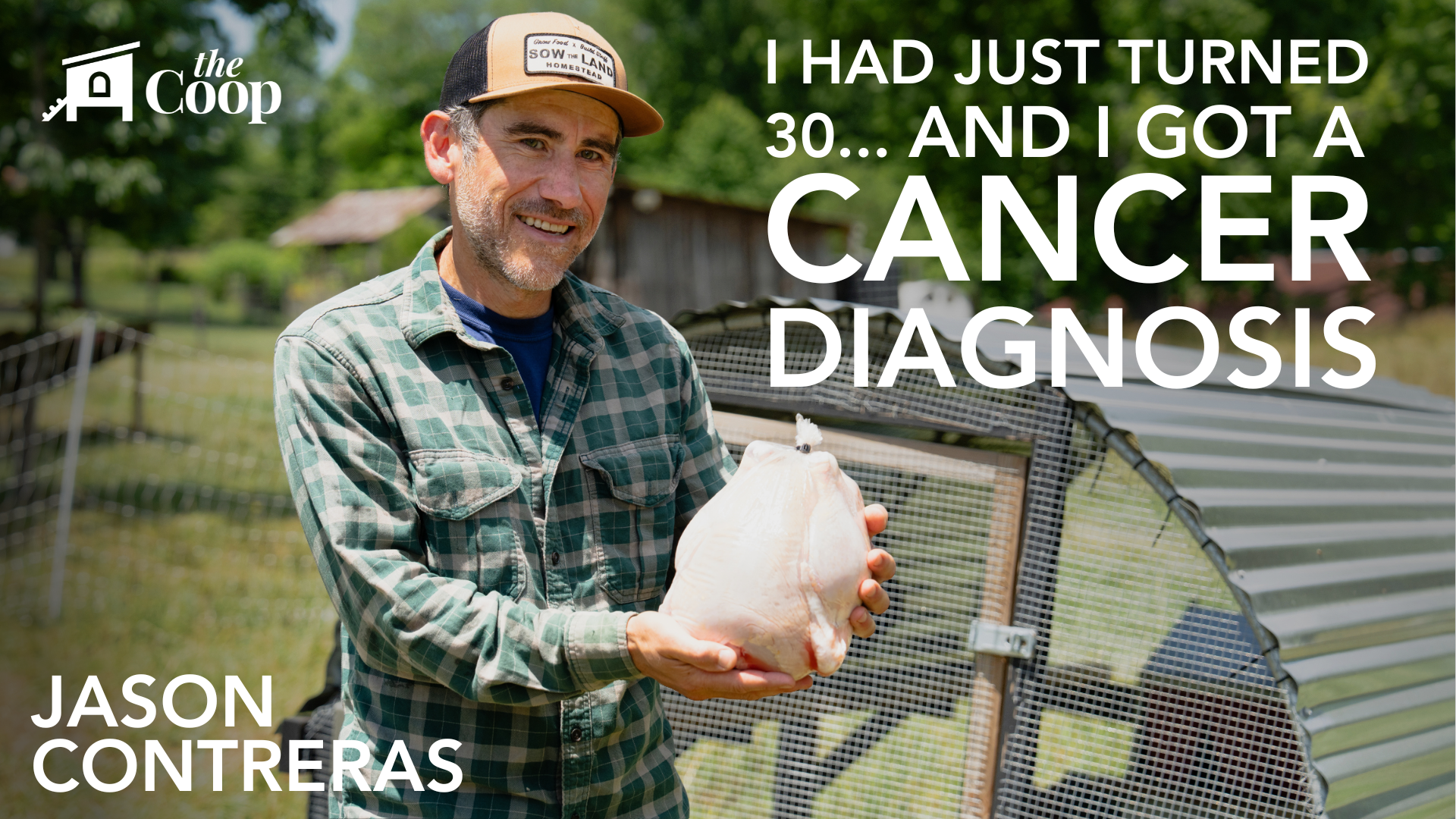



Episode #30 of The Coop is for anyone standing at the edge of a bigger life … and wondering if they have to leap overnight.
Homestead Living Editor-in-Chief Anna Sakawsky sat down with Jason Contreras (Homestead Living contributor and the voice behind Sow the Land) to talk about the long road from a standard modern life outside Los Angeles to a working homestead in North Carolina.
Jason shares how a Hodgkin’s lymphoma diagnosis at 30 started the questioning … and how the last thing his oncologist said after chemo (“go back to your normal life”) is what made him and his wife refuse to. They didn’t sell everything the next week. They grew one tomato. Then they canned. Then they hosted a food swap. Then they sold the kitchen table. Six years later, they moved.
In this episode, Anna and Jason discuss:
- What life looked like before the diagnosis: 17 years at a drafting desk, fashion-industry hours, two cars, four bedrooms they didn’t use
- How “go back to your normal life” became the turning point
- Starting with one backyard tomato, and why you can’t go back to the store-bought kind
- Homesteading in the city: raised beds, pickles, tomato sauce, living with one car, and a no-money food swap at the park
- Why the move took six years (2016), not six months
- Learning to process chickens at Primal Pastures before they owned land
- Trading a day of weeding for a CSA box to learn a new climate
- Treating 1.5 acres like a college course to find out if they even liked the work
- YouTube’s first year: about $80, and why the skills came first
- What he’s most proud of: a family that harvests and cooks together, and a daughter who doesn’t remember the old life
- Why you have to dare yourself to fail, because the next vision is better than the first
Whether you’re still in a backyard, still in a job you’re questioning, or already on the land and wondering if you started too fast, this conversation is proof that the leap can be slow, deliberate, and still count.
Listen or watch the full episode right here:
The show notes …
0:00 – Introduction
3:22 – Life Before Cancer
16:16 – The Process of Change
18:41 – Leaving LA
22:45 – How to Find the Right Land
29:27 – Making the Financial Leap
41:03 – From Home Videos to YouTube Success
44:22 – Learning Homesteading Skills
50:17 – Is Your Health Still Your #1 Priority?
54:37 – Advice for Anyone Waiting to Make the Leap
Jason Contreras:
We sold the kitchen table and I was like, “Well, if we’re selling the kitchen table, I think we’re pretty serious about this.” And sometimes you have to dare yourself to fail. You have to dare yourself to go make that leap because yeah, you might fail, but it’s not failing because you’re just going to learn a ton.
Anna Sakawsky:
If you’re a mom like me, then you probably know what it’s like to spend way too much time worrying about what’s in the everyday cleaners and body products we bring into our homes and use on and around our families. In fact, a few years ago, I completely overhauled our cleaning products and started making my own vinegar cleaner, baking soda, toilet scrub, and homemade laundry detergent. And while those have honestly worked pretty good, I don’t always have time to make my own cleaners. And if I’m being honest, I don’t always want every surface of my home to smell like vinegar. And that is why I love Rustic Strength. Rustic Strength offers a full line of non-toxic laundry, home and body care products, all made in small batches by a family-owned company in Missouri. Their formulas are safe and effective for real, for real, and free from the junk you don’t want in your home, on your body or near your kids.
Clothes come out clean without overpowering scents. Surfaces shine without the lingering scent of vinegar or toxic chemicals, and you can sleep soundly knowing that you don’t have to worry about what’s in your cleaners and skincare products. So if you’ve been thinking about making the switch to cleaner, non-toxic home and body products, then consider this your sign. Head over to rusticstrength.com today and see why so many moms have already made the switch. Again, that’s rusticstrength.com. Tell them the coop sent you. Hello everyone, and welcome to episode number 30 of The Coop. I’m your host, Anna Sokosky, editor in chief of Homestead Living Magazine, the magazine that helps you grow what matters, from growing your own food to growing healthy minds, bodies, and souls. Our mission is to empower people to take control of their wellbeing and to live healthy and sustainable lives. And today’s guest perfectly embodies this mission as he went from living a standard modern lifestyle, eating a standard modern diet, and working a standard modern job to leaving it all behind, driving all the way across the country and starting a new life with his family as homesteaders.
His journey, not unlike many others, started with a health scare that prompted him to start questioning all of the foods that he was eating. And then from there, it was a slippery slope into growing and raising his own food, growing a skillset that allowed him to be more of a producer than a consumer, which is something we talk a lot about on this show, and questioning and rethinking just about every other aspect of modern life before eventually selling most of his worldly possessions and buying land in another state. So my guest today is Jason Contreras, homestead living contributor and creator of the popular YouTube channel, Sow the Land. Jason’s story is not only inspiring, but it’s proof that where there’s a will, there’s a way, and it’s a testament to building the arc before you need it or learning the skills and positioning yourself for success before you make the leap and commit to a whole new life.
So I think you are really going to love this conversation. Let’s get into it. All right. Well, Jason, welcome to the show. I am so glad to have you here today and just to chat a little bit about your journey into homesteading and just kind of some of the logistics of how that worked for you because you made a pretty drastic change going from living a pretty standard conventional lifestyle, working a corporate job in the LA area to leaving everything behind, giving up everything in your former life and moving across the country to North Carolina, getting some land and starting out on this homestead journey. So I know that for you, this actually started with a bit of a health scare and a cancer diagnosis and that kind of snowballed into this decision to make this drastic change. But I would love if you can start by taking us back there, tell us a little bit about what life looked like for you when you were living in LA prior to the diagnosis, and then what was ultimately the catalyst that made you look at your life and say, “We need to change absolutely everything about the way we’re living.”
Jason Contreras:
Yeah. So me and my wife, we met in high school and grew up in just outside of LA. And I guess we lived the standard LA lifestyle, kind of like the standard American diet. And I worked in an office. I think when I left, I was there for 17 years. I think both of us, everyone says, parents say, “Just go to college, get married, buy a house, buy two cars and you rack up all this debt.” And so that’s exactly what we did. My wife, she was in the fashion industry and that was her career. And then me, I was a computer drafter, drew up blueprints for a company and just did that.
I don’t know, we didn’t grow up around farming or growing anything, any kind of food. I don’t think I even knew anybody who had a tomato growing in their backyard. It just wasn’t a thing. Definitely no chickens or any animals or anything like that. And then I had just turned 30 and I get diagnosed with cancer. It was just very unexpected. I had some health issues probably the year prior and they were just saying, “Oh, it’s probably allergies.” Because I had an enlarged lymph node on my neck and they were like, “Oh, you’re probably just getting over a cold.” They were just pushing it off like that. And then finally it was just getting bigger and bigger and they did a biopsy on it and that’s what it was. It was a Hodgkin’s lymphoma and it was just kind of shocking because I don’t know, at the time I didn’t think we’re super unhealthy people.
I mean, I was hiking and running at the time and we were already married and stuff. This was before we had our daughter.
But I guess that’s the reason why we live the style now is because of that diagnosis. And from there, we just started questioning different things. And I did six months of chemo and that was it. Didn’t have to do any radiation or anything and I’ve been in remission ever since. But it was just during that time as we started questioning things like, “Oh, should we be eating healthier? Should we stop drinking soda? Should we stop eating wheat?” All these things started snowballing of trying to question things and figure it out. So this is kind of I think pre-YouTube, pre, I think maybe Facebook and Instagram were around, but it wasn’t like we went down the rabbit hole of YouTube videos. There was really none of that. So we were just trying to figure out for ourselves of what we should be eating. And a lot of it was kind of common sense, cut out fast food and stuff like that.
And I think it was my last oncology appointment, which after I did the chemo, I did my last scan and they were like, “Oh, you’re cancer free now. No more chemo. You should be good.” And then I asked, after going through six months of that, it’s just kind of like a roller coaster of emotions of just uncertainty and just trying to figure it out and trust the process that I’m supposed to be going through chemo and doing all this stuff. And I always thought, “What’s the reason for it? Why is this happening to me? Why is this happening to us?” And so my last oncology appointment, I was like, “Okay, so what now?” In my mind, I was like, “Should I be taking vitamins or should I be on some kind of strict, I don’t know, special diet or something like that?” And then she was just like, “No, there’s nothing.
You’re done. We’re done with you. Just go back to your normal life,” is what she said. It’ll be like it never happened.
I guess looking back at it now, it’s almost like I wanted her to tell me how I should live my life. I wanted her to tell me how I should eat. Tell me I need to go hiking more. Tell me that I need to eat more vegetables or whatever it is. But now I’m thankful that she said what she said because that really lit a fire under us on we need to figure this out ourselves. We need to figure out what’s healthy for us and we can do that. We’re grownups. We could figure this out.
And so from there we started reading more labels, go to the grocery store, reading labels, see what’s it made out of, what certain foods are made out of and stuff like that. And slowly we realized is that we’re not going to really know what’s in our food unless we do it ourselves, unless we raise food ourselves. And so not had any experience with that. We had just bought a house and had a little backyard and I built some raised garden beds and bought some plant starts at the hardware store and threw them in the ground. And you grow that first tomato, it’s like all of a sudden you feel like a farmer.
And then after eating that first tomato, you’re like, wow, okay. You can never go back. You can never go back eating a store bought tomato again. And then from there, we fell in love with that idea of growing our own food in even a little way, maybe one tomato plant, that’s where we started. And from there it was cucumbers, kale, and we just went down the list of things that. Then you started growing stuff that you don’t even buy at the grocery store, but the fact that you grew it, like say beets, I don’t think we ever bought beets at the grocery store, but then we started growing it, then we started eating it. They were like, “Oh wow, these beets are great.” So after doing that for a little bit, we started questioning other things like just our lifestyle. We had a four bedroom house and we started living, started thinking more minimalistic, more minimal mindset of we’re not going to need certain things.
Why do we have. There’s four bedrooms and there’s a couch in each of these bedrooms. We don’t even go in these bedrooms. We don’t need all these couches. We don’t need this lamp. We also kind of started talking about like, “Oh, it would be fun to find a little bit if we had a little bit more land and maybe we could have some chickens, maybe we could grow our own meat.” I mean, I don’t know. It was kind of like a joke between us because we grew up in that area. All our family is within maybe 30 minutes from each other.
Everybody’s there. Grandma, mom’s on the next street over. It’s just kind of like that’s what we’re used to. So the whole idea of maybe finding land somewhere was bizarre. That was not going to happen. We were just kind of joking. But then the more that we did it, the more we lived more minimally, we kept joking about it. We kept getting rid of stuff. We kept learning how to grow food in our backyard. We started figuring out how to canned tomato sauce, make pickles. At the time, I don’t think we were realizing what we were doing, but we were homesteading where we were at in the city. We even started our local food swap because we were trying to find. We had our friends. We had friends that we grew up with and that we knew, but nobody there grew anything. So almost like we wanted to find people that did that.
And so we felt a good way of doing that was creating this food swap, which was. It was kind of old school now, but we just posted flyers at the local library and even around town that we thought that people would hang out at, like maybe community gardens or something. And we would say, “We’re hosting a food swap at the park.” Or even we did it in our backyard also where people would just bring. If they had an abundance of something, say if they had an apple tree or blueberries or something or eggs and they would just bring there and then we’d exchange stuff and there’d be no money involved and we’d just like, “Hey, I have a dozen eggs. I’ll trade you for two bottles of salsa that you made.” It was really fun. It was really great. We kind of fell in love with that idea too.
We’ve met a lot of good people that way in the area that had no idea that lived in the area.
Anna Sakawsky:
I was going to say that I would imagine that at least living in that area and in California, there’s a lot of food that is produced down there.Because you do hear stories similar to yours, but maybe people that live in areas that are a little bit more like food deserts, right? So it’s really hard to actually source that food locally. They really have no choice but to maybe grow their own because there’s nothing else around. So were you at least in a position where you were able to find good, healthy, local-ish food?
Jason Contreras:
Oh yeah.
Anna Sakawsky:
Yeah.
Jason Contreras:
And that food swap helped us a lot, just meeting other like-minded people who were doing it. We just didn’t know. A lot of them people were kind of our neighbors, which we never had met before. We didn’t know they had a garden in their backyard because I think there’s a lot of people in the area. So it’s harder, I think, to connect with people because everybody’s coming and going and doing their own thing. So yeah, it was definitely a good experience doing that. I mean, we just fell in love with that whole idea of growing food and bartering with people and then that with a combination of questioning our lifestyle, living more minimally. We went down to one car, we got rid of our TV and still joking around of finding land somewhere. At the same time, questioning our own careers. We eventually had our daughter and my wife, she quit her career to be a stay at home mom because she got tired of driving three hours into traffic every day.
I was questioning my own career too and didn’t understand. I started to not enjoy working in an office, in a cubicle, doing the same thing for 17 years, working on a computer. So that was eating away at me slowly. I think this whole process of from when I got cancer to when we actually moved away from California took six years. So it wasn’t like an overnight thing. It was just a gradual.
Anna Sakawsky:
It wasn’t like, “Oh no, I got this diagnosis and we need to change everything overnight.” So it was a bit. Because I am interested, obviously it started with examining your food and what’s in your food. I think that’s where it starts for a lot of people. Oftentimes you hear that as being a catalyst in one way or another. It was people doing it for their health. How did you first make that connection? Was that a conversation you ever had with your doctors or oncologists about changing your diet or was that from your own research? How did you decide, “Okay, I’ve got this diagnosis. I need to first look at what we’re consuming and make a change there?”
Jason Contreras:
Yeah, I think that’s what it was. I mean, I don’t remember the doctor saying anything about nutrition or anything like that. I think it was just us just thinking. Again, I think a lot of it’s kind of common sense of cutting out just the basic stuff, like sodas and fast food. I think that’s where it started. And then we went down the rabbit hole of maybe we should. There was a moment there when we’re like, “Maybe we should go all vegan. Maybe I should just be drinking green smoothies.” I don’t know.
Anna Sakawsky:
But there was never a conversation about, “Oh, you got this diagnosis because of diet and lifestyle.” Was there anything like that? Or was it just this happens to some people and here we are and you’ll deal with it and then you kind of decided to look at like, “Well, what could I do to be healthier?”
Jason Contreras:
Yeah. It wasn’t like you got this diagnosis because you are eating bad. It wasn’t that at all. It was just they didn’t know why. It just happens. That was their answer. It happens to some people. Some people don’t get it. But they did say if this. I don’t know if it made me feel better, but they said, “If you’re going to get a cancer, this is the good one to get
Anna Sakawsky:
Because
Jason Contreras:
It’s not as aggressive or I guess it’s more common and it’s easier to treat.” So I don’t know if that made me feel better, but
Anna Sakawsky:
It’s still
Jason Contreras:
Scary.
Anna Sakawsky:
Was your family always supportive of these changes as you were going? Was this you kind of being the leader here? Was it really you and your wife together? Was there ever any pushback? And then when you actually decided to make that move, what was the hardest part of making such a big change and moving across the country?
Jason Contreras:
Yeah. Our family was definitely always. They still are supportive. Everybody’s super supportive. Even making the move was, of course, they were very scared for us and maybe they didn’t understand totally, but they were still very supportive and still our number one fans of our family. When we started joking around finding more land, both me and my wife, we were both on board. It wasn’t like my idea or her idea or there was no convincing each other. It was just, we were both talking about it and we were both joking about it. We were both dreaming about it. And then yeah, we were both wanting it. We still do. We still both love this lifestyle and still want to do it.
So in that sense, it was like, yeah, I think that has been important being both in it, 100% all in. I think I just said one day after work, I was like, “Man, I don’t want to do this anymore. I kind of wanted to work with my hands in some way.” And my wife was like, “All right, well, let’s just sell it all. Let’s just sell it all and go somewhere.” I think at first we wanted to stay in the area because that’s all we knew, but we learned very quickly that it’s so expensive and there’s no land and there’s no land there where we were at. We’d have to go further away. So within the six years, we were kind of selling stuff out of our house and getting rid of things and learning how to grow food and all that. Eventually, a lot of the stuff was gone in our house.
I think pretty much all we had was maybe like a couch, a lamp in our kitchen table. And this whole time we were still kind of joking around like, “Well, when we become farmers one day, we’re not going to need all this stuff.” We’re talking about finding some land and maybe living in a tiny home, that kind of thing. We didn’t know what we wanted to do or how it was going to work.
So we sold the kitchen table and I was like, “Well, if we’re selling the kitchen table, I think we’re pretty serious about this.” So we did, and that’s when it became serious. Shortly thereafter, we sold our house. It was during the whole six years we were trying to get out of debts. We had student loans, like a lot of student loans, and trying to get out of that, pairing down and trying to live more minimally and selling our house, the plan was we’re going to sell this house, we’re going to move back in with mom, which lives on the next street over, and we’re going to live with her for a year until we can maybe find some land somewhere. Within that year, we stayed with mom and we went on vacation. We went up north, California, we went to Santa Fe, we went to Arizona and we really didn’t know where we’re going.
We knew we didn’t want to go so far out.
Anna Sakawsky:
Were you traveling this whole time with an eye for maybe we could settle down here? Was that kind of the point of the traveling to kind of check out different areas and see? Okay.
Jason Contreras:
Yeah. We weren’t even really looking at land or houses or anything. We were just kind of seeing different areas. And then we knew through social media, we knew a couple that moved out to Western North Carolina, Asheville area. They would tell us about the area and saying there’s a lot of people who are homestead out here and you might want to come and check it out. I was like, “Man, that seems so far away. I didn’t want to live that far away from family.” But then we weren’t really seeing anything else within that year. And then finally we took a trip over there just for a week, vacationed, and man, we really fell in love with the area. It was just so much different than California as far as there was plenty of water and greenery and a lot of local little farms and a lot of like-minded people.
I was like, “Man, I think this is where we got to be.” We went back home and we didn’t even look at land. We just looked at the area because honestly, both me and my wife, the furthest East we’ve ever been our whole lives was New Mexico.
Anna Sakawsky:
Pretty far west.
Jason Contreras:
Yeah. I didn’t know anywhere on the East Coast what the weather was like or how was the humidity, anything like that. So we really had no clue. We went back home. I was still working in an office job and didn’t know how that was going to work. I think six months later, we were still not sure what to do. We were still living with mom and I was like, “I don’t know. What are we doing? Are we going to find something or not?” I was like, “If North Carolina is the place we got to be, then I just got to go down there and look at places because we could look all day long on Craigslist or these realtor websites, but we don’t know the area, so it’s hard to find anything.” So I flew down. My wife, she trusted me to fly down. I flew down for a weekend by myself and I went with a realtor and we saw probably, I don’t know, 15 places on a weekend, one after another.
It was straight land, a house with land and all these things. I just went one by one and we had a little criteria list of what we were kind of looking for.
The last house I saw was a single wide mobile home. This place was vacant, I think, for over a year. It was one and a half acres, had a stream running through it, and it was probably 20 minutes to downtown. So it checked off all the boxes and I was like, “I think this is it.” We didn’t want to live in a mobile home and I didn’t think it was going to be so run down, but it was it. I mean, it was a good price and we ended up getting that. Then six months after that is when I quit my job and we moved everything and we moved in.
Anna Sakawsky:
Right. Okay. I’m really interested in this part of the story and the kind of logistics because I think this is where a lot of people get tripped up. It’s like that sounds great. That sounds like the dream. I love that you said that you traveled and just wanted to see the different areas because I think that’s what a lot of people miss. They’re looking for the land, but they’re not, especially if they’re moving out of state or they’re going somewhere they’re unfamiliar with, they’re not maybe familiar with the area or it’s that piece of land’s location in proximity to everything else or what the community’s like there, all those things. I think that that’s a really good approach is to first of all, find the area that you think is going to be the right place to sell down, get your bearings there and then find the land because I think a lot of people I hear when it doesn’t work out or they have to move a bunch of times it’s because they found a property that they really liked, but then they get there and realize actually the community doesn’t work for us or the area is not right.
So this kind of that method of finding the right area first and going places that you might not have thought, like who would have though? North Carolina, as you said, having never gone anywhere farther east than New Mexico, but actually traveling to those places and seeing my husband and I moved from. We grew up in Vancouver, so city, same thing our whole lives and wanted to get out and we didn’t go that far. We came to Vancouver Island, but still there was lots of options, but I’m like, “We got to actually go to these places and see because it’s one thing to look at like,” Oh, there’s some nice properties like you say on Craigslist, or this looks cool on a map or whatever, but until you’re actually there and spending time in that place, it’s hard to know. So that’s actually we decided to honeymoon out here and get our bearings and decide that this was the right place to go.
No.
Jason Contreras:
Early on, we thought of just buying an RV and traveling for a year. But then I thought, see, I wouldn’t have a job, so all our savings I felt like would just dwindle away. And then what? And then we would have nothing to buy land. So I felt like that wasn’t an option. And we were so on fire for this lifestyle that we were ready to just. Let’s just do it and figure it out.
Anna Sakawsky:
This episode is brought to you by Azure Standard. Family owned since the 1970s, Azure Standard is on a mission to make real food more accessible by delivering it straight to your doorstep or to a convenient local drop point near you. Everything they offer is completely organic, non – GMO, and free from junk additives you don’t want in your home or in your body. With more than 13,000 carefully vetted products, Azure Standard makes it easy to stock up on what really matters, from bulk grains, nuts, and healthy oils to fruits and vegetables, frozen meats, pantry staples, and even clean household goods. And the best part is you skip the grocery store markup. You can order exactly what your family actually needs, save big on high quality food, and pick it up alongside neighbors who care about the same things you do, health, sustainability, and supporting ethical producers.
You head to azurestandard.com right now to get started. Again, that’s azurestandard.com. Well, and that’s the next part of my question is, so now you’re here, you’re going to make the move. What did that look like financially for you? Because again, I think that’s what is the barrier for so many people is like, this all sounds great, but then that big barrier is like, “But that means I’m quitting my job here and I don’t really know what life looks like ahead of me once I get there.” And there’s a lot of security that you’re maybe leaving behind. So how did you actually make that financial transition and leave your jobs and everything else?
Jason Contreras:
Yeah. That was a huge mind shift. But at first I looked for different office jobs before we made the move out here. It was so hard because I didn’t live out here, so nothing came up. And so with the sale of our house, we were able to make some kind of money off of that. And that’s how we were able to make the move with the sale of the house. And we continued to save while living with my mom and try to get out of debt. And we never fully did get out of debt when we made the move. It was our student loans that were a lot. So I thought of it as we had saved enough money to live off for say six months after we made the move. So I mean, that’s living like bare bones, something to pay for a cell phone, electricity, just the basic needs.
And if I didn’t find a job for six months, at least the bills would be paid and we would have food. And then even when we bought this one and a half acres, I still had to take a mortgage on it. It’s funny, kind of at the same time, there’s a lot going on at this time how it happened, but it’s like we had enough money from the sale of the house to make this move, to put a down payment on this one and a half acres, live for six months without having to, or if I’d never found a job at first, or we could pay off our student loans and be 100% debt free. That was a huge decision because if you read all the gurus and all the books and stuff, they tell you, get out of debt. You need to be 100% debt free, especially if I’m going to make this move with no job.
But that did not sound fun to me. I was like, we want to make this move. We were so on fire and ready to do this that being into debt wasn’t going to stop us.
And so we still had student loans. I had to take out a mortgage on the one and a half acres and we quit the job and we made the move. And I though, I was like, I don’t know how it’s going to work. I don’t know. I was like, I’m sure I’m going to find some kind of job in six months. But also, it wasn’t just about growing food for ourselves and finding land and raising chickens. I mean, it was also about we wanted to work for ourselves in some way. I didn’t want to go back to an office job. The last thing I wanted to do was move out here, say we’re growing our own food, but then I’m going back to an office job.That’s something I did not want to do. Now I would have, and I actually tried to when we first moved out here, if it came down to it, but I never found anything.
And I’ve been working for myself ever since. And that was just saying yes to a bunch of stuff,
Anna Sakawsky:
Just
Jason Contreras:
Saying yes to everything that came my way and just figuring it out.
Anna Sakawsky:
So what sort of, just little odd jobs and stuff at first or what kind of things were you doing?
Jason Contreras:
Yeah, just odd jobs. I mean, we didn’t know anybody either. So we would hang out at farmer’s markets, even if we didn’t buy anything, we would just go every farmer’s market that we would go to and just hang out and walk around and maybe just try to talk to the local farmers just to show our face to say, “Hey, we live here now.” Or just go into town and go to the little stores and just walk around. And in that way, we would meet other people. And I think specifically Asheville, North Carolina is a special place, I think, because a lot of people that live there are not from there. They’re like us. So in that way, it was kind of easy to connect with people because we all kind of got each other. We understood where we’re all coming from. And in that sense, it was kind of easy to make friends.
And so it was just really just, if I meet somebody, be like, “Hey, if you need anything done, I’m looking for work.” Just anything.
Anna Sakawsky:
I was going to say, on your YouTube channel, you’re obviously very skilled at building different things, construction type stuff. What kind of work were you interested in? How were you putting yourself out there? Because you were coming from doing a corporate job, desk work, that sort of thing. So what skillset did you then bring with you? And how did that translate into actually finding work? Because again, I think this is a question that a lot of people have is if I leave behind this cushy desk job and take on maybe some objects, what am I actually skilled to do? How did you market yourself almost to be able to find work in the interim?
Jason Contreras:
Yeah, that’s hard because I wanted to work with my hands, but at the same time, I’ve never really built anything. Well, before I left California, there was an adult education center that had woodworking classes.
So for a whole year, I would take these standard woodworking classes, just basic stuff of how to run a table saw and not chop your hand off, just basic things like that. And I took a year of that and I learned a lot through there, just the kind of simple stuff of how to run certain things. And so that definitely builds your confidence on running tools like that. And so from there, when I came here, I was like, oh, I started just making little kitchen items like hand carved spoons and things like that. And I think people maybe saw like, “Oh, I do woodworking type stuff.” And they just started asking me, “Oh, can you build me a shelf?” Even though I’ve never built a shelf, but I really need the money. Oh yeah, I could do that. Trusting myself to figure it out.
Anna Sakawsky:
And
Jason Contreras:
Then being that I did do drafting, computer drafting blueprints and stuff, I would try to connect with people that needed blueprints done
That were in the area. And I’ve met people that way. Early on, I would do some of that, even through Craigslist, people were putting ads in Craigslist of like, “I’m looking for somebody to draw up plans.” I’d respond to that because I knew how to do that. Stuff like that. And just also meeting people in the area that I don’t think I really met anybody that had one good job here. They were all kind of like me. They were all just saying yes to a bunch of different things. And maybe during the day they were doing woodworking and at night they were bartending or I don’t know, they’d sell at the farmer’s market and tree trim the next day. It’s just kind of random stuff. And I felt really inspired by that because I’m seeing these people doing it and they don’t have one good job.
Anna Sakawsky:
And
Jason Contreras:
So that was super helpful to see that and meet those people and talk to them. And I was very encouraged by that and still am. And so I think it was just telling people I’m willing to work whatever you got. I might not know how to do certain things, but I’m willing to figure it out even just to help them. Even if you need help doing something, we could both figure it out.
Anna Sakawsky:
Obviously you have your YouTube channel and everything. What are you doing for income nowadays? Is that your entire income is through your online channel and stuff or how do you generate income now?
Jason Contreras:
No. I mean, YouTube is a big part of it now and that’s developed. We’ve been doing it for 10 years now, but it’s also doing, we have online classes now, selling merchandise. We have a whole website now of just selling things just to help people, like stuff that we use or things that we trust other people that we’ve used over the past years. As far as chicken butchering equipment, we have that on our website. Also, we started selling past few years, we started selling meat like chicken, pork, lamb. And that’s just over the years, it’s just seeing what people kind of want. I think what people want to see us do, of just trying to listen to what people are looking for. And that’s just developing our website into what it is. And it’s a never ending process of figuring that out. I still say yes to a lot of different things.
I still do woodworking stuff. And we also do in-person classes of chicken butchering and I’ve done build workshops. We’ve done pig processing here. And it’s just a lot of different things. I never wanted to strictly do YouTube videos. That’s never been my goal. It’s part of it and it’s a big part of it, but it’s not something I just want to do that and that’s it.
Anna Sakawsky:
What was the original kind of catalyst for deciding to pick up the camera and start doing YouTube? Were you looking to actually generate income from it or were you just wanting to share what you were doing and how did that evolve?
Jason Contreras:
Originally it started from, because when we moved out here, I don’t think our family really understood it all. So I would send them with my phone, I would just send them little clips of send mom or grandma like, “Hey, this is our daughter in the garden. We started this. Oh, we just got chickens.” I just send them little clips through a text or email. And after a while of that, I was like, “Man, I don’t want to send everybody these email every time.” So then I though, “Well, what about I just start our own YouTube channel and then I’ll just send family the link and then they can watch it on their own time whenever.” And so it kind of evolved from there. It was really for our family. And then after about a year, I think the first year, the entire year, I made 80 bucks.
Anna Sakawsky:
Yeah.
Jason Contreras:
And it was so exciting. I was amazed that I made 80 bucks because I felt like I wasn’t even trying.
Anna Sakawsky:
Yeah. It’s so funny because, I mean, first of all, I think it’s really important to be honest about that because I think so many people now see people doing the YouTube thing and generating income, full-time income and that sort of thing. But the reality is it doesn’t happen overnight, right? No. And that is usually how it is, like 80 bucks the first year, maybe a few hundred the second year and it takes some time, which is why it’s important to not just like, “Okay, we’re going to move and just start YouTube channel.” There’s got to be something to fill that gap. It’s not that easy. But also, I know it is really exciting that first. I remember because I have a blog as well on the first $11 day, I made $11 with ads because somebody had shared my link and I was like, “That’s it, honey.
You’re going to retire soon. I’m doing it,
Jason Contreras:
Right?” No, I know, but it’s like you made the 80 bucks now. I was like, “Okay, that paid for our internet for this month or whatever.” So then it kind of went from there like, “I wonder if I can make enough to pay for our cell phone bill. That would be great.” And then it kind of just went from there and you take those baby steps of continuing on. But that first year, I felt like I was almost treating it like Instagram stories. I would just throw a little clip, two minute clip on YouTube and I’m like, “That’s for mom, that’s that.” And then after that first year, I though, “Well, I wonder what it would look like if I actually made an effort to tell a story or to film better.” I never filmed anything prior to that. I was just kind of figuring out as I went and wondered what that would look like.
And then slowly just people started subscribing and following us and watching.
Anna Sakawsky:
What was the timeline here of you making the move, just so we can place those? We
Jason Contreras:
Made the move in 2016.
Anna Sakawsky:
We were here in 2016. There was some stuff online, but certainly not as much available as there is today. How were you learning a lot of these skills, especially some of the more maybe complicated things like raising and butchering livestock and that sort of thing. How did you actually acquire those type of skills to then be able to start sharing and teaching other
Jason Contreras:
People? When we were still in California, within that six year timeframe of I took those wood shop classes, but I also, there was Primo Pastures. We lived by Primal Pastures about an hour from them. At that time, they were just kind of starting out. Now they’re pretty big now, I think, but they were a pasture raised chicken farm and they were doing workshops on how to butcher chickens. And so prior to making the move, I took two workshops with them and they showed me how to process a chicken. That was the first time holding a chicken was when I put it in a cone. Talk about, that was a little bit traumatizing.
Anna Sakawsky:
That was a little jump in with two feet.
Jason Contreras:
Yeah. But we were on fire. We were serious about it. So it was like, well, this is something that I think we might do is raise our own chickens for meat. And if we are, then we got to do this. This is part of it. So those guys were super helpful on teaching us how to do that. And then after we made the move, we just started doing it for ourselves. Now, as far as growing vegetables, we didn’t know how the weather is over here. We didn’t know what people are growing typically. So I mentioned we would go visit farmer’s markets.
We met a small scale market garden couple that they have, I think at that time they were living in the area for, I don’t know, five years maybe. And they were pretty successful, I think, of growing food. And so I just asked them, I was like, “Hey, do you guys need help? You don’t have to pay me. I just want to come and pull weeds just to learn what you guys know.” And they were like, “Yeah, come down.” So I basically worked for a CSA box of vegetables a week. So it was one day a week I would go there, whatever they wanted me to do, pull weeds, wash vegetables, harvest, and I get to hang out with them and kind of pick their brains and they showed me a lot on what they grew. They showed me their high tunnel that they built themselves, seeing that I kind of mimicked that, our first high tunnel that we made in our one and a half acres.
So I learned a lot that way of how to grow vegetables. And also I had the time because I wasn’t working. So that was helpful of trying to figure that out. And we’re still friends. They helped us a lot in that part of it. And then from there, you just kind of get the confidence the more you do it of figuring it out and fine tuning things. And then word gets around that you butcher your own chickens and then next thing you know, people are asking you like, “Hey, do you need help or can you show me how to do it?” And then that kind of grew into doing workshops on teaching people how to do it.
Anna Sakawsky:
Right. And then kind of becomes another income stream, right? So feeding back into this idea of being almost like building the arc before you need it, right? Taking those classes, learning. Because again, I think similarly to the going and finding the right area and then finding the property, a lot of people do that backwards. They find a property, but maybe didn’t research the area or get to know it so much. Same thing, I think it was one of the big pitfalls I see anyway with people that are wanting to start home saying they’re like, “Once I get the land, then we’re going to start doing all these things.” I’m like, “But that’s a huge learning curve then, and now you’re committed. So start learning those skills ahead of time, even if it’s like, well, I’m only on, I don’t know, a small suburban lot and I can’t raise chickens, but one day I might want to raise some meat birds.
Go take the course now. Go start learning those skills now so that then you’re ready to do those things again, once the opportunity presents itself.
Jason Contreras:
Yeah. The one and a half acres, we’re treating it as like a college course for us because honestly, we didn’t really know that if we would even like doing all of this.
Anna Sakawsky:
Well, and that’s the other thing is people think they’re going to be into it. And then I’ve seen a lot of homesteading accounts, for example, online right now. There’s a big movement away from it because there was a lot of people that I feel like maybe came into this over the past few years, especially with the COVID rush into this lifestyle and that sort of thing. And they’re like,” Actually, this isn’t necessarily what we want, but we committed, we did this, and now we’re kind of selling everything and moving back and there’s this big movement away from it. “And I don’t think that that’s necessarily about the lifestyle itself. I think it’s just that you need to know if it’s the right fit for you, but also not every part of it, it has to be the right fit for everybody. Like maybe you like doing the garden, but you don’t want to raise your own meat or whatever, right?
But you won’t know until you try a little bit.
Jason Contreras:
Yeah. You can’t fall into that because you see somebody else doing all the things that you’re going to have to do all those things. You got to gravitate to what you like doing because otherwise you’re not going to like doing it after a while.
Anna Sakawsky:
So when you first started down this path, your health was kind of the main catalyst for you, was obviously a huge motivating factor. Has that evolved over time? Is that still kind of your number one reason for doing all of this or has homesetting and living this lifestyle come to kind of represent something bigger for you?
Jason Contreras:
I think that’s still part of our why. Sometimes when it’s August and you’re sweating and you don’t want to go out there or if an animal escapes, you kind of have to go back to your original why. Sometimes these YouTube videos can get pretty demanding, or at least in my head they’re demanding. And I need to remember the why. And the why is we’re here to grow food. We’re here to grow good food for our family. And now we’re growing extra to sell. So I mean, that’s still a huge part of it, but now it’s just, I think it has evolved into teaching people how to do this. At first, when we really started to post videos online, a part of me was like, why is anybody going to watch our channel? And if you look on there, that’s when all these other homesteading channels started popping up.
And I’m like, man, these people are so good at teaching on how to do this. And I don’t know how to do any of this stuff. And I have a channel. I was like, why would anybody watch it for somebody who has no idea what he’s doing?
But now it kind of evolved with after doing this for 10 years, it’s like, okay, we learned a lot. We learned a lot of things. And I think now it has evolved to teaching people. We shared the journey of trying to figure it out. And now after figuring it out, we’re sharing what we’re learning and what we learned and continue to learn, continue to learn about different things that we. And in essence, I think that’s what our channel has become of sharing the journey of how we’re learning it and then what we learned. And hopefully people can feel inspired by that.
Anna Sakawsky:
Yeah. Yeah. That’s awesome. I mean, you’ve obviously made a lot of changes over the years. You’ve built a life really from the ground up. When you look back on everything, what would you say you’re most proud of?
Jason Contreras:
I think seeing the whole family involved. I mean, I think just seeing that, to be able to cook a meal with everything that we grew and seeing our daughter growing up in this way, that’s something that we really wanted because we started when she was four, now she’s 15. So now this is all she knows. She doesn’t even remember how we used to live. But I think I’m most proud of our family when we are working together. And it’s not always unicorns and rainbows here, but when we come together and we’re harvesting the food and cooking it together in the kitchen, and my wife cooks such good meals and our daughter too, she bakes a ton. And so I am definitely spoiled here. So when I see that, I think that’s something I’m more proud of is just my family and how we’ve come together and evolved over the years on trying to figure this lifestyle out.
Anna Sakawsky:
That’s awesome. So for anybody who’s maybe listening right now who knows they need to make a change, maybe they’ve had their own health scare, maybe stress of modern life is taking a toll, or maybe they just want to build some more security, more self-reliance for their family, whatever their motivating factor is, they want to make this change. They hear a story like yours, they’re inspired, but there’s still that hesitation, that kind of trepidation of like, “I don’t know if I can do this.” Or it’s that nervousness to leave your comfort zone, even if that comfort is keeping you in a place – The fear
Jason Contreras:
Of the
Anna Sakawsky:
Unknown. The fear of the unknown, the fear of leaving the life you know, even if it’s not necessarily the life you want. What advice would you have for them? What would you say would be the first step you would recommend?
Jason Contreras:
I mean, I think you have to fall in love with the process. You have to really not be afraid of failing. You have to not be afraid. If you fail, don’t be afraid of what others will think about you because it’s not failing. You have to change your mindset in that way. And sometimes you have to dare yourself to fail. You have to dare yourself to go make that leap because yeah, you might fail, but it’s not failing because you’re just going to learn a ton. And unfortunately, what I’ve learned in the past 10 years of raising animals is that you learn the most when something goes wrong and when something does not work, unfortunately. So say you make a leap and you maybe had this vision initially how it’s going to be, and if it doesn’t work out, the next vision that you have is going to be 10 times better because you’ll have learned many things from not making it that first time.
And so you have to not be afraid of doing things and having hope and I guess having the hope that everything’s going to be okay. We’re all going to be fine and we’re all hard workers here. I
Anna Sakawsky:
Think just this whole mindset shift around nothing is a failure as long as you take it as a learning experience and try again, right?
Jason Contreras:
Oh yeah. That’s how I learned the best, I think, is just trying the thing and figuring out as I go, just hands on your own personal experience because yeah, I mean, in-person workshops are great or events like that are great, but it still doesn’t compare to doing it on your own land and on your own place and in your own situation. That helps.
Anna Sakawsky:
Yeah. Yeah, for sure. Well, and you also, you are actually on the cover of our September, October issue, which if you’re listening should be out now. So if you are a subscriber to Homestead Living Magazine, you’ll see Jason on the cover and you wrote a step-by-step guide to butchering chickens, which is the first time we’ve ever run anything like that. And I know that it’s a really hard thing to maybe convey through a magazine article and photos. We’ve done our best there, but again, I would just encourage anybody listening or reading that as well to take that, but then actually try your hand at things, right? And if you don’t feel like maybe that’s a starting point, maybe you don’t necessarily feel confident that like, okay, I read this magazine article and now I can go dispatch chickens, but maybe it’s a foray into that.
And then you go and you find a hands-on workshop or a course, but just getting that experience, getting that exposure and just trying things. You got to put yourself out there. You got to actually work with your hands and figure it out.
Jason Contreras:
I always seen it as like everyone, if you want to take baby steps, after watching all the videos online, that’s one step. And then you read the blogs, you buy the books, that’s another step. And then maybe you take a hands-on workshop, that’s another step. But then you take the hands-on workshop and then you go home and you’re like, “What was that step?” But then if you look at the step-by-step guide, it’ll give you a refresher on the next step.
Anna Sakawsky:
Yeah, absolutely. Or yeah, just looking at it and going, “Okay, all right. I think I can do this.” It just kind of demystifies the process of it, right? Yes. And that’s what we hope to do with the magazine and everything else too, is just demystify the processes behind this. We have a lot of people who are in the beginning stages of home setting or kind of intermediate and they’re in that stage that we all were at first too, or we’re just ravenous for this information we want to learn and just kind of showing that this is possible, this is how you can do this, and maybe it’s going to take a while before you’re super confident in doing this, but here’s step one. And then hopefully that gives you confidence to take the next step. So obviously I know that you have your YouTube channel and you have mentioned you host online courses and that sort of thing.
So if somebody is interested in learning more, taking that next step, where can they find you and learn more?
Jason Contreras:
Yeah, you can find us on YouTube at Sowtheland and I mean all the things, sowtheland.com where you could find everything, our online classes and everything we offer there and also on Instagram, Facebook, and everywhere. Sow the land.
Anna Sakawsky:
Sow the land. Awesome. And yeah, as I said, be sure to check out Jason. Article in the September, October issue of Homestead Living Magazine. So Jason, thank you so much for being here today and for being so open about sharing your story. I think your journey is, it’s a powerful reminder that we have more agency over our health and the way that we live our lives than we sometimes realize. So appreciate you sharing all that with us today.
Jason Contreras:
Yeah, thank you for having me on. This is fun.
Anna Sakawsky:
If you enjoyed this conversation, be sure to subscribe to The Coop wherever you’re listening. Leave a comment or review letting us know what you thought of this episode and consider forwarding this to someone who you think could benefit from this conversation. And if you want more information like this, especially information that you can hold in your hand, keep on your shelf and refer back to again and again, be sure to check out Homestead Living Magazine. Each beautifully designed issue is packed with practical and inspiring content to help you on your homesteading journey. And unlike online content, it will never disappear on you if the power goes out, the algorithm changes or any number of other things affect your access to this kind of information that used to be passed down through generations, but that was largely lost somewhere along the way. So if you want to relearn these timeless skills that sustained our ancestors for generations and reconnect with the foods that we were meant to eat and the way we were truly designed to live, visit homesteadliving.com/subscribe to start your subscription today.
Thanks again for joining me today. Until next time, keep growing what matters and I’ll see you next time on The Coop.
Resources/Links
Brought to you by
This Episode of The Coop is brought to you by Rustic Strength
Family-owned in the Ozarks, Rustic Strength creates powerfully clean laundry, home, and body care products using high-purity, toxin-free ingredients …
This Episode of The Coop is brought to you by Azure Standard
Our friends at Azure Standard have been quietly setting the standard for clean, wholesome food since the 1970s. Real food. Honest prices. No junk. Just good choices made easier for families who care about what they eat.
Learn more: https://www.azurestandard.com
Leave a Reply