
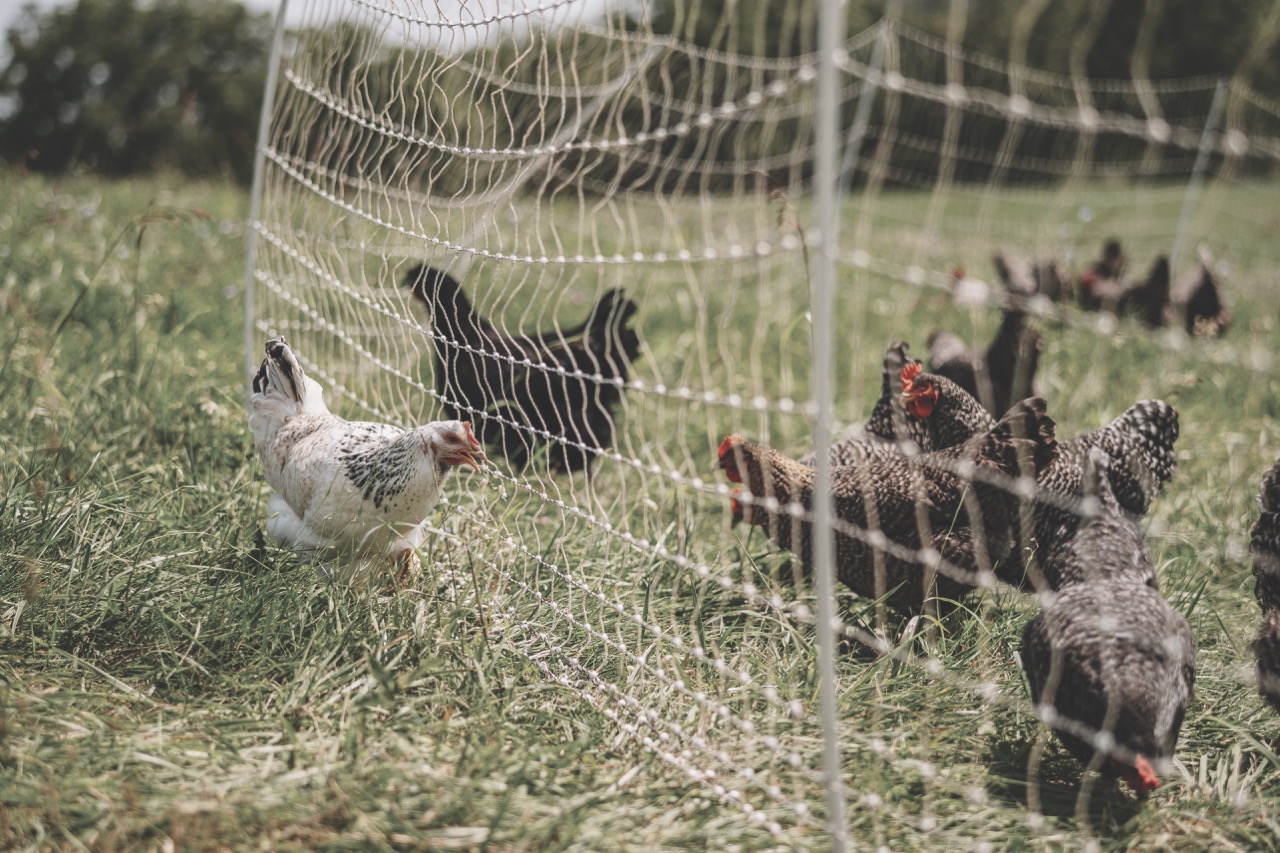
In nature, animals move. That seems like something you wouldn’t have to mention, but it’s the Achilles heel of domestic livestock production. The key to sanitation, health, and production is movement, but it’s the hardest element to incorporate into any production protocol.
How do you control the animals so they stay where you want them for the period of time you want them to be there? And how do you get water to them? And how do you shelter them from the sun if they don’t have access to trees? And should you plant trees for shade? These are all critical elements in the moving game, or what is commonly known as rotational grazing.
Whether you have one acre or 1,000 acres, you need a landscape design plan that includes access, water, and control. Access is how you move around—you, your animals, and your equipment. Access can be called a lane, road, or alley, but it should meander to touch as much of your land as possible. Think of the lane as the center of an airplane and your grazing areas as the wings.
The idea is that you can efficiently move your stock from one end of your property to the other, with one person, once the animals are in the laneway. A lane should be at least 8 feet wide for the surface and 16 feet wide to fence edges, and all-weather usable. It concentrates traffic and protects pastures from tire compression.
Down one side of that lane you’ll run a water line. You cannot afford to haul water; pipe is cheap and easily installed. The water line can service both sides of the lane, with an access T every hundred feet on an under-10-acre property and longer distances on larger tracts. The access valves should be placed at laneway access gates in order to service two temporarily-fenced paddock subdivisions. Bringing subdivisions to lane gates makes it easy to move stock in and out of lanes.
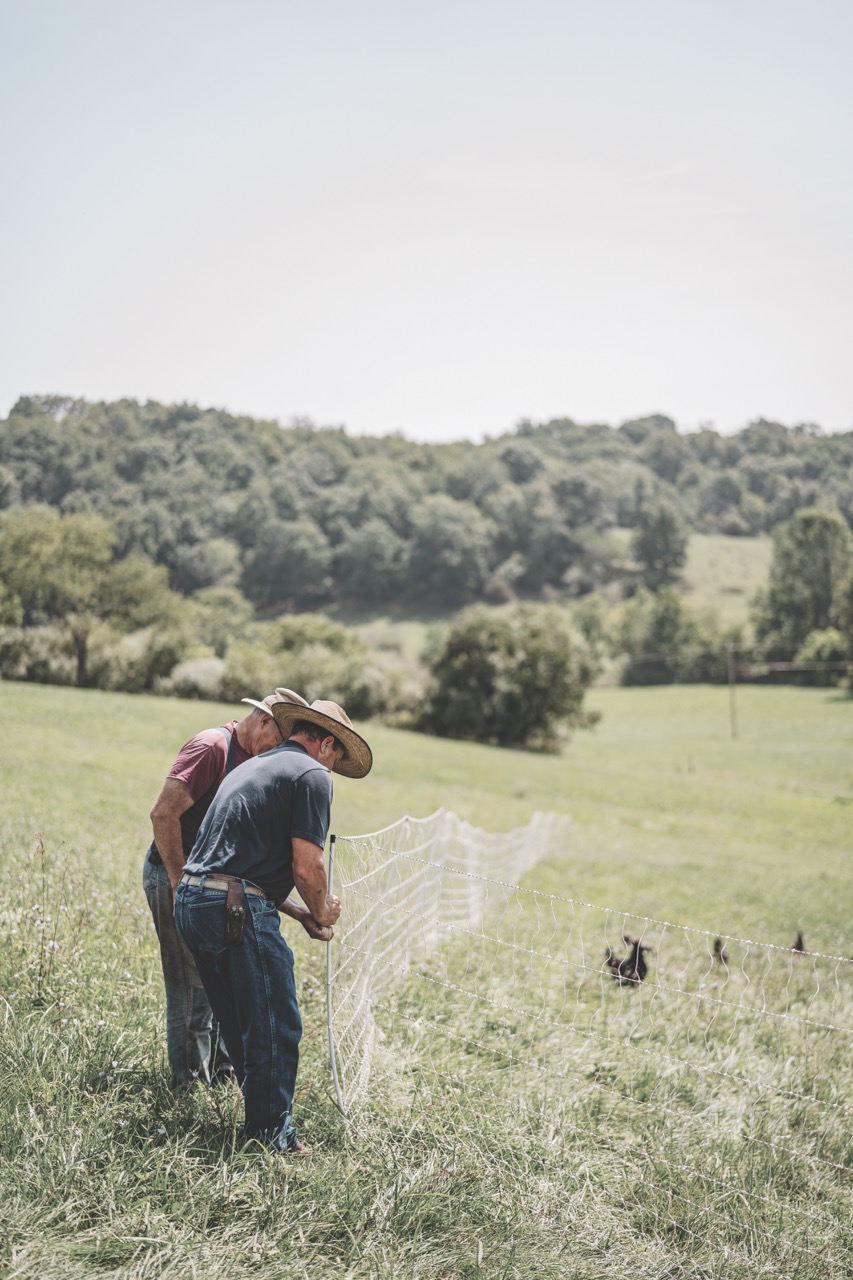
Locate lane gates directly across from each other so you can easily move equipment like portable shelters or eggmobiles from one side of the lane to the other without having to turn onto the lane. Lane gates should be at least 20 feet long. On each side of the lane, a permanent electric fence creates the foundation of your control.
Each field should be permanently fenced with a physical fence. All internal fencing can be electric. Cows are fine with one wire; sheep and pigs two; goats three. Any fence that will hold a goat will hold any other type of livestock. After fencing access and boundaries, fence-out other critical areas like ponds, streams, woods, yard, and garden. With access, water, and control complete, you have the infrastructure to begin raising livestock. Without all three of these elements, do not acquire livestock. Period. If you can’t efficiently move ‘em, you’ll overgraze and have health-compromised animals.
Animal Math
Every vocation has a way to measure performance. For an electrician, it’s amps, watts, and volts. An orchardist measures bushels. A banker uses dollars. In grazing, we use animal units, which are usually keyed to the size of a cow, or 1,000 pounds. On our farm, since we primarily have cows, we use cow equivalents as a standard, which means we measure with cow-days. A cow-day is what one cow will eat in a day. It varies based on whether she’s lactating or whether the grass is spring flush or mid-summer drought-stressed. In general, seven sheep equal one cow.
The goal of domestic livestock management is to move the animals daily to an area that can carry them adequately. That means you need to know how many animal units (AU) you have and how big an area you gave them. At the beginning, this is just a guessing game. But if you carefully record the AU and area, in a matter of days you’ll begin to understand the carrying capacity of a given sward.
Mastery is when you can look at a paddock and say, ”This is 40-AU forage,” or, “This is 60-AU forage.” Let’s imagine you have four cows, one milk cow, four calves (about three months old), and four yearling calves from last year, plus a flock of 10 ewes and 15 lambs about three months old. Converting this group to an AU looks like this: five cows, four calves equal to one cow, four yearlings equal to three cows, 10 ewes equal to two cows, and their lambs equal to one cow. If we add all that up, it comes to a grand total of 12 cow equivalents, or 12 animal units (AU).
With that number, and the area you give them for a day, you can determine the AU per acre. If those 12 animals need only a quarter acre, you have 48 AU/acre grass. If they need half an acre, you have 24 AU/acre grass. The formula is simple: AU multiplied by days divided by acres. Often, especially in a smaller operation, you’ll be dealing in fractions of an acre per day. An acre is about 5,000 square yards.
If you need half an acre (2,500 square yards) and your paddock is 50 yards side to side, you’ll want to give them a 50×50-yard paddock for the day. What if you miss? Figuring the right amount of area has two monitoring points: the animals and the forage. If the animals act dissatisfied and their left side (the main paunch side) is gaunt, or a bit hollow, they probably didn’t get enough. If they don’t pay attention to you when you go out to move them, and quite a bit of uneaten forage is left, you probably gave them too much.
This is like sculpting a landscape. Imagine you’re creating a masterpiece in forage, soil, worms, and livestock with your management. If you decide you shorted them by 10 percent, increase the paddock commensurately (in our example, from 2,500 square yards to 2,750 square yards). If you wasted forage by giving them too much, decrease the next paddock by 10 percent.
By moving them every day, your feedback loop is precise and immediate. Within a month you’ll have 30 tests; at this rate of feedback, your skill level increases rapidly. In a month, you may not be a master, but you’ll have the nuts and bolts figured out and will begin feeling comfortable with the routine, and so will the animals. They’ll begin to trust you to care for them, view you as a friend, and become extremely disciplined.
The Importance of Well-Managed Rotation
The reason I’m a stickler for daily moves is because this level of management forces you to learn quickly, develop access, water, and control, and achieve the highest utilization of forage without damaging it. The primary objective in moving is to never regraze newly-regrowing forage, or what guru Andre Voisin called “the law of the second bite.” When grass grows rapidly, it can easily grow up to an inch a day; in less than a week, the new shoots are grazeable.
If those new baby shoots get nipped, it weakens the plant. Waiting until the new shoot is long enough to replace the stored sugars in the roots that sent forth the new shoot enables the forage to achieve energy equilibrium. Continuous and overgrazed pastures operate at an energy deficit, which means they never grow as much volume, suffer harder during drought, and gradually move toward unpalatable species.
Mobbing animals into small areas for a day encourages them to eat far more variety and keeps them away from yesterday’s excrement. Manure and urine spread more evenly on the pasture rather than concentrating in lounge spots. I’m a huge fan of portable shade using lightweight structures with nursery shadecloth on top. All animals except chickens can handle rain just fine.
It’s important to know the habits and preferences of different livestock if you want to be successful with multi-species rotational grazing. Goats are browsers, not grazers; they want to eat above their shoulders 80 percent of the time. Pigs dig holes; I don’t recommend running them in pastures where you’ll run chickens. Yes, some pigs dig less, but the non-digging pigs take twice as long to grow; everything has tradeoffs. Digging pigs around the edge of your nice fields can utilize rough or forestal areas to great effect.
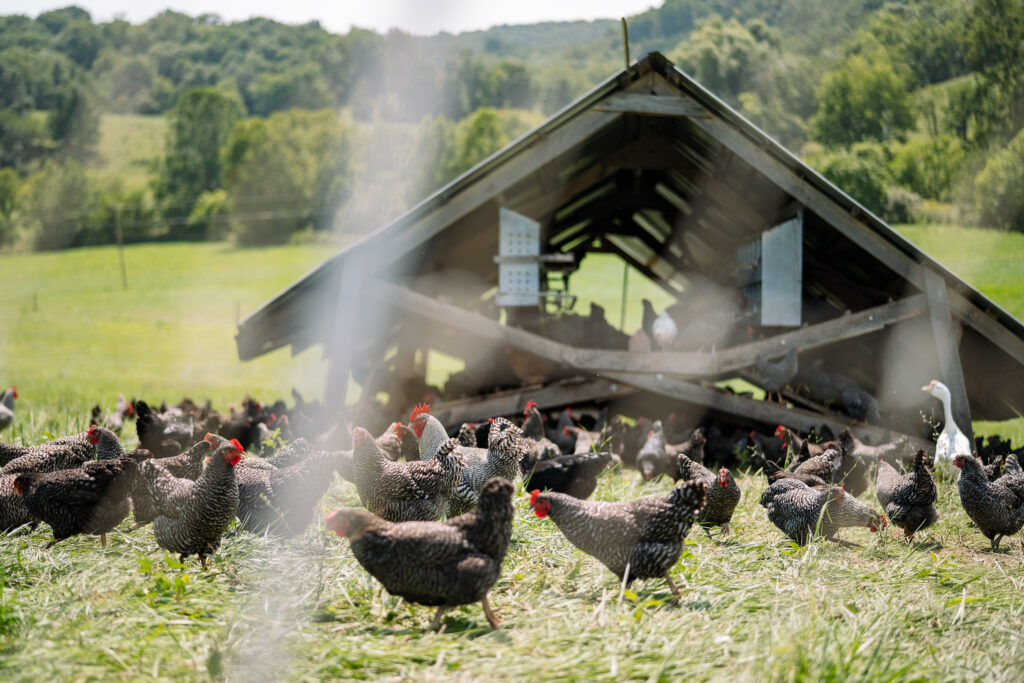
Poultry work symbiotically with herbivores and pigs but are far more vulnerable to predation. In general, I like completely enclosed shelters for broilers and young layers. These can be moved through the same paddocks as the livestock. Adult laying hens can either be run in enclosed shelters or in portable electric netting. A guard goose or nearby guard dog can be invaluable to protect birds.
Animals love routine; I like to move cows around 4 p.m. That gives them the longest graze time in comfort—the sun begins going down and the night is cool. It’s also when the brix (sugars) are highest in the forage and it’s dew-free, which protects from bloat. One of the most critical elements in a grazing plan is to change it from year to year. If you start at paddock A one year, start at paddock B or C the following year.
By altering your rotation, you allow different paddocks to grow different plants to physiological maturity (seeds) and increase your plant diversity. On larger acreages, you want to subdivide fields using aspect as lines of demarcation. Southern aspects grow differently, for example, than northern aspects. If you combine sharp differences in aspect in the same paddock, you’ll probably graze too early on some of the ground and too late on some of the others. Maintaining homogeneity in your paddocks increases your chances of grazing the whole paddock at exactly the right time.
As you develop skill in reading your forage, you’ll be able to inventory your forage just like counting bales of hay in a barn. You can match your livestock to your carrying capacity. You can determine if you’re running ahead or behind. And if a nearby place becomes available, you can know exactly how many animals you can run there.
A well-managed controlled grazing plan usually increases production at least three-fold over continuous grazing. That’s a lot, even on a small acreage. The best thing you can do for your forage, soil, and animals is to just move ‘em.


Leave a Reply