
In the last two generations, our society has made the thought of consuming the flesh of a cute, cuddly, fuzzy bunny nearly abhorrent. When we were first introduced to the idea of raising rabbits for meat, I am sure our reaction was the same as many who have never considered the practice before.
It is a stretch for most average, modern North Americans to wrap their minds around the fact that these animals can play an important role in our diet and the management of our properties. (For those readers outside of North America, your culture may be more accepting of this fact.)
The first thing to consider is why rabbits have been missing from many homesteads and farm plans.
There are many facets to this answer. Society’s view of rabbits has changed drastically over the last eighty years. Up until the 1950s, the rabbit was seen as a common source of protein and regularly appeared on dinner tables. Two factors influenced this change.
First, the rise of industrial agriculture and the decline of the fur industry. Second, and around the same time, the rabbits were “humanized” in the form of cartoons. Millions of children and families were waking up on Saturday mornings to the vision of animals walking, talking, playing, singing, and living in a house just like they did.
In the following decades, as rabbit meat became more and more uncommon, it was relegated as food for someone of “less privilege”. While this assumption was made in North America, rabbit continued to be placed on the menu of some of the most prestigious five-star restaurants around the globe.
The final turn that pushed rabbits out of consideration as a meat source was the big “cruelty-free” campaign in the 1980s. Rabbits became the poster child of this movement and to this day are featured on cosmetic, hair-care, and even toothpaste packaging to show that the products are not tested on animals.
From the 1980s through the beginning of the 21st century, these mindsets dominated the landscape. Commercial rabbit lines were maintained mostly by small farms and backyard breeders in North America.
The acceptance of rabbit as a meat source has gained traction worldwide in the last 20 years. A few European countries have had a consistent production and demand for rabbit meat throughout the 20th century. Spain, France, Greece, and Germany had a fairly steady rate of production and consumption from 1950-1990. Over the last two decades, Italy, Bulgaria, and the Czech Republic have seen an increase in demand.
Eastern Asia has also seen an increase in demand. China and North Korea lead this region in the production and consumption of rabbit meat. These two countries account for nearly 70% of the 1.5 million tons of rabbit meat consumed around the globe.
The global market demand has grown annually by an average of 2.8% from 2007-2017 and is expected to grow by 2.3% in the next few years. North America is almost dead last in its production and consumption. Keep in mind that these numbers are almost solely commercial production numbers and not figures from backyard or small farm production.
Recent global events have led to a renewed interest in meat rabbits. 2020 brought in a wave of people seeking breeding stock for their homesteads and backyard operations. Individuals began to see holes in the supply chains and in their own ability to meet their family’s and community’s needs.
Rabbits have some unique qualities that can help to fill these gaps. The meat harvested from the carcass shines above other home-raised meats and the byproducts can assist in enriching other areas of your property.
The primary purpose of a meat rabbit is, well, meat. Oh, and what a meat it is! A healthy domestic rabbit produces a high protein, low fat, mild-tasting flesh. Some have said, “It tastes like chicken”, however, we feel it is closer to a white pork/white turkey hybrid.
It has just enough flavor to stand on its own when needed or it serves as a constant companion in flavorful soups, stews, and ethnic foods. Pair the nutritional value of the meat with the sustainability factor, and you should have a slam-dunk winner for anyone seeking to maximize the production of meat on a property.
A breeding trio of commercial-type rabbits can produce 250-300 pounds of meat following a
conservative mating schedule. This amount can be throttled up or down depending on the needs of the family or community. It can be brought down to just a litter or two a year and up to a litter every 45-60 days if required. And if one needs to increase production further, a quality doe can be held back and introduced into the breeding schedule within 6 months.
This is one of the factors that lend to the sustainability of meat rabbits … once a breeding herd has been established, it can continue for years with no external input. There is no need to purchase new stock every year. The use of line breeding with rabbits is an accepted practice and can be used to strengthen the desired qualities. The qualities include temperament, body type, coat condition, coat color, litter size, and growth rates.
Another factor leading to the sustainability of rabbits is the reduced need to purchase equipment to raise or process the rabbits. The mothers will sustain the bunnies until they reach weaning age. No incubator, no brooder, no heat lamp, and no need to purchase separate feed for the young. The mother rabbit, while appearing inattentive and uninterested, will do what is necessary to care for the young rabbits.
She should build an appropriate nest out of hay or straw and line it with fur she has pulled from her own belly. She will enter the nest one or two times a day to nurse the babies. And when it is time for them to begin eating solid food, the babies will eat and drink when she does.
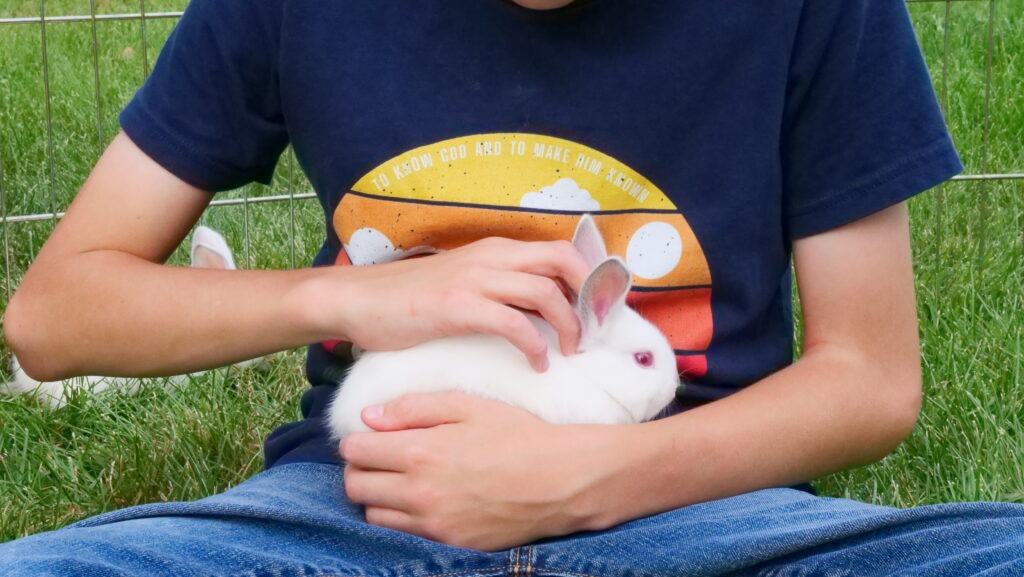
When it is time to process the rabbits, usually around twelve weeks or five pounds live weight, a sharp knife is all you really need. The processing is quick, producing little mess and smell, and can be accomplished by most people.
Rabbit byproducts provide another reason to make space for them on a homestead and small farm. Rabbit manure is probably one of the most well-known of these byproducts. Their manure is “cold” and can be used directly in the garden and landscape as a fertilizer, reducing the need to purchase commercial soil boosters.
Due to its immediate use and outstanding N-P-K (Nitrogen, Phosphorus, and Potassium) value, 2.4-1.4-.60, it is sought after by gardeners and in some areas can be sold at rates that may cover feed costs. Rabbit manure can also be combined with the native soil to create a powerhouse seed-starting medium. Besides the amazing plant nutrition it provides, it has fibrous material to assist with maintaining moisture. The manure alone has convinced some to raise rabbits.
The other byproducts consist of the parts of the processed rabbit not included in the finished carcass.
The pelt is one of the obvious parts that have value. If of sufficient quality, the pelt can be tanned and preserved for leather goods. The pelts of younger rabbits or ones that are in a molt may not be usable for crafting, but can be dried and used as dog treats. Similarly, organs such as the liver, kidneys, heart, and lungs can be dried or used in a raw-feeding program.
Raw-feeding for dogs and cats has seen a rise in the last decade and there is demand for parts, whole processed carcasses, heads, or even whole rabbits that have been dispatched. The remaining parts can be fed to other omnivorous livestock, used as bait for hunters, or added to a balanced compost pile.
Housing rabbits can be as simple as a stand with a few cages or as complex as a purpose-built building. Domestic rabbits have successfully lived in hutches and cages for over six hundred years and really don’t need too much space to thrive. They only need to be protected from the elements, have sufficient air movement, and have six square feet of floor space per adult rabbit.
Grazing tractors can help reduce feed intake, but are not necessary for healthy rabbits. Most commercial rabbit pellets are a complete food source and nothing else is required. However, if you are able to meet their nutritional needs with items grown on your property, it is possible to close the loop and have a truly self-sustaining meat source, especially if you are using rabbit manure to nourish the plants.
Whether you are looking for protein-packed meat for yourself or a nutrient boost for your garden, rabbits can fill that void. No other commonly raised animal checks all of the boxes.
These furry creatures require little space, grow swiftly, have a feed-to-weight ratio only beat by Cornish Cross chickens, have the potential to bring in some extra income, and provide manure that can help your gardens thrive. Rabbits can be that missing link to help you achieve your self-sufficiency goals!






Leave a Reply