
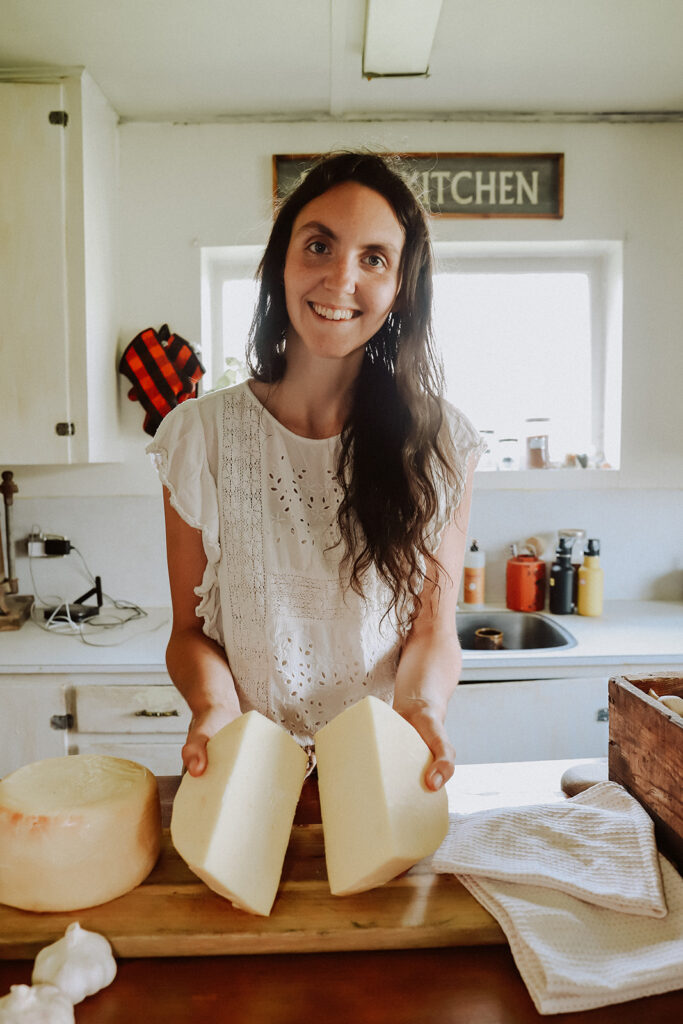
I am a wife, mother to small children, cattle rancher, homesteader, business owner, and cheesemaker. My hats are numerous, but I am fortunate enough to be able to wear them almost all at home.
On our Canadian homestead and cattle ranch, winter mornings are the same as the summer mornings, just colder. There are chores, some more seasonal than others. Each morning, my first order of business after my feet hit the cold floor is coffee. Then, I stack the wood stove and pull on my insulated coveralls. I fill a thermos with hot water and rags, grab my bucket, and head to the barn.
In the summer, these treks to the barn are filled with light and the sound of song birds. In the winter, they are dark. A headlamp on my head is the only light, and the only sound is my feet crunching through the snow.
At the barn, I pull off my gloves and pat my good cow. In this northern climate, fresh vegetables are shipped in for at least six months of the year. Having a milk cow provides us with a fresh food source nearly year round. I sit down on my stool beside her, dipping my hands into the thermos I brought to retrieve a warm rag before washing her and beginning to milk. Her body warmth warms me, and as the milk hits the bucket, steam rises up.
After milking, she is pitched fresh hay, the ice in the water trough is broken and scooped out, and I am back to the house. The house is warm and cozy from the wood stove, and before I do anything, I peel off layers of barn clothes, suddenly claustrophobic with the heat. The milk is strained into glass jars and most of it is placed in the fridge with the exception of a pint that I save to feed to my clabber culture.
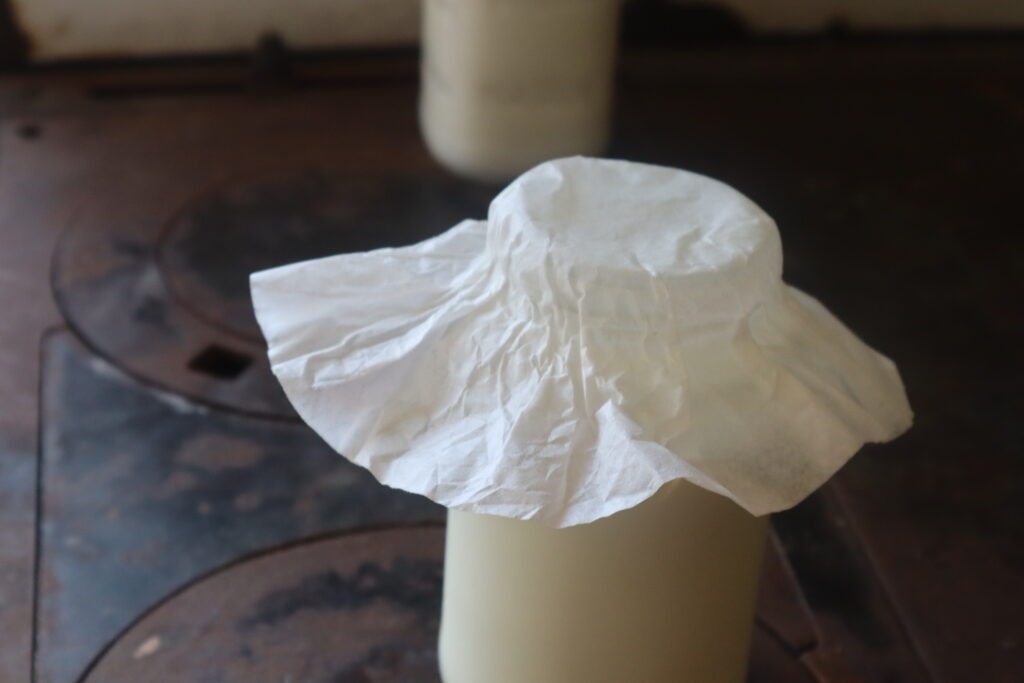
Clabber, referred to in its German name, is a raw milk culture I keep on the counter and use as a starter culture for cheesemaking. I feed it everyday, discarding most of it, keeping only a little back to feed with new, fresh milk. In the spring and summer months, the clabber discard is plopped into the cheese pot each day along with the morning’s milk. It acts as a bacterial starter culture that will inevitably start my milk on its journey to becoming cheese.
In the winter, however, the discard itself is the prize. Instead of using it for cheese, I stir it into batters: pancakes, waffles, muffins, breads of all kinds. I mix it with jam and feed it to my children as yogurt, strain it through cheesecloth and spread it on toast, heat it and suddenly it becomes cottage cheese. My clabber is used fresh in the winter because the season has passed for cheesemaking.
Winter is our season for rest on our homestead. As cattle ranchers, we send our calves to the sale yard at the end of November. For 2 months, until the cows begin to calve again in early February, a peacefulness falls on the ranch. Sure, there are chores: our house cow must be milked, a few eggs collected from the resting chickens, the big herd of cows fed each day with the hay we put up in the summer. But once the chores are done, we rest….. and we eat.
The days of quick, simple meals are behind us. It’s not uncommon to walk into our little house and smell fat roasts dripping in the oven, bread baking, and to be offered a spot at a long table laden with a year’s worth of bounty.
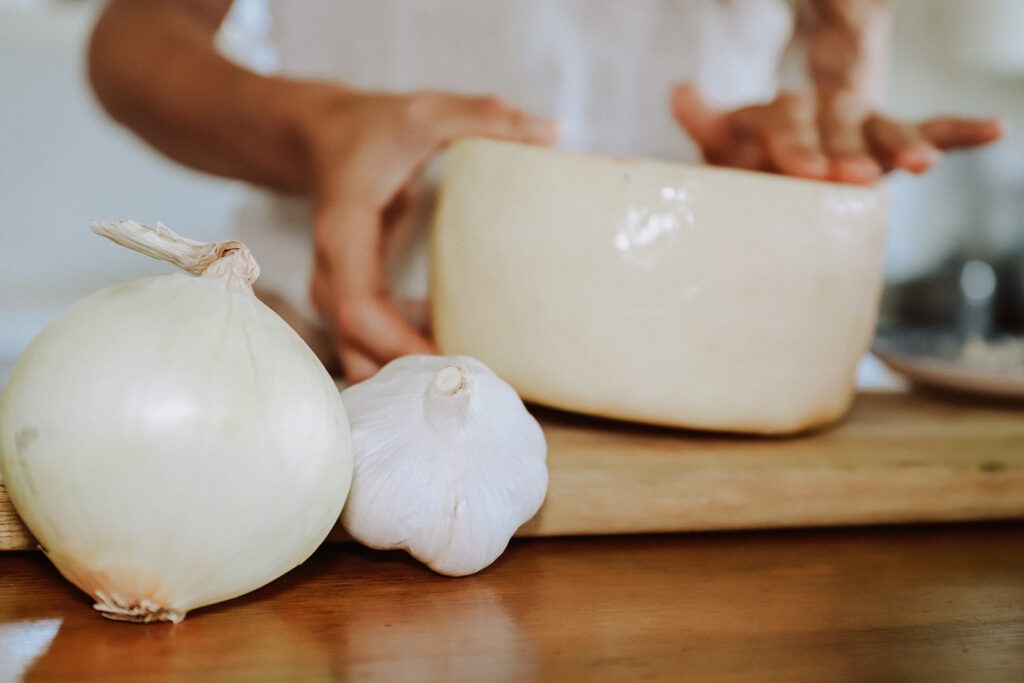
It feels rich to lay a whole wheel of cheese on the table and hand out thick slices to accompany each meal. My family enjoys cheese like anyone enjoys cheese: a simple pleasure, perhaps dolled out a little more frequently in our home than in others. I, of course, enjoy eating cheese. But more than anything, I enjoy the treasure hunt of opening up a new wheel.
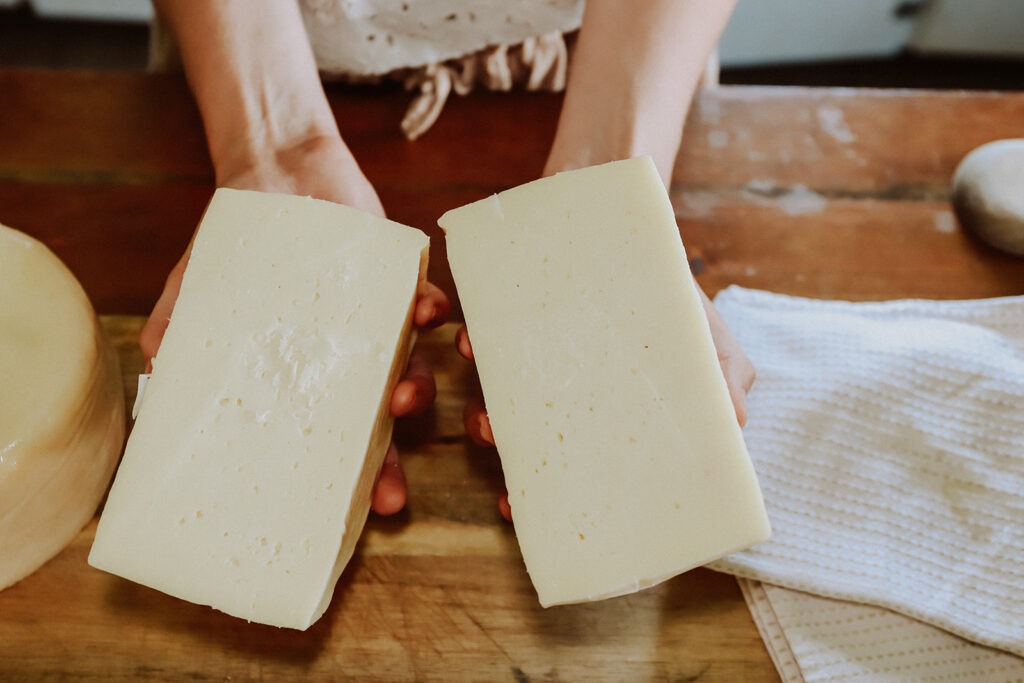
I scan each cheese with the eyes of a cheesemaker, a student of my own work. I see the crystals forming, the knit of the curds, the occasional hole (or, as we call them in the cheesemaking world, “eyes”). I scan each eye closely to determine if it’s made from an error in my cheesemaking or from a bacteria gone wild that left behind a carbon dioxide bubble. Winter is a time to assess my work and make mental notes for next year.
Some of these cheeses were made over a year ago, some as recently as September. Depending on the type of cheese, I will let it age longer or shorter. It mostly has to do with how hard or soft the cheese is and what cheese making techniques I used to make it. For instance, cheeses like gouda and colby I stock up on at the end of August and September. Their higher moisture doesn’t lend well to years of aging; they do better when you eat them between six weeks to six months. We want to eat them throughout the winter, and they always taste better if our cow is eating fresh grass when they are made. So August and September it is.
Fresh grass almost always makes the best cheese. As winter sets in and we begin to feed our cows preserved hay from the summer, I sometimes run into contamination problems in my cheese. A cow fed haylage (a fermented hay) is more likely to produce cheeses that contaminate during aging with large eyes and a putrid vomit smell (butyric acid) that is most likely caused by botulism.
As with anything on the homestead, you often have to learn from experience. After you have seen this once and had your nostrils invaded by the terrible smell of butyric acid and dumped a few wheels for the chickens, you tend to be more careful about when and how you make your cheese. So I don’t often make cheese if my cow is on fermented feed; it’s not worth it to me.
Dry hay is a different story; it makes fine cheese. But, depending on the summer weather, it is always a toss up of how much dry hay we can put up. You need stretches of weather with no rain to make dry hay, and sometimes we don’t get these stretches when the crops are ready to be taken in. In these cases, we have something called a bale wrapper, which means we can bale our hay when it is too wet and wrap it in long plastic rows that lock out the oxygen and cause fermentation to occur. We call this haylage. It’s quality feed; it will keep our cows well conditioned and healthy, even if it doesn’t lend well to cheesemaking. That’s OK.
As a cheesemaker, I recognize that just as a cow’s milk will change as her lactation changes, there is a seasonality to cheesemaking. The more we work with this seasonality, the easier cheesemaking becomes, something that I hope to talk a lot about in my upcoming book, which will be released sometime in the next two years.
As a cheesemaker, I am always thinking about the similarities that cheese has to the real world. This process of fermenting hay is very similar to how I vacuum seal my cheeses for aging. The hay is wrapped so no mold can grow, and so is the cheese.
One look in my cheese cave (an old fridge turned to the warmest setting) and you will see that most of my cheeses are vacuum packed. These vacuum-packed cheeses will age with little effort from me. The hardest part of making them was, in fact, making them. That part took the most time, but no more than a morning at the cheese pot.
Now that they are sealed in the cool environment of my cheese fridge (50-60°F or 10-15.5°C), my job is done. I will flip them every few weeks, inspecting the packaging for whey. As long as I don’t see any liquid on the inside of the bag, these cheeses will age with no help from me for the next weeks, months, and years.

Occasionally, I will want a different outcome for a cheese than what can be provided in a sealed bag. Vacuum sealing locks in the moisture, and once in the bag, nothing moves in or out. My children and my Wisconsin-born husband prefer my vacuum-sealed cheeses to anything else. They want simple cheese, nothing too harsh on the palate, something quite similar to what you would buy at the store for eating each day: colbys, mozzarellas, cheddars, all cheeses that lend well to vacuum sealing.
However, sometimes I crave the nuances that natural aging brings: the stinky softness of a washed rind cheese or the dry crumb of a parm. So the space in my cheese fridge that is not taken up with vacuum-packed cheeses is filled with their more naturally aged cousins. Ripening boxes (just a fancy word for plastic containers) line the shelves. These little boxes act as chambers to help me control the humidity of each cheese.
Weekly, sometimes daily, I pull these boxes out and spend 15 minutes puttering away, giving each cheese what they need. Some need to be scrubbed with a brush to remove any new mold; others are washed in a brine. They are flipped and inspected. I gauge the humidity by what type of mold I see and how much condensation is on the top of the box lid.
You see, the hardest part of making a naturally aged cheese is not the making part, but the aging part. It is a labor of love and one that I don’t always have time for. But, come winter, when rest and eating has set in, these are the ones I am most excited to open.
Come winter, when cheesemaking season is over, these 15 minutes of puttering don’t seem so long. The cheeses eventually develop a strong rind that is easier to maintain, and by the time Christmas rolls around, there is really little left to do other than sit back and enjoy a good book and a slice of well-made cheese.
Leave a Reply