
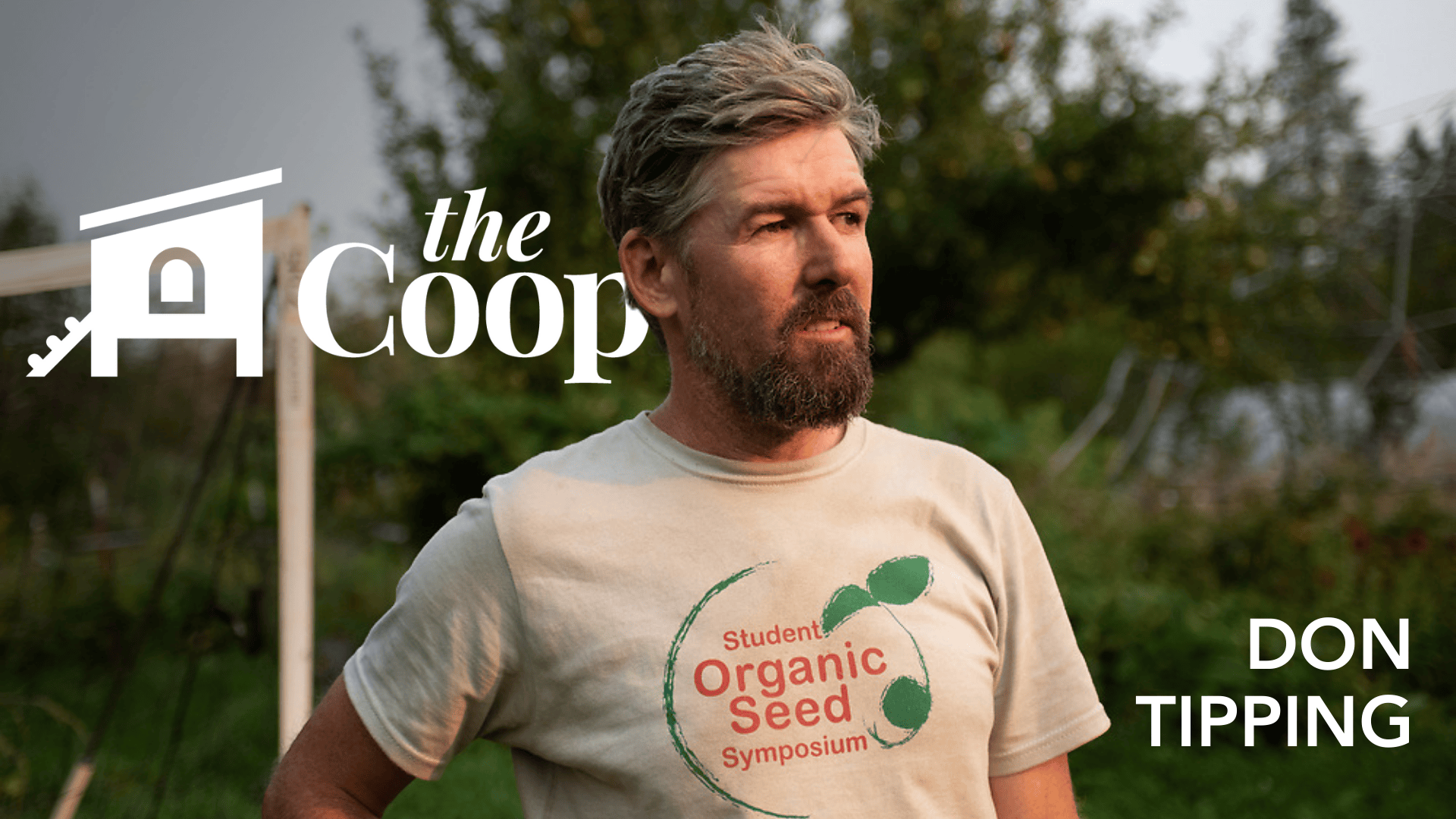



Don Tipping has been at the seed starting game a long time.
He’s farmed and stewarded seeds at Seven Seeds Farm since 1997, founded Siskiyou Seeds in 2009, and now grows over 700 open-pollinated varieties, breeding for bio-regional strength in Southwest Oregon’s variable climate.
He’s seen the industrial seed game up close: big companies sourcing globally, pushing flashy hybrids while workhorse open-pollinated lines get neglected.
His work pushes back, prioritizing adaptation to local pests, weather, and soil so your garden thrives without constant inputs.
The core truth is quiet and powerful:
- Start from seed for control over every dial (light, soil, timing)
- Source bio-regionally adapted varieties for plants that are adapted to your climate
- Prioritize workhorse varieties for a more reliable harvest
- Keep a journal, talk to neighbors, swap seeds, and never underestimate the power of local wisdom
If you’ve ever felt intimidated by seed starting, spent way too much money on transplants that didn’t produce, or wondered why your results vary crop by crop and season by season, this conversation will give you all the tools and information you need to get growing.
In this episode, Anna and Don discuss:
- Why home-started seeds often outperform nursery transplants
- Local wisdom vs. USDA zones (frost dates, microclimates, neighborly advice)
- The importance of sourcing seeds from your bio-region
- How to source quality seeds (and red flags to beware of)
- Workhorse varieties and proven, reliable performers
- The difference between heirloom, open-pollinated, and hybrid seeds
- What “days to maturity” actually means (and why it matters)
- Starting indoors vs. direct sowing seeds
- The truth about GMO seeds (and whether you need to worry about them)
- Practical tips to avoid, common pitfalls, and much more!
About Don Tipping
Don Tipping is a permaculture leader, organic farmer, writer, and seed steward at Siskiyou Seeds in Southwest Oregon. Since 1997 he’s grown food and seed at Seven Seeds Farm, breeding open-pollinated varieties for bio-regional resilience. He teaches seed saving nationwide, serves on the Seeds of Light nonprofit board, and is a contributor to Homestead Living magazine.
The show notes …
0:00 – Intro
4:54 – Seeds vs. Transplants
8:58 – Frost Dates & Seed Selection
12:05 – Best Places to Source Seeds
16:49 – Seed Swaps & Libraries
22:06 – Selecting Varieties: Start Native
26:25 – Reading Seed Packets
32:53 – Are Heirloom Seeds Better?
43:22 – What is a Hybrid Seed?
47:31 – Should You Worry About GMOs?
50:09 – Direct Sowing vs. Starting Indoors
57:44 – Reading Days to Maturity
Don Tipping:
I’m sorry. Never get seed at the hardware store where they’re a dollar a packet. Why would you do that? Why would you hobble yourself right from the start? Think how long that seed sat in some UPS truck in the sun, not in an optimal situation versus people that are treating it more like, I don’t know, the handmade goat cheese at your farmer’s market where the person loves their goats and the kids gave them names. That’s a very different thing than the industrial model. Why not grow some nice transplants? And that’s why I love transplants because I can prepare my beds, till them right before I plant, get it all just how I like it, and then put transplants in at the exact spacing. There’s no weeds. And then my plants have that six to eight week jumpstart on all the weeds.
Anna Sakawsky:
This episode is brought to you by Azure Standard. Family owned since the 1970s, Azure Standard is on a mission to make real food more accessible by delivering it straight to your doorstep or to a convenient local drop point near you. Everything they offer is completely organic, non- GMO, and free from junk additives you don’t want in your home or in your body. With more than 13,000 carefully vetted products, Azure Standard makes it easy to stock up on what really matters, from bulk grains, nuts, and healthy oils to fruits and vegetables, frozen meats, pantry staples, and even clean household goods. And the best part is you skip the grocery store markup. You can order exactly what your family actually needs, save big on high quality food, and pick it up alongside neighbors who care about the same things you do. Health, sustainability, and supporting ethical producers.
You head to azurestandard.com right now to get started. Again, that’s azurestandard.com. Well, hello everyone and welcome to episode 15 of The Coop. I’m your host, Anna Sokowski, editor-in-chief of Homestead Living Magazine. And today I am joined by Dawn Tipping, owner of Siskiyou Seeds to talk all about seed starting. So Dawn is an established permaculture leader, organic farmer, writer, and community activist based in Southwest Oregon. He’s been farming and offering hands-on practical workshops at Seven Seeds Farm since 1997. And in 2009, he founded Siskiyou Seeds, a bioregional organic seed company that grows and stewards a collection of over 700 open pollinated flour, vegetable, and herb varieties, with new ones being bred and distributed nationally. Dawn is active in the seed stewardship movement and teaches regionally on seed saving through the Seed Academy, the Student Organic Seed Symposium, various seed schools, and numerous conferences. He currently serves on the board of a new nonprofit called Seeds of Light, which is developing educational programs for gap year students and workshops aimed at growing humans through their head, heart, and hands.
Dawn is also a contributor to Homestead Living Magazine. You can catch his latest article on the importance of sourcing seeds locally in the January, February issue of Homestead Living Magazine. And I’m so glad to have Dawn on the show today to talk all about seed selecting, sourcing, and starting because it is the season. As we head into spring, now is the time to start planning and soon we will be planting our gardens out. So Dawn, welcome to the show.
Don Tipping:
Thanks so much. I’m happy to share some time with you.
Anna Sakawsky:
Awesome. Well, I’m really excited to pick your brain today because I have now been gardening for about 10 or 11 years. But A, I remember when I first started out, I had no idea what I was doing and you hear kind of conflicting things sometimes or you kind of almost get analysis paralysis. And I remember the first year I just didn’t even know where to start. And even now, 10 years later, there’s something new that I’m learning all the time. And I think that it’s probably safe to assume that a lot of our listeners and readers of the magazine, a lot of them probably maybe do some gardening in some capacity, although we do have people who are brand new to homesteading, maybe have never gardened before. And then there are others. I hear this a lot from people that there’s kind of an intimidation factor when it comes to starting seeds or maybe it’s been because of frustration because they’ve tried starting seeds in the past and they’ve had challenges or their seedlings have died or whatever.
So a lot of people will just kind of revert to purchasing transplants from the nursery and growing a garden that way. So before we get into kind of the nitty-gritty of how to select, source, start seeds, what would you say are the benefits to starting plants from seed versus just going and purchasing transplants or starts from the store?
Don Tipping:
Yeah. Well, that’s a great setup and inquiry. And I think it’s important to consider that any life form, so in this instance we’re talking about plants, wants to begin growing and then grow at a steady trajectory up without encountering limits, constraints, undue stresses, or grow in a bubble and then be exposed to the cold, hard world. And so a lot of new gardeners will say, “Oh, I don’t have the situation set up for myself to start things from seed, whether it’s the trays or the ability of mixing soil or just the time.” So they’ll buy starts at a garden center or the farmer’s market or something like this. However, when you put yourself in the mind of someone selling vegetable starts or flour starts, and you’re going to want them to be big and dark green and leafy, and these are people that know how to grow things, which means that oftentimes, and I think almost exclusively, they’re fertilizing them excessively so that they look good, but it’s all show and no go.
So when you put them into your home garden soil, and especially think for a new gardener, maybe their soil isn’t quite at the organic matter or tilth or soil preparation that you may be able to achieve when you’re more experienced. So you put this new vegetable start that’s grown by an expert into a more challenging environment and then it gets stressed out. And two, like I talked about wanting to start at one point and grow on a smooth trajectory, you’ve just interrupted that. So when you start your own seeds, you’re just more in control of all the dials, of all the parameters of the light, the timing, the soil, the proper temperature, and all of this to set yourself up for success. And I think that that’s really important. It’s not all that difficult. I’ve made a few YouTube videos of how to make potting soil, our recipe of homemade potting soil and how we start various seeds.
Different species want different approaches taken to them, but it is one of the crucial parts. And if you think, if you look on the broad scale, planting things from seed was the hallmark of agriculture because nobody had greenhouses, there was no garden centers or that kind of thing. So for the great arc of thousands of years of human beings doing agriculture and gardening, they were planting right into the soil. So I think that it’s really implicit to start there. And like we learned to play the piano by learning how to play chopsticks before you learn the notes, but you learn that feeling of making sound on the keyboard. So I encourage everybody to go that way. See, buying starts as the backup plan and say in case yours fail, but don’t start there because it’s just going to set you up for a bit of a disappointment because you put these beautiful, big, leafy, dark green starts in, and then they just kind of sit there or maybe get frosted, attacked by disease, pests, or maybe too much sunlight because they were being grown under shade cloth, which is very common and in an environment where there was no wind.
So there’s a lot there, but start off with that.
Anna Sakawsky:
Well, that makes a lot of sense. And we’re going to get into that and talk a little bit about direct sewing seeds versus starting them indoors and which seeds prefer what and why. But again, before we kind of get into the actual seeds starting, before anybody even goes and purchases their seeds, what sort of information should they have or what sort of things should they be considering, like things like gardening zones, frost dates, stuff like that, what should you know before you even decide what seeds to select?
Don Tipping:
Yeah, that’s good question. And I typically encourage people to get to know your gardening neighbors is the best source of local wisdom, much more so than a USDA zone, because all that tells you the hardiness zone is how cold does it get in the winter. But we’re generally gardening during the time of year where it’s not winter and it’s not frost. So locally through garden clubs or your neighbors who are already experienced gardeners, you can find out when is the last spring frost date. That’s crucial information as is knowing when typically frost comes in the fall, but even more important is the last frost date in the spring. For us, it’s usually around Memorial Day, the end of May. So that’s the demarcation point wherein you have to wait to plant the cold, sensitive, like frost sensitive crops that include all the summer vegetables of tomatoes, beans, corn, peppers, squash, cucumbers, melons, that kind of thing.
The brassicas, lettuces, other greens, onions, leeks, peas, they can handle some light frost. So for us, we’re usually putting things like that, either direct seeding or transplanting in April in Western Oregon, but it’s going to vary. So you need to find out what the local wisdom is. And typically, there’s a gardener club or some kind of resource that you’ll be able to find, and it’s all very case by case to your location.
Anna Sakawsky:
Yeah, it’s so true because even our area, so I’ve got probably a similar climate to yours because I’m on Vancouver Island. So West Coast, same thing, same kind of idea, Memorial Day, that kind of time for us, it’s like Mother’s Day weekend is usually the weekend I typically, if weather is average, I can plant out things like my tomato starts and that sort of thing. So again, those warmer weather crops, but it varies even within our community, depending on where you are. Our microclimate is different because we’re at the top of a hill. So we get a little bit colder winters. We get a little bit hotter, a degree or two Celsius, but hotter in the summer than down lower. So it’s taken us a while to get to know our specific little micro climate here as well and when to plant everything out. And so I think there’s just a lot of validity to that is you can’t just necessarily go with what your gardening zone says or whatever you really need to get to know and have a feel for your particular microclimate.
Don Tipping:
Exactly.
Anna Sakawsky:
Okay. So when it comes to actually sourcing seeds, you actually wrote an article for the magazine this month on the importance of sourcing locally. So we’ll kind of talk about that, but what are just in general, what are some of the best places for home gardeners to source seeds? Are there certain companies? Should you always be looking for something local? Are there any sources that maybe you should avoid or that are red flags?
Don Tipping:
Yeah. Well, I think for one, obviously I have my own biases and insights because I have a seed company, but I’ve also been a commercial seed grower growing seed for many other companies. For instance, I’ve grown seed for high mowing seeds, Johnny’s, Fedco. All of those are in the Northeast. So let’s say you live in the Northeast of this country and you imagine, “Oh, I’m going to support my local seed companies.” The reality is, is like those three that are all excellent companies that really do a great job are sourcing nationwide and globally oftentimes and from more ideal seed growing regions like the Pacific Northwest. So just because a seed company is in a certain area doesn’t mean they’re obtaining the seeds locally. There is a different category of small farm-based seed companies like my own and others like up where you are, there’s saltwater seeds, BC ecoseeds, co-op, there’s uprising seeds is in Bellingham, Washington.
And we’re hoping to develop a map so people can find this out. But once again, getting to know your neighborhood gardeners and asking them where they get their seeds is really helpful because it takes many iterations. And you think about, like I’ve been gardening for 35 years, so that may sound like a long time, but that’s only 35 times of an opportunity to source seed and all that. So being able, there’s an old saying like, “It’s good to learn from your own mistakes, but much easier to learn from the mistakes of others.” So becoming friends with other gardeners. Another good opportunity if it exists where you are is a seed swap because that’s a way to meet other gardeners and then you’re getting seed that local gardeners have grown and then they can share their experience about that. I wanted to give mention to there’s days to maturity, and this kind of overlaps our last question in this one too.
So when you look at a seed packet, let’s say a lettuce, it may say 55 days to maturity. That doesn’t mean that you put that seed in the ground and that 55 days you have a head of lettuce, but it all depends on temperature, wind, pest, disease, how much sun, how much rain. So days to maturity can be really confusing and that’s why your local lore is more valuable and keeping a garden journal too. So one myth about seeds, and one of my mentors had kind of a tongue-in-cheek joke about it. He said that most seed companies are just paper companies. They print catalogs and packets and just need a little bit of floor sweepings to put in it because most gardeners will blame themselves for a failure or lackluster performance rather than the seed. Whereas a seed company like Johnny’s or high mowing, they can’t afford to be distributing poor quality seeds because farmers know the difference.
They know like, “Hey, I planted carrot seeds here and
They just didn’t work out. ” Because there’s so many variables. So keeping a journal and write your seed source in there, write what seed you started with. And a good way to learn about it is obtain seed from a few different sources and grow them side by side. And then you’ll learn firsthand what works for you and your site because there are so many variables and it’s important not to blame yourself, but the more data you have throughout the growing season, like maybe an observation is it was rainy and cool for a week before I put my seeds in the ground, the sun finally came out. Let’s say you’re planting sweet corn. Well, the soil’s still going to be cold and damp. So even though sun came out, doesn’t mean like everything warms up all of a sudden. So keeping that garden journal will really help you understand what went well and what could have been improved.
Anna Sakawsky:
Yeah, that’s a great tip. I need to get better at that. I am not a good garden journal keeper. I usually start out like when I start my onion seeds, which are usually the first things that I start around now, January, early February, and I’m really diligent about keeping track of everything and then later on in the season it all kind of falls apart. I have started just taking photos at least of the garden. So at least I know where things were planted so that I can do things like crop rotation and that sort of thing. But definitely garden journaling is a good tip and something I need to get better at. I love also the tip of like looking to see if there’s local seed swaps, that sort of thing. We have, in our community, we have something in the spring called Seed Saturday.
So there’s a Saturday in March, early March, usually where you can go down to one of the community centers here and it’s a big seed swap and seed purchasing event, but all these local seed producers are there and it’s everybody from like some of the bigger seed companies, bigger local seed companies that actually sell in the garden stores and that sort of thing to just like just people swapping seeds, just everyday gardeners. So that’s been a really cool resource. And if you don’t have that in your community, another thing that I have found here and that I’ve heard that a lot of people have in their communities is like a seed library. So we have one of those at our public library in the spring. They just have a place where if you have saved seed from your garden, you can drop some off if you’ve got extra and if you want to pick some up, you can pick it up.
And that’s a great way to get started for free as well. So yeah, love the idea of kind of starting locally. I’m just curious in your opinion too, what does local mean? How local should you be looking or what’s the radius that you want to stick within if possible?
Don Tipping:
My view about local has changed over the years, whereas I used to see it much like local food where you wanted to get it as local as possible from local farmers because of a whole variety of reasons that everybody probably already knows. However, with seeds, they’re plants and they imprint more on a climate analog. So the idea of bioregionally adapted is more important. So like you mentioned, you lived up there on Vancouver Island, which is actually more similar to my climate here than if I were to go east four or five hours from my location on the east side of the Cascades where it’s more a high desert climate. So it’s not so much about the radius, it’s more about what kind of springs do you have? Like here we have cool wet springs that vacillate from rainy and cool to sunny and nice. In the summer, it can get really hot, but nights are still cool because we’re in the mountains.
Our winters are fairly moderate because we’re close enough to the ocean to have a bit of that maritime climate thing. And so from years of doing research and development on my farm, I’ve learned that seeds that were grown in Western Colorado actually do better on my farm than seeds that were grown in the Upper Pacific Northwest where it never really gets hot because we can get into the upper 90 degrees or for those that use Celsius, about 40 degrees Celsius in the summer, whereas around the Puget Town, it never gets that hot. So I think that’s a valuable thing to understand over time. And that’s back to the keeping a garden journal, getting to know your gardening neighbors. And like we mentioned before, seed swaps and seed libraries are great repositories for local seed. And unfortunately, the big seed companies, and I’m not going to name names, but the really big ones source like a couple that I know of, they source up to 70% of their seeds from China.
There’s no requirement to disclose the country of origin for that. So obviously that’s the other side of the planet, but they’ll never tell you. And it’s really not doing gardeners any service because they’re trying in all their earnestness to do a good job growing from seed. However, if those seeds, seeds have memory and they get used to not only the location and climate, but also the growing techniques. So if perhaps the seed you’re planting was grown in a conventional environment with lots of nitrogen, chemical fertilizer, insecticides, fungicides, that kind of thing, or maybe it was even grown in an indoor environment, then those seeds over time, they won’t know what to do about the wind or cucumber beetles or any of the challenges that maybe fall a typical garden.
Anna Sakawsky:
Yeah, that’s a really interesting point too. I didn’t even think about that, but just even like the local pests and that sort of thing that you might have sourcing locally, hopefully you’ll get varieties that are more adapted, not just to your climate and your conditions, but to pests and things like that. Also, just thinking about some seeds that we sourced at one of these seedy Saturday conventions a number of years ago now, we got an heirloom type of seed that I have not seen anywhere else. So it’s like a local heirloom variety of tomato. It’s technically a paste tomato, but it kind of doubles as a slicer. It’s a beautiful … It’s perfect, right? And because it’s a local heirloom, it’s really adapted to our climate. It’s always our best performer every year. So that’s just another reason why sourcing locally, you might end up getting just varieties that you’re not going to necessarily find sourcing from those larger seed companies and ones that are obviously more adapted to your local region.
Now, that being said, regardless of where you’re sourcing them from, the next kind of step to that is choosing the actual varieties, right? Because there are lots of different … I mean, it’s easy enough to go, okay, I want to grow some carrots, I want to grow some tomatoes and some broccoli, some lettuce, whatever, but then there’s a million different varieties of each one of those. So how does somebody that’s maybe just starting out know what varieties to choose?
Don Tipping:
Good question. And it can be bewildering because there are literally thousands of varieties out there. And sometimes too, I’ve, in all the years I’ve been gardening, notice sometimes multiple names for what is actually the same variety because it’s like a game of telephone that things change over time or people rename them or they lose the plant marker and just give it a name. So that’s where your local farm-based seed companies are useful. Here at Siskiyou Seeds, I have a general rule of we don’t sell it if we can’t grow it. So like okra, I’ve never really been all that successful growing okra. We’re just not in the right climate. Our nights are too cool. We do have one dwarf short season variety, but if you want okra and you’re really into it, go get seed from like Southern exposure seeds or so true seeds or true love seeds, one of those down there in the Southeast where they really know their okra.
So whereas the plants that I have an affinity for, we have way more varieties for because I just care about them and I know they grow well in our area, whether that’s different varieties of corn or zinnas or lettuces. So variety selection, I would say, here’s my advice, just gamble and try some new things to catch your eye because there’s always new things coming out. I grew a few dozen new varieties of tomatoes that I’ve never heard of before this year, just because they’re new, so there wasn’t an established track record, yet there are those old favorites that all grow every year just because, and I know that they work in my area. So those are the kind of things you can find out through local garden clubs, seed libraries, food swaps, an experienced gardening neighbor. And in permaculture, there’s a little saying, and I think this axiom applies here, and it just goes simply like this.
Start with natives, then proven exotics second, and then unproven exotics last.
Anna Sakawsky:
Right.
Don Tipping:
So don’t plan your whole canning approach on new varieties that you’ve never grown before.
Anna Sakawsky:
Yeah. I like that advice. And it’s funny that you bring up okra because I got some seeds actually given to me by, I guess, a mid-size seed company now, but based in the US and based a little bit more to the south. And there was a whole bunch of different types of plants and varieties in there, and one was a type of okra. And I thought, oh, I’m just going to give it a go. And I think I got two okras per plant, but I only grew three plants. I thought I wanted to grow a few just so that if one was just a bad plant or I could test a few, but I didn’t want to dedicate a whole garden bed to them or anything because if they didn’t work out, and even stuff that is more local, you’re right. If it’s not a proven thing that you know you’re going to do really well with, so that’s kind of how we have developed our approach to gardening over the years too, is to choose the things that we know are proven winners.
And then we usually try one or two new varieties every year. And sometimes we do get something else that we’re like, “Hey, I really love that. I think it’s important to try new things too, but we have some good old standbys now that’s what takes up most of our garden space.” And most of it is kind of locally sourced, although you get surprised sometimes too. Actually, Melissa K. Norris, who you know as well, she sent me some of her family’s heirloom green bean, which she does grow obviously in the Pacific Northwest, but it’s originally from, I think, North Carolina, Tarheel green beans. And they grow great for us and we love them. And that’s kind of a standby every year too. So all that to say, it’s worth it to try new things, but I like that your idea of starting locally and with what’s proven in your area first and then branching out from there.
Now, what about seed packets? If somebody is going to the garden center and they’re looking at different information on the seed packets and trying to choose the right seeds for them, first off, what kind of information can you typically find on a seed packet and how can that inform your decision?
Don Tipping:
Yeah. Well, it all depends because everybody puts different amounts of information on seed packets. And nowadays too, in our modern digitally interconnected world, a QR code may bring you to a website that provides infinite information about things. But in general, you’re looking for … Species would be the botanical description for lettuce or corn or tomatoes, and then the variety. So you want clear information there. If you’re interested in saving seed, having the Latin name is useful, but you can look that up because some things like squash, for instance, most gardeners grow varieties from three different species, cucurbita pipo, which is your zucchinis and pumpkins and delicata, cucarbita maxima, which is your buttercups and your kabocha squash and cucurbita mashada, which is your butter nut squash. You can grow those all next to each other and they won’t cross pollinate because they’re in different species. Plants cross within species, but very rarely outside of species lines.
So that’s helpful information. Dase to maturity I think is only useful in terms of comparing one variety against another. So let’s say you want to ensure that you have fresh sweet corn for as long of the season as possible. Plant a 70-day variety, an 80-day variety, and a 90-day variety, or successionally plant. So some of that information is useful.
And a lot of the general information of plant this deep, this far apart, that you can obtain that information from other sources. And as a general rule of thumb, I always say plant a seed twice as deep as it is long. The spacing really depends on the fertility of your soil. So just following the information on the packet may or may not lead you to success. So I think that’s just a caveat. I wanted to kind of back up on the last point, and this is where one of my mentors, he introduced me to the term workhorse varieties. And when we used to do truck farming for farmer’s markets, we called it box fillers. Varieties we just do, they’re dependable, they can fill boxes versus primadonas. And unfortunately in the seed trade, it’s the perfect setup for the primadonas. Think of the covers of the seed catalog.
It’s always new or just released. It’s something pretty that catches our eye or the name conjures our imagination, but that doesn’t necessarily mean it’s tried and true. And so one of the mentors of this mentor that taught me that term, John Navasio, who got a PhD in plant breeding at University of Wisconsin, but he learned from Dr. Henry Munger, who was a plant breeder at Cornell. And Henry Munger developed a lot of the market more cucumbers and other vine crops like that. And this was in the era before insecticides. And so what he would do is seed thousands of seedlings and they need to have his grad students literally taste the lead So the cucumbers for the ones that weren’t bitter because the cucumber beetles are attracted to the bitter flavor. And this is the kind of work that true seedsmen or seeds women of old did before modern seed companies existed.
So every agrarian community had some people that they just knew the varieties and the seeds and they worked on that because we didn’t have the fallback of grocery stores, various crop supports, sprays, row covers, that kind of stuff. And the resiliency of the crop needed to happen through the genetics. And that’s again, I’m just going to bring you back to implore people, find your local seed company, find the people doing this work because it’s vital and it’s not just supporting local. The difference, and sorry if I’m offending anyone, between locally produced soap and soap from somewhere else, it might be very small. But the genetics inside locally produce seed for your area versus seed produced somewhere else, it can be a world of difference. And that’s where we want these workhorse varieties that hopefully over time will be like a pop song on the radio that everybody knows like, oh, you grow crimson sprinter tomatoes or this, that or the other thing you just know or costato romanesco zucchini are the best tasting ones, which they are.
And then you don’t even have to think twice. And so then this time of year when you’re thinking about sourcing seed, instead of being overwhelmed with all the diversity and all the information on the packets and all that, you’ve learned like, I know it’s easy to get distracted, but like there’s a bass player who had a great little piece of advice. Don’t drop the groove to play a note. You got to hold the groove because that’s why we’re growing gardens is for productivity and abundance. Some of it’s beauty and just the therapy of being in our garden, but at the end of the day, wouldn’t it be nice if it was productive and reliable as well? And that’s where the workhorse varieties really come through. And like at our seed companies, I have a couple collections I call Farmer Gone’s favorites. And I’m like, well, if you don’t know where to start, here, let me help you out.
I know these ones may seem really good, but raising my kids, lemon cucumbers are the jam. They’ll just eat them as snacks. There’s stuff like that where it’s like, take my advice, this works.
Anna Sakawsky:
Right. Now, okay. So those kind of tried and true ones, are those typically like the heirloom seeds, which almost came first? I feel like a lot of them are probably heirlooms because those are the ones that people tend to save because they have good traits. But then also those traits are really good because people have saved them and selected them and bred them over years. And so they have developed these really great traits as well. So is that something that people should be looking for? We hear about this a lot like heirloom, right? Everybody wants to grow an heirloom garden. Is that a feature that people should be looking for when they’re selecting their seeds that it’s an heirloom strain?
Don Tipping:
Yeah. I’m really glad you brought that up. And there’s a lot of confusion in terms sometimes. So just to start off with the term, heirloom means the air of the loom and it comes from European weaving guilds. So if you, let’s say your parents were weavers, you would become the heir of the loom. That would also include who has the sheep? What are the weaving patterns? Who’s going to buy the cloth? The whole system. So again, like an heirloom tomato like I have Polish and Hungarian heritage that from there was also part of a recipe and a whole culinary thing and maybe a traditional food. So right now heirloom is a very buzz marketing term that it’s like theoretically better. Whereas I’ve bred varieties I call the heirlooms of tomorrow because maybe there weren’t heirlooms in our area of Oregon because agriculture’s kind of new.
So I’ll cross pollinate a number of good ones together and then select so I get a combination of the best qualities, kind of like animal breeding in a way. So an unfortunate thing about heirlooms is with the advent of modern F1 proprietary hybrids that would generally start in the 1950s and it was just accelerated. There’s now a conception among some people that hybrids are better, but really that’s where all the focus of plant breeding went is into these because people have a belief you can’t save seed from hybrids, which is wrong. You totally can. So the effort of maintaining the heirlooms went away. So a Detroit dark red beet that was from seed from the year 1900, if you go back to the year 1900, that’s a way better beet than if you were to buy seed of the same exact variety today because the effort into selection and maintenance isn’t there because it’s difficult to recoup the investment of time that would go into that.
Whereas if you look through a seed catalog, I’ll just use Johnny’s for example, and they produce a lot of excellent seed, source excellent seed. I’m not trying to pick on them at all. When you look at the open pollinative variety, so all heirlooms are open pollinated, meaning that if you let them just grow and flour, they will cross pollinate and grow true to type from seed, as long as they don’t cross with other varieties in the same species. I try not to make this too confusing.
So anyhow, back to that idea, like with the hybrids, there’s a lot more effort that’s required in maintaining those and they’re sold by the seed count, whereas the open pollinated ones are sold by the graham or the ounce or the pound. And so there’s this weird obfuscation that is trying to trick people from comparing the price per seed. If you look at what a hybrid cucumber or hybrid melon seed costs, they can cost up to like 25 cents a seed. They’re really expensive because it’s a lot of effort to produce that seed. And increasingly, the big seed companies like Bejho, Vitalis, and Zazada, these ones you never even hear of because you can’t go buy seed from them. They only sell to big distributors. They have to put a lot of effort into this and it’s a lot of like laboratory techniques and they need a way to recover their investment.
And so they’re producing primadanas for the industry. So I know it gets a little confusing between these terms, but heirloom isn’t always better. What you need are well-maintained open pollinated heirlooms. So like for us, let’s say we grow Cherokee purple tomato, which is a self-pollinated crop. Let’s say I’ve got a hundred foot row of them and I’ve planted one every 18 inches, so maybe there’s 80 plants in that row. If I notice one where the leaves just don’t look good, the plant, like it’s just not vigorous, I’ll literally go out there and rip that plant up and throw it in the compost. I don’t want any seed from it. Or let’s say a lettuce like a bronze arrow or crisp men or something. If when it’s making seed, I notice that it gets a disease and the plant dies, I’ll rip that plant up. Even though it managed to make seed, I won’t save any seed from that because you don’t want seed from a plant that got diseased.
And this is the work that a seedsman or a seeds woman does, is the close observation. But imagine some big industrial field that’s producing container loads for all of seed for the global market. There’s nobody walking the row looking for the disease plants. I’m sorry. It’s just the industrial model. So our choices have consequences. And when you think about a $5 packet of seed, that’s a pretty cheap price. We’d go back to a tomato or a lettuce. How many tomatoes or lettuce can grow from that $5 packet? A lot. So spending a little bit more money at that stage. And one of my mentors, Larry Middleton, who worked friends is odd in one of the big Dutch seed companies, he reflected that in Europe, farmers were very willing to spend more money on quality seed because they knew that starting with quality, it results in a better result.
Just like let’s say you’re playing music. If you’re playing a dime store guitar, it’s hard to make it beautiful versus a well-made instrument. Whereas in America, people tend to spend their money, this is his observation from many decades in the seed trade, on fertilizer, the tractor, and then they think about seed as an afterthought, which is why … I’m sorry, never get seed at the hardware store where they’re a dollar a packet. Why? Why would you do that? Why would you hobble yourself right from the start? Think how long that seed sat in some UPS truck in the sun, not in an optimal situation versus people that are treating it more like, I don’t know, the handmade goat cheese at your farmer’s market where the person loves their goats and the kids gave them names. That’s a very different thing than the industrial model. And our thoughts and our actions have consequences.
And thankfully we’re seeing this renaissance where people want to participate in things that are consistent with the rest of their value set. So if the farmer … And I think with an heirloom, to me, an heirloom isn’t an heirloom unless it has a seed story. We’re limited by the amount of word space on our packets because we’re still low tech. We use Avery labels that we stick on there by hand. But on our website, I’m constantly updating it as I learn new stories oftentimes from older people about a variety like Cherokee Purple. That was actually some homesteader that moved to living near Cherokee indigenous people. It’s not a traditional crop of the Cherokee. Tomatoes are from the Oaxacan region of Mexico, but he really appreciated what he learned about living off the land from his Cherokee neighbors. So when he developed Cherokee Purple, he named it after the tribe.
And so we get all these orders from like Oklahoma from what I presume are indigenous people from there who are wanting to reclaim their heritage. But I think it’s interesting the seed story, this game of telephone that’s beautiful in a way, and that it includes many people, many histories and lineages along the way. And that’s what we’re trying to rebuild with our broken food systems by having to have story and have heart and soul in it.
Anna Sakawsky:
If you’ve ever dreamed of waking up to your own fresh eggs every morning, today’s sponsor is the place that’s been making that dream real since 1917. The Murray McMurray Hatchery has been family owned for over a century, handpacking the highest quality day old chicks, ducks, geese, turkeys, and rare heritage breeds, and then shipping them straight to your door with their famous live arrival and 48 hour livability guarantee. Low minimums, 90% sexing accuracy and everything you need to get started. Murray McMurray is the one-stop shop for your flock. Go to mcmurrayhatchery.com and tell them the coop sent you. Again, that’s mcmurrayhatchery.com. Now what is, and I love that about the heirlooms is that they do have stories or you can look them up and they do have a story behind them. Sometimes they’re hard to find depending on the heirloom and how popular it is and where it’s from, but that’s what I love about them.
Because there is a distinction, like a timeline, isn’t there, for how long something needs to be saved for, how many generations it needs to be saved for something to become an official heirloom?
Don Tipping:
Yeah. There’s no hard and fast line. It was like in the late 1950s is when hybrid sweet corn really began to and field corn make inroads into agriculture. So I’ve heard 1959 being kind of the threshold, but I think it’s more the idea of how many generations has this been around? Has it been something that’s in the cultural milu?
Anna Sakawsky:
Right. So passed down through a few generations. I’ve heard on average it’s like, I don’t know, three or four generations, that kind of
Don Tipping:
Thing. Yeah. That sounds good to me.
Anna Sakawsky:
Yeah. And because you mentioned, because I think there’s some overlap and I just want to make it clear for anybody who’s kind of new to this and who is maybe a little bit confused, that you said all heirlooms are open pollinated seeds, but not all open pollinated seeds are necessarily heirlooms, right? Exactly. So open pollinated seeds, just to kind of clarify, are seeds that pollinate naturally, right? Yeah. They pollinate either they’re self-pollinating or they pollinate by wind or by insects pollinating them, that sort of thing, right? And then they become heirlooms if they are specifically saved by the gardener or farmer and saved and replanted it over years and years to develop certain favorable traits. Correct. Now, just for anybody who might not understand what a hybrid is, because I’ve heard this from people before where there’s maybe confusion where they think it’s like a GMO seed, like something that’s actually bred in a lab.
What is a hybrid seed?
Don Tipping:
So I like to use the term proprietary F1 hybrids because hybridization is happening all the time in nature. Every time there’s sexual reproduction in plants or animals, there’s hybridization occurring. So even in an open pollinated seed lot, like if it’s a cross-pollinated crop where you have, let’s say 100 or 200 plants cross-pollinating, they’re all interhybridizing. You can’t avoid that. However, for a F1 hybrid, what they do is they maintain these inbred parent lines to achieve the uniformity and other desirable characteristics. And oftentimes those inbred lines are really wimpy and would never grow without immense human effort. But when you cross pollinate parent line A with parent line B, just to use generalized terms, then you get the F1 and you get what’s called heterosis, which we know that as hybrid vigor and the idea that hybrids have more vigor. Open pollinated varieties can be every bit as good, if not better, because you can save the seed than hybrids, but it’s very difficult to recover the cost of the effort to do that breeding work.
But our hybrids aren’t necessarily bad. I’ve definitely taken F1 hybrids and just grown a whole bunch of them and then let them cross and develop new varieties out of that. We have a variety of broccoli called Nutra Bud that came out of the F1 hybrid Pac-Man. And actually in laboratory testing, it showed to have the highest amino acid content of gluthalamine of any broccoli. So like win, but now here’s a variety that’s a stable open pollinated that you can grow. So yeah, there’s a lot there.
Anna Sakawsky:
Right, right. But if you’re kind of new to it, like you said, you can technically save seeds from hybrids, but they can be a little bit trickier because they’re bred from two different parent plants that are not necessarily the same open pollinated variety. And so from what I understand, you could have something that reverts back to one of the parent plants or the other or can be something totally new. It’s a lot more volatile. You’re not really necessarily sure what you’re going to get out of it. Is that correct?
Don Tipping:
True. Yeah. And there’s one of my mentors, Dr. Allen Kapler, he took early girl tomato, which was a very popular round red slicer that lots of truck farmers grew, and he grew it out. And by the F4, like fourth generation growing it out, he had a cherry tomato, aroma tomato, and a beefsteak, and ones that looked like the original. So all those were in the parent lines, just like we’re mutts of our parents and grandparents. So that’s useful. And generally, the big seed companies only produce hybrids for cross-pollinated crops, those that will outcross with others. Whereas the self-pollinated crops like lettuce, peas, beans, those ones don’t, you’ll never see an F1P, but they will put a utility patent or a Plant Variety Protection Act patent. And these are all intellectual property techniques that they sometimes tell you about in the seed catalog, sometimes not, to protect their investment.
So a popular example of that that’s available is the saladova lettuces. I’ll have a utility patent. You’re legally not allowed to save seed from those. Yeah.
Anna Sakawsky:
Right. Okay. And I remember that actually freaking me out when I first started gardening too, that there’s legalities around it. I think I feel, this is almost embarrassing, but I feel like when I started gardening, I was so worried about something growing a seed or saving a seed, and I had no clue what I was doing at that time. I didn’t know where they were coming from. I was one of those people that worried, maybe this is a GMO seed. You hear these horror stories about farmers saving seed, Monsanto seed, and then having huge lawsuits. And I feel like I actually emailed Monsanto and I was like, “Am I going to get in trouble if I do this? ” But I mean, on that note, if you’re new to gardening, you do. There’s all these questions, and I see this come up too as a question of GMO seeds.
Are these something that home gardeners ever have to worry about accidentally getting GMO seeds and planting them or having … I mean, well, we can talk about cross pollination maybe another time, maybe I’ll have it back and we can talk about seed saving, but is that something … Because I heard about a couple years ago now about a GMO seed that did come on the market that was available to home gardeners was like a purple tomato or something.
Don Tipping:
Exactly.
Anna Sakawsky:
So what’s the status on that right now?
Don Tipping:
GMOs are only for commodity crops. And if you look at the history, the first GMOs were all, they basically looked at what are the highest acreage planted crops in the country. And it was like GMO corn, GMO soy, GMO alfalfa, GMO cotton, sugar beets. These are commodity crops that people don’t eat because most of the corn and soy is just going to feed cows and pigs and feed lots. It’s not like your sweet corn. So this one, I can’t remember, it was like the Norwood purple tomato. Baker Creek totally put their foot in their mouth by … It was on their catalog cover. And it actually is a GMO tomato. So it’s not just purple on the outside, it’s purple on the inside. That was the first GMO vegetable crop for human consumption. Baker Creek to their credit did retract and withdrew that variety. And you can have GMOs cross into your variety.
Let’s say you live in the Midwest, but I don’t …
Anna Sakawsky:
With corn is what you’re saying, with corn crossfallen again. One
Don Tipping:
Of my mentors, Dr. Jean Navasio always said, nature finds a backdoor. GMOs aren’t Frankenstein. Nature’s been here for so long and it’s always going to find the path of least resistance. And none of the GMO laboratory techniques are actually beneficial to the plant. It’s all just for making money or control. So I wouldn’t lose sleep about it. Not that I’m for tampering with the genetics of our food, but I think a lot of it is this fear that people pass along just because it gets likes and clicks.
Anna Sakawsky:
Yeah, for sure. Or you see one crop come out a variety like that and you think, “Uh-oh, now the market’s being flooded with GMO seeds and now it’s something we need to be wary of. ” So no, but good to know that it’s not generally an issue. If you’re just gardening at home, right? Homesteading gardening, that GMO seeds are not really something that you need to worry about. I do want to talk a little bit about the actual seed starting process because you’ve mentioned a couple times days to maturity, which can be really confusing for people, and that has a lot to do with whether we are starting seeds indoors or whether we’re direct sewing them. So first off, just as far as starting seeds indoors, A, why? Why do we need to start seeds indoors at all? Why can’t we just plant them directly in the ground?
And B, how do we know which seeds to start indoors? If you’re a new gardener, how do you know which ones should be started indoors ahead of time and which ones should just go directly outside in the ground?
Don Tipping:
Yeah, great question. And for some crops, you can do it either way, either start inside or direct it seed in the ground. So we have a chart we have on our website, and I’m sure this is widely available information, but these of when should you plant these various crops, species by species from arugula to zucchini, and do you start it inside or outside? Oftentimes we’re starting things indoors to get a jumpstart on the season because you can maybe gain two months or more of the plant’s life cycle. And it’s important to consider that we grow a lot of subtropical plants in the north. So tomatoes, peppers, eggplants, corn, beans, squash, cucumbers, melons, all this. These are all subtropical plants in terms of where did they originate? So we’re trying to grow something that needs a long, warm growing season where we maybe just have a short growing season, whereas other crops maybe evolved over time at our same latitude.
So latitude makes a big difference, especially with plants that are photosensitive like onions. So I have a little rule of thumb just to create peace of mind for myself being a farmer is I don’t plant any seeds before February 1st, just to give myself all of January. So coming up soon, we’re about to plant onions, leeks. We’ll start the cool season crops like lettuces, mustards, arugula, broccoli, cabbage in the greenhouse. Those ones, also a question you need to answer is, does it need warmth to germinate? So those like subtropical plants that I mentioned earlier, like tomatoes and corn and stuff, they need warmth to germinate, otherwise the seed will just rot. So if you are serious about starting from seed, it’s totally worth investing in a heat mat. They’re fairly inexpensive for the advantage they give you. And it’s a simple thing that plugs into electricity and just provides some bottom heat.
So if you’re growing in trays, you can sprout things like tomatoes and other heat loving crops earlier and grow them in a protected environment. Things like broccoli and lettuce, they’re fine. They can germinate in 40 degrees soil. It’s going to take them longer. Other people have more elaborate techniques. YouTube is full of different approaches, but heat mats are awesome.
You can even use a little dome on top to expedite the process. So we make our own potting soil out of compost, sand, eggshells, and a little bit of kelp for minerals. We’ve got recipes like that. I don’t like buying a lot of stuff because when you buy your potting soil, their suppliers may change. And every year I hear about some farmers in my area, and I’m talking farmers, not just like backyard gardeners, who their supplier changed the ingredients in their soil mix and maybe it was too hot, too rich in nitrogen, and they lost all their spring seedlings because they don’t have control over that crucial part. So I think that’s a goal worth evolving towards. If not, ask some experienced gardeners what their starting mix is and copy them. Direct seeding outside totally works, but you got to remember early in the season that all of nature is waiting for spring and they see your little carrots or your lettuce seedlings come up and they’re just going to pick them off.
So depending on your environment, you may need to use floating row covers or like some hardware cloth or some other deterrent because nature’s slow to wake up, especially here in the north. So that’s another advantage of starting inside. So you can totally direct seed lettuce outside, but why not grow some nice transplants? And that’s why I love transplants because I can prepare my beds, till them right before I plant, get it all just how I like it, and then put transplants in at the exact spacing. There’s no weeds. And then my plants have that six to eight week jumpstart on all the weeds. If you go out and direct seed carrots or onions, the weeds are going to grow faster than your crop. And then you’re going to be out there doing archeology looking for like, well, where are my seed things? And especially when you’re new to gardening, you don’t know what the baby seedlings look like of your plants.
And there’s maybe weeds that look exactly like what your desired plants may look like. So transplants really give you that advantage and it’s a very fulfilling, at least for me, I like that sense of order and uniformity, no gaps.
That said, some plants like your root vegetables just work better, direct seeded. Corn, almost nobody transplants corn. You can, just because it’s not really worth doing. So just find a chart that kind of works for your area of like what people direct seed or transplant and when they do it. And then remember succession planting because like I mentioned before, if you want sweet corn, we do a May 1st planting, a June 1st and a July 1st, and then we’ve got sweet corn the whole season.
Anna Sakawsky:
Yeah. That’s something else I need to get better at. Every year I’m like, “I’m going to succession plant.” And some things I do a little bit, but I just tend to like, it’s easier in the spring. I know my dates, I know my times to start everything now. So I, for example, planted a whole row of carrots last year. We’re still eating them. The carrots are actually amazing because they last so well through the winter, especially on the west coast it’s pretty temperate, so I can still dig them out of the ground. So we’re still eating carrots that I planted last April, but I have all these good intentions to do a second planting and I just don’t get around to it. But I’m like you, I actually prefer to start a lot of them indoors and then plant out because then like you say, you have less gaps.
You can be a little bit more precise with when you’re planting and make sure … There’s certain ones that I do tend to direct. So peas being one of them, especially because they can go in really early when the soil’s still pretty cool and they’re pretty hardy. They’ll grow without issue. Although beans was another one that I’ve heard you should direct so they tend to not like to be moved as much, but I had one year. And so I do that usually, but I had one year where I think it was little pillbugs eating them, I don’t know, but the pest situation was so bad and I must have done five plantings of these. And I was at the point where I’m like, I’m going to give up. I’m almost at the end of the season where I could even plant them. And I thought, oh, well, what the heck?
I’m just going to try starting them indoors. And I was able to transplant them and they were just fine. So all of that to say that these are not always hard and fast rules, right? So for anybody who feels like maybe I did one starting out gardening and feels really intimidated by all these, do this, don’t do that. You can play with different things too. Before we wrap up, I do want to talk a little bit about the idea of days to maturity, because I do know that this is a sticking point for people.
And you mentioned it at the beginning that it doesn’t necessarily mean days from when you start the seed, but sometimes it does. So how do you know? Sometimes it’s from when you start the seed, sometimes it’s from when you plant them in the ground. So how do you know what’s what?
Don Tipping:
Yeah. Honestly, we put days to maturity on our packets because people want us to, but if I could wave a magic wand, I wouldn’t. I would just say, this is an early tomato. This is a mid-season tomato. This one takes a long time to mature because it all depends on how much fertilizer do you have in there. Did the plant get stunted because you had a free cold snap happen right after you transplanted it or did slugs eat off all the leaves of your broccoli early and then it had to grow new leaves or were conditions just perfect? So I think the days of maturity, like I mentioned before, is really just for comparing varieties to varieties and it’s coming out of that industrial mindset where the industrial frozen canned corn industry needs to know, is this a 78-day sweet corn or an 83-day sweet corn?
To the gardener, there’s so many other variables that it doesn’t really matter, but I think just to clarify, like a tomato, let’s say a really early tomato, for instance, like we have one called Oregon Spring. When I look at a packet, if it’s ours or somebody else, it’ll say 75 days. So we plant tomatoes from seed March 1st in our greenhouse. Well, 75 days after March 1st is like, what is that, May 15th? No way are we getting tomatoes May 15th? That tomato’s going to take a long time to germinate because even if it’s on bottom heat, it’s growing slowly in a greenhouse where maybe the average temperature between day and night is like 43 degrees or something in March or April. And then we’re transplanting it out end of May. We’re lucky if we’re getting tomatoes by the end of July. Well, March 1st, let’s just say August 1st, well, that’s five Five months.
Imagine if we put 150 days on a tomato and said, “This is an early tomato.” That would be truth in advertising.
Anna Sakawsky:
And
Don Tipping:
That’s why I think you always have to look a little deeper, which is why we have all these videos on YouTube and we make a blog for a seed company because that’s one way I see it. Really the role of myself as a seedsman is I don’t sell seeds. I provide a service. I help facilitate the experience of gardening and we provide seeds as a vehicle for that. But without the proper cultural information of how people do it. I’d grown okra for years to go back to okra. Before I finally was out at a small conference in Wisconsin and talking to people that had grown okra for years, that culturally for them. And they’re like, “Oh, you grow okra as a transplant?” No, you don’t do that. You plant it like corn. And they had okra that was four or five feet tall. So I’m like, “I’m going to listen to them.
They know what they’re talking about. ” So now when I grow okra, I wait till the soil’s warm end of May, early June and I direct seed it and I do way better. So there’s so much to learn. And this is why old people, sorry for calling them old, are the best gardeners because it takes so many seasons to learn all those little things. Whether you have a good memory or you keep a journal or you just get together for tea or coffee with your neighbors that garden, that’s where the collective wisdom I think is stored about how to … My goal, in permaculture, we say we go from patterns to details. And the way I look at it is I want fresh food from the garden for as long of the season as possible. And then we begin to design a system backwards from that.
Anna Sakawsky:
Yeah. I love that. And so true on looking to … Our elders will say, especially in our communities, I have a neighbor who’s, they’re elderly, but they garden and have been growing in this exact spot for many, many years now. And so I’m always kind of picking their brain and asking how they do things and seeing if I can improve and get better. And so yeah, I think that’s a great tip that that’s a great source of wisdom. And again, there’s nuance to everything, right? And you kind of have to just learn as you go and do it. And so don’t be intimidated or afraid of getting started. Even if there’s some things that you don’t understand, that’s how you learn. And every year I’m learning something new. Just when you think you’ve got it with one thing, then it’s like whack-a-mole, right? You’ve got one problem under control and then another one pops up or one crop fails one year and then one does great.
And so it’s just every year is a little bit different learning all the time. I’ve definitely learned a lot today. I didn’t know things like the different varieties, like the different, like when you’re talking about the Latin names of the different squashes. I thought all squash could cross pollinate. So that’s awesome. That’s great to know now. So then I know which ones I can save seeds from. And so there’s been some great information. I would love to have you back. I have so many more questions. I would love to at some point get into like how to actually start seed, say indoors, like what they need, looking at different, like you talked about starting or making your own blends of potting soil and what people can do with that, what kind of lights they need, all that. And then of course, I would love to talk to you later in the season too about seed saving, because that’s another big one that is a rabbit hole we could go down and we don’t have time for today, but I think that would be of great interest to a lot of people.
So I will definitely have to have you back. And I look forward to also having you as a contributor for the magazine again. But until that time, if people do want to learn more from you and about you, maybe get their hands on some of your seeds. A, where can they find you and your seeds online? But B, I also know that you do a lot of live in- person conferences and speak. I think the first time I saw you speak was at the Modern Homesteading Conference, but you do a few of these throughout the year. So if somebody wanted to catch you live, where can they maybe catch up with you this year?
Don Tipping:
Yeah. Well, I’m very much looking forward to coming back to the Modern Homesteading Conference. I really enjoyed that event and I’ll be there and sharing a couple talks and we’ll have a booth. And whenever we do a booth, I call it my office hours in town of like, come ask questions. We do a few events on our home farm that I run with my two young adult sons in Southwestern Oregon. I haven’t set dates yet, but I will be doing so soon. So we do an on- farm hands-on seed saving course. So I feel like it’s best to learn right from the plants, from the land. And you can see so many little things. So we usually do one or two of those a year and kind of a whole systems permaculture thing because we’ve got a good size flock of sheep and hundreds of fruit trees and 11 ponds and a whole interconnected farm ecosystem.
So all of that can be found on our seed website, siskuseeds.com. And that’s S-I-S-K-I-Y-O-U-S-E-E-D-S.com. And there’s a tab for our blog and other, a portal into all that stuff. And again, I just see it’s all a service helping people because I was born in Detroit, Michigan. I didn’t know any of this stuff. So I’m very much indebted to those that came before me and taught me and I want to do my best to pay it forward. And I really appreciate the time we’ve had today.
Anna Sakawsky:
Awesome. Well, thank you so much. And we will include links to your site and anything that we’ve referenced in the show today in the show notes, but thank you so much. That was super informative. Like I say, even for me, having Garden for over a decade now, I learned a lot, so I’m sure that our listeners got a lot out of the conversation as well. Yeah, so that is great. We will also obviously be at the Modern Homestead Conference this year. I’ll be there with the Homestead Living team. So I look forward to catching up with you in person there.
Don Tipping:
Wonderful.
Anna Sakawsky:
Awesome. Okay. Well, thanks so much, John. We’ll have to have you back soon.
Don Tipping:
Yeah, thank you very much.
Anna Sakawsky:
All right. Thanks everyone for joining us here today, and I will see you back here next time on The Coop. Before we wrap up today, I just want to thank you, our listeners, for being a part of this community. If you’ve been listening for a while and haven’t yet joined us as a subscriber, this is your sign to start your subscription to Homestead Living Magazine. A Homestead Living subscription includes six beautifully printed issues each year, and they’re designed to be kept, dog eared, bookmarked, pulled off your shelf and referred back to you again and again. Every issue is filled with practical skills, seasonal guidance, and trusted voices who’ve put in the hours and learned the hard way so that you don’t have to. Right now, a full year, all six issues is just $49, and it is one of the best ways to support the work that we do here while building a home library that you’ll return to again and again.
As the editor, I may be a little bit biased, but if you value thoughtful, authentic, grounded guidance from people who don’t just talk the homesteading talk, but actually walk the homesteading walk, then this magazine was made for you. So you can start your subscription now by heading to homesteadliving.com/subscribe or click the link in the show notes.
Resources/Links
Brought to you by
Azure Standard
Family-owned since the ‘70s, Azure delivers real food to your doorstep or a local drop point.
Completely organic, non-GMO, no junk additives …
Murray McMurray
Trusted since 1917, this Iowa family operation hatches premium poultry for homesteaders and enthusiasts, delivering healthy, hand-packed birds and all the supplies you need to start your flock right …
Leave a Reply