

While my economics lessons always start with frugal living, I’m well aware you can’t starve yourself into prosperity. At some point, you need to make some money. You need an income.

Here are six principles I use to solve the age-old income dilemma.
Create Recurring Revenue with Consumables
While plenty of folks have made successful businesses out of non-routine purchases, consumables carry leverage because your customers use them up. They may eat them, burn them, or quickly wear them out. That’s why food is such a great place to start.
Everyone eats, and when someone eats what I sell, they don’t have it anymore and want to come back for more. Food is the ultimate consumable. People need it every day and never get tired of it. Things people buy for gifts or investment-type purchases require you to keep finding new customers.
The hardest part of marketing is finding a new customer. The key to marketing is to turn your customer into a repeat customer. The Holy Grail of marketing is to turn your customers into addicts… in a good way. Nothing makes me happier than hearing a customer say, “I think I’ll die if I don’t have your eggs.” That’s a profitable addiction.
Stand Out from the Competition
As a small operation, you can never compete at wholesale or commodity level. Artisanal and craft need to be your bywords. Your eggs must be better than supermarket fare. Your tomatoes cannot be the typical cardboard texture. They need to spurt juice all over your face.
Seth Godin, in his iconic marketing book Purple Cow, drills down on this ‘Aha!’ concept. The whole idea of the book is that few people will come to see your normal cows. But if you tell them you have a purple cow, the world will beat a path to your door to see it.
Once you’re producing a consumable item—probably food—your next benchmark is to hit that purple cow excitement. Never offer humdrum stuff. It needs to pop. It needs to be noticeably different, in texture, taste, and nutrition, than commodity counterparts. Don’t try to sell something if it’s not special. If you want addicted customers, sell them something they can’t get anywhere else.
Create Year-Round Cash Flow
Most businesses fail not because they offer inferior service or products; they fail because of cash flow. It’s either too sporadic and they can’t survive the lean periods, or the expense:income cycle is too incongruent to pay timely bills. With food, you can solve this with freezers, canning, freeze-drying, season extenders like greenhouses and root cellars, and by adding value overall.
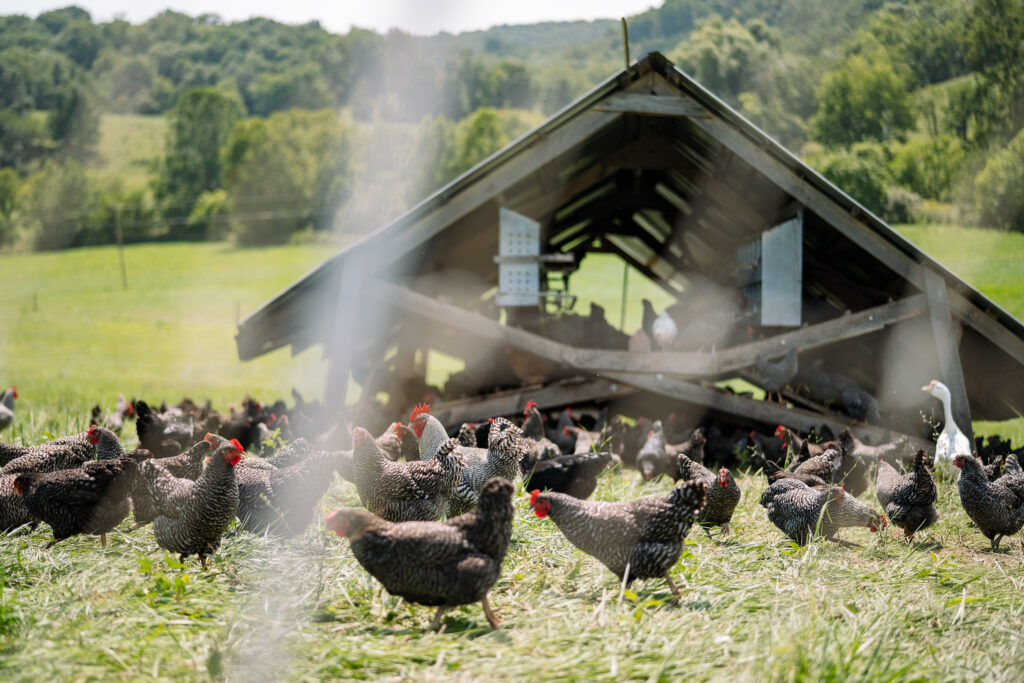
When you decide what you want to sell, chart out its income and expenses on a calendar. What can you do to keep expense and income high at the same time or low at the same time? And what can you do to extend the season? On our farm, we sell both fresh and frozen chicken for the same price. Yes, it costs to freeze them, but having them year-round preserves our customer base and gives us cash flow, even though freezing cuts into our margin a little bit.
Offer a Variety of Products
Offer diversity in your portfolio. Again, the hardest part in marketing is getting the customer. Once you have a loyal addict, she looks around for something else to buy. Your customers buy from you not because you have a fancy label, but because they trust you. It’s all about relationship and emotional satisfaction.
If you’re selling chicken to happy patrons, they probably want bacon or tomatoes or apple juice. The one-stop shop works. People can go to WalMart and get their oil changed, buy diapers, and get their tomatoes all at the same time. You might not sell diapers or change oil, but you can certainly add herbs to your meat, produce, or fruit. The goal is to turn your $50 customer into a $500 customer.
From an efficiency standpoint, having 100 customers spending $1,000 a year is far superior to having 1,000 customers spending $100 a year. That doesn’t mean you have to personally produce all the items in your portfolio. Collaborate with complementary food and fiber-crafters in your area.
The person that makes the sale owns the customer. You could handle half a dozen neighborhood brands, but if you own the retail interface, whether it’s an on-homestead store, roadside stand, or website shopping cart, your customers will perceive you as their provider. You’ll be their contact. That means you get the benefits as well as the complaints. Welcome to retailing.
Offer Value-Added Products at Higher Price Points
As a small business, your financial stability depends on strong enterprise margins—and those margins grow when you move a product further up the retail value chain. A dozen eggs might be worth $7. That same dozen eggs sold as part of a quiche might be worth $14. As soon as you embrace the value-added mindset, a whole host of additional products and income streams open up.
While those of us in the homestead community welcome all comers, we’ll remain a tiny, tiny percentage of the population for the foreseeable future. While all of us would like to think people will see the light and develop a love for domestic culinary arts, the safe bet is that people will continue their addiction to convenience. McDonald’s recently announced plans to build 2,200 additional restaurants in 2025 (600 in the U.S. and 1,600 in foreign countries). Look around; do you see the need for 600 more McDonald’s in the U.S.? Really?
The consumer craving for convenience won’t abate anytime soon. Around our farm, we joke that what our customers really want is Polyface Hot Pockets and Polyface Lunchables. When the local food movement cranked up 30 years ago, I thought surely by now the average American family would be in their kitchen cooking whole foods from scratch. Instead, 75 percent of what Americans consume is ultraprocessed, which means, by definition, you can’t manufacture it in your kitchen.
On our farm, we send pallets of chicken backs and necks to a soup outfit that turns it into stock that we then sell to our customers. In our family, we never buy stock. We cook from scratch and keep the chicken broth and have always had stock. I can’t imagine having to buy chicken stock. But our thousands of customers cook boneless, skinless breasts, which don’t give stock, which then requires folks to buy chicken stock.
Just because you don’t buy something doesn’t mean others don’t or won’t. Walk down the aisles of the supermarket and look at what folks are buying that you never do. Granola. Pie filling. You can pick apples and can pie filling in your kitchen. People will buy it. Ride the value-added train and you’ll suddenly turn small quantities into a big income.
Maximize Profits by Accounting for Turnover
According to the Lean Business model developed in Japan, one of the biggest leaks in a business is inventory. You grow or create something, with all the labor and expense up front, and then it sits. And sits. With food, it can spoil. Then it becomes pig food.
How long does it take to get the product from start to finish? Beef takes a long time. Broiler chickens, eight weeks. That’s turnover. As you think about potential items to market, think about that lag time. Why does Iberico ham cost $150 a pound? Because they cure it in caves or environmentally controlled rooms for more than five years. All that preparation, labor, and infrastructure needs to be captured when it’s finally sold. That’s a long lag time.
If you want to offer orchard fruits, start with something that has a faster turnover, like baby greens or chicken. Build your customer base right away with a quick turnaround item while you’re waiting on your trees or grape vines to mature. If you have to run a sale to clean out inventory, do it. Don’t be too proud to admit your production and marketing are a bit out of sync. Customers love sales.
Discounts are far preferable to outdated inventory. If you have leftover turkeys after Thanksgiving, grind them into ground turkey and sell it to people who prefer turkey lasagna to beef lasagna—those people exist. Finding you is not your customers’ responsibility; it is your responsibility to find your customer.
How many times will a customer buy the item you’re selling in a year? In a month? Navigate your production toward those repeatable items. Lower-priced, frequently purchased items are often called gateway products because they offer a low barrier to entry. For us, it’s eggs. Every business needs something that’s priced right—and wanted enough—to get folks in. Once they’re in, you turn them into addicts.
Don’t ever think you can’t make a living on a small homestead. Plenty of people have done it. The weak link is imagination. Now go do it.




Leave a Reply