
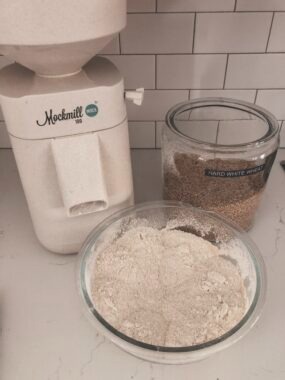
Being born and raised in the South, down-home comfort food has always been on the menu. From garden-fresh corn on the cob and fried green tomatoes to mac and cheese and bacon-wrapped green beans, delicious food has always made life sweeter and brought people together.
Alongside almost every Southern meal is some kind of mouthwatering bread. Most meals have their complimentary bread counterparts: for example, chili and cornbread, roast and rolls, or chicken and biscuits. The list goes on. Southern tables are laced with delectable dishes and an abundance of bread in the breadbaskets.
This type of “heavy carb” meal was commonplace for me growing up. However, as an adult, I have become increasingly aware that bread has received a bad reputation for being unhealthy and loaded with carbs that cause unwanted weight gain. This perspective has brought about many low-carb and no-carb diet fads, along with a growing number of people switching to gluten-free diets. As a result, many skip the breadbasket when it is passed around the dinner table, hoping their waistlines will thank them later.
In my adult life, I began adopting many of these cultural views toward bread, such as the idea that “carbs are bad.” I even tried some of the low-carb diets. But each time I ate this way, I didn’t feel well in my body. No matter the weight loss I may have achieved, I lacked energy, and my gut didn’t feel healthy.
This process led me back to something that had always puzzled me. After all, breadmaking has been an ancient tradition and a food staple throughout history, across all cultures. People have grown, harvested, stored, and ground their grains into delicious and nutritious food for millennia. So what has happened in the last century and a half to turn this fundamental food staple into a pernicious one?
Essentially, everything has changed.
Benefits of Freshly Milled Flour
Historically, people have always ground whole grains using a mortar and pestle, quern, or stone mill powered either by hand, water, wind, or steam. This freshly milled flour included all of the parts of the grain seed and was incredibly nutritious, but not particularly shelf stable. Because the oil from the germ remained in the flour, once it was exposed to the air, the flour began to turn rancid and had to be consumed within a short amount of time. This meant that families needed to visit their local miller often and thus communities formed near the mills.
Then, in the 1870s, the flour milling industry was forever changed when steel roller mills were invented. These new roller mills allowed companies to separate the parts of the grain when it was ground into flour. To understand the great importance this invention had on our health, we need to know about the parts of the grain seed.
There are three main parts to each grain seed:
- Bran: The protective outer layer that is high in fiber and B vitamins.
- Germ: The seed for a new plant and the life force of the grain, the germ contains B vitamins, minerals, protein, healthy oils, fatty acids, and is one of the most abundant food sources of vitamin E.
- Endosperm: The white flour portion of the milled grain that contains starch, protein, and very little vitamins and minerals.
The new roller mills were less expensive to operate and separated the bran and the germ, leaving only the endosperm—the least nutritious, starchy part of the grain. With the bran and germ removed, this long-lasting white flour was fluffier, more shelf-stable, and could be distributed over greater distances to the masses, thereby becoming more profitable.
The new invention was seen as a modern advancement, but it soon became clear that this refined white flour was behind the increase in many diseases. By the 1920s pellagra, anemia, and beriberi were escalating rapidly. Each of these diseases is caused by a deficiency. Pellagra is caused by a niacin (vitamin B3) deficiency, anemia is an iron deficiency, and beriberi is caused by a thiamine (vitamin B1) deficiency. Iron and B vitamins are part of what is sifted and removed from the milled flour to produce the white flour.
In the 1940s, America was facing disease at such high proportions that the government stepped in and mandated that store-bought flour be enriched with iron, along with three B vitamins (thiamine, riboflavin, and niacin).
However, iron, thiamine, riboflavin, and niacin aren’t the only nutrients lost during processing. You might be surprised to learn that 30 nutrients are removed when the bran and germ are stripped from commercially milled flour. Of these, only four are added back, yet we call it “enriched flour.” In reality, that flour is anything but “enriched,” and it’s used in many processed foods that contribute to obesity, diabetes, constipation, and more. By using freshly milled flour, which includes all parts of the grain, you’re adding fiber, vitamins, minerals, and fatty acids back into your diet—and your health will thank you for it.
As homesteaders, we are always working to provide our families with wholesome, fresh, quality food. We grow gardens for vegetables and fruits and preserve the bounty for our pantries. We cook from scratch and love to buy local, organic meat, dairy, and produce. Why would we not prepare and cook our grains as nature intended to reap all of their nutritional benefits in our baked goods?
Types of Whole Grains
When it comes to buying grains to mill, I like to purchase hard wheat and soft wheat grains (also called wheat berries) in bulk, as well as whole oats, and whole dent (or field) corn. I typically buy these in 25- or 50-pound bags. I use hard wheat in almost all of my bread baking including honey wheat bread, sourdough bread, and muffins. Soft wheat is fantastic in softer baked goods like cookies, biscuits, cakes, and pastry dough. I like to keep smaller quantities of spelt, kamut, and einkorn berries for baking. If you’re trying a new grain, I recommend starting with a small quantity and experimenting with a few recipes to see how you like it before buying in bulk.
Whole grains can be purchased from many suppliers including Azure Standard and Amazon. I like to buy mine from Azure Standard because they offer many organic options for the grains I use.
Choosing a Mill
Just like many homesteading skills, having the right equipment is key. When it comes to milling, it’s important to consider several factors before purchasing a mill. Consider how much time you plan to devote to milling and the cost you are willing to invest. There is a milling method for just about every budget. There are even ways to mill your grains without a home mill.
Manual Vs. Electric Mills
The first thing to decide when choosing a flour mill is whether you want a manual or electric mill. This is fairly self-explanatory but does play a role in how much time you are willing to spend milling your flour. Although they can be more tiresome and time-consuming, manual mills are an excellent choice if you are concerned about making flour without electricity. Lehman’s, Grain Maker, and Country Living are all great choices for manual mills.
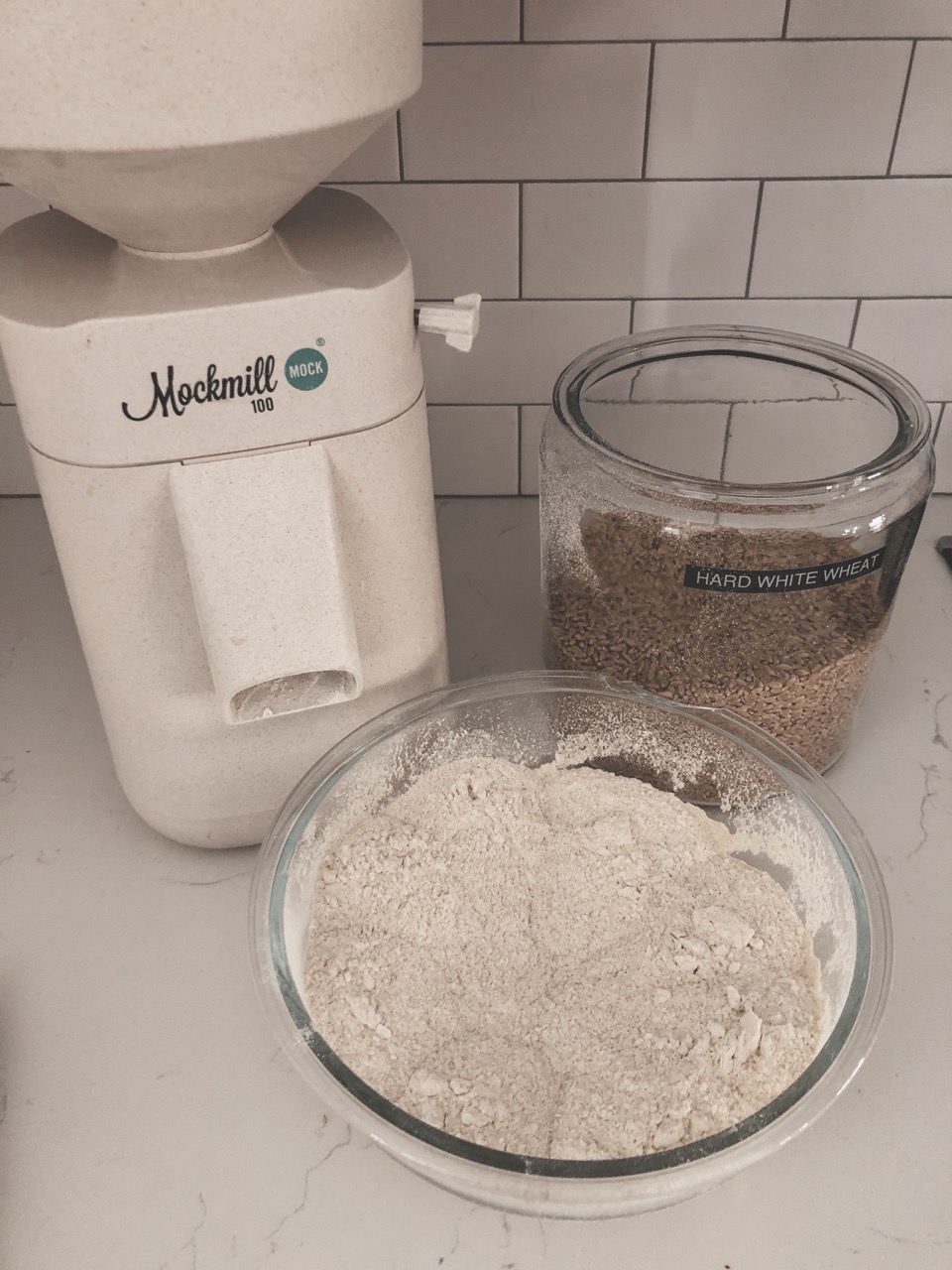
Electric mills require minimal effort and allow the user to continue other kitchen tasks as the grain is efficiently ground into flour. Some popular choices for electric flour mills include Mockmill, Nutrimill, and Wondermill. I personally own the Mockmill 100 and love it!
Impact Vs. Stone Mills
The second thing to decide on is the method of grinding you prefer. Impact mills use stainless-steel blades to fracture and grind the grains. Wondermill and Nutrimill are examples of impact mills. Stone mills use two millstones, one stationary (the stator) and one that rotates (the rotor). Together these stones work to grind the grains into flour. Mockmill is an example of a stone mill.
Baking With Freshly Milled Flour
Baking with freshly milled flour requires a few adjustments to your recipes. First, you’ll need to use less freshly milled flour than you would store-bought flour. Freshly milled flour is also more absorbent, which means you’ll likely need to add extra liquid. As a general rule, you can add up to 1/4 cup of additional liquid per recipe when substituting freshly milled flour for store-bought flour. The exact adjustments will depend on what you’re baking. If your dough feels too sticky, add more flour one tablespoon at a time. If it seems too dry, add more liquid one tablespoon at a time until you reach the desired consistency.
Additionally, freshly milled flour tends to create a tighter crumb texture and may not rise as much during proofing compared to store-bought flour. These subtle differences can add unique character to your baked goods while still delivering delicious results.
Storing Your Grains
Whole grains store for years in five-gallon buckets with gamma lids, making them a great bulk buy to keep as pantry staples. Once milled, unsifted flour should be kept in the freezer in an airtight container or freezer bag for up to two months. Some of the nutrients begin to oxidize within 24 hours after milling, so don’t leave flour at room temperature. Either bake with it the same day or freeze it for later use.
Knowing the amazing health benefits and nutrients of freshly milled grains, I no longer stay away from bread but instead welcome the healthy grains in my diet as nature intended—freshly milled and using all of the seed. Today, I love to cook and eat bread, muffins, cookies, biscuits, and cornbread made with freshly milled grains. What greater gift could I give to my family than nourishing food that brings us all together? Pass the breadbasket, please!
Milling Flour Without A Grain Mill
You don’t have to own a grain mill to have nutritious whole grain flour at home. Here are a few economical alternatives to purchasing a home grain mill.
Coffee Grinder: This is the most affordable option and is easy to use. You can sift out any larger pieces, but overall it gives a beautiful grain on the coarser side.
Food Processor: This works very well for grinding things finely and quickly. It will hold more flour than a typical coffee grinder and is cheaper than a grain mill.
Blender: Many of us already own a blender—like a Ninja or Vitamix—and that is an efficient way to grind your grains into a very fine flour. This option is still cheaper than a grain mill.
Recipes
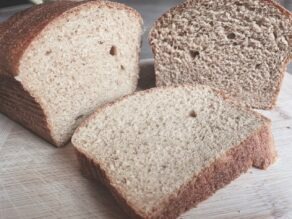
Ingredients
- 4 1/2 cups freshly milled hard wheat flour white or red
- 1 1/2 cups water or use half water, half milk
- 3 tablespoons butter
- 3 tablespoons honey
- 2 teaspoons instant yeast
- 1 egg
- 1 1/2 teaspoons sea salt
Instructions
- Mill about 3 cups of hard wheat berries in your mill. This should give you about 4 1/2 cups of flour. Set aside.
- Add water (and milk if using), butter, and honey to a glass bowl and heat (either in the microwave or over a small pot of water on the stove) until the butter is melted. Add the butter mixture to the bowl of a stand mixer fitted with the dough hook. Sprinkle the yeast on top and let it bloom for 5 minutes. Then add the egg, salt, and freshly milled flour.
- Knead with the dough hook until the dough cleans the bowl while kneading, and passes the windowpane test when pulled gently. If the dough seems too sticky, add more flour one tablespoon at a time. If the dough seems too dry, add more water one tablespoon at a time.
- Let the dough rise in a covered bowl in a warm place until doubled (about one hour).
- Divide the dough in half and roll up to shape into two bread loaves. Place into greased loaf pans and let rise until doubled again.
- Bake at 350ºF (177ºC) for 30-35 minutes. Remove from pans from the oven and allow to cool completely before slicing.
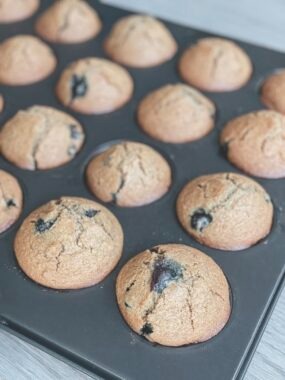
Ingredients
- 2 1/4 cups freshly milled soft white wheat flour (spelt or kamut work great also)
- 1 teaspoon baking powder
- 1 teaspoon baking soda
- 1 teaspoon sea salt
- 1 1/2 teaspoons ground cinnamon
- 1/4 teaspoon ground nutmeg
- 1 egg
- 1/2 cup olive oil
- 1/2 cup honey
- 1 cup buttermilk*
- 1 teaspoon vanilla extract
- 1 cup fresh or frozen blueberries
Instructions
- Mill about 1 2/3 cups of soft white wheat berries in your mill. This should give you about 2 1/2 cups of flour.
- Whisk together the wet ingredients. Then add 2 1/4 cups of flour and stir to combine.
- Scoop into a greased muffin tin and bake at 400°F (204ºC) for about 20 minutes or until golden.





Leave a Reply