
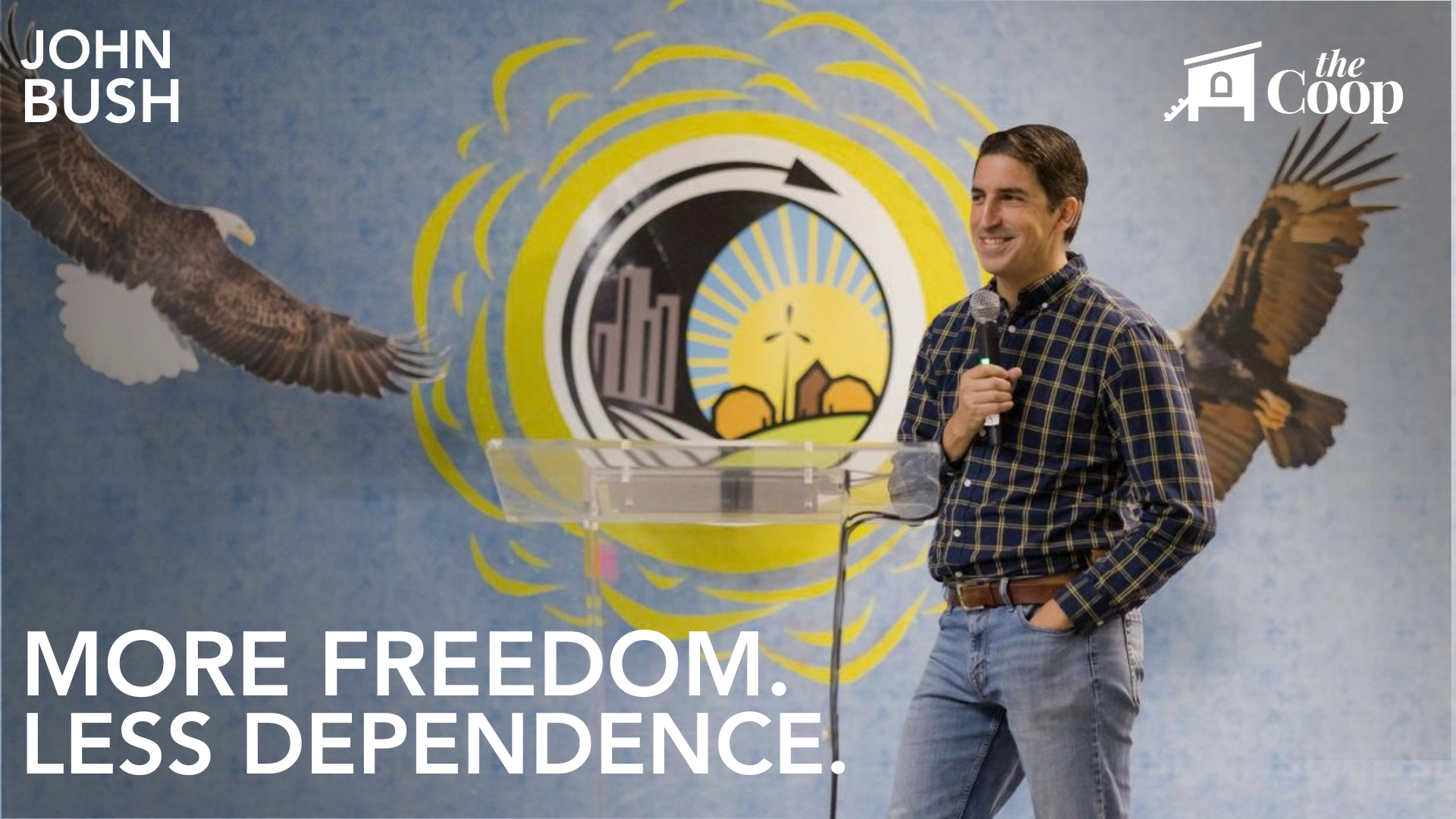



John Bush has spent years teaching people how to move toward greater freedom and autonomy through his work with Live Free Academy and the Exit and Build program.
John’s ‘Exit and Build’ philosophy centers on moving away from systems he describes as centralized, coercive, and corrupt, and building alternatives rooted in decentralization, voluntary participation, and more trust.
In Episode #32 of The Coop, Homestead Living Editor-in-Chief Anna Sakawsky talks with John about what this looks like for people who are already growing food, building local networks, and looking for more independence.
They cover the “inside-outside” approach (taking meaningful steps without having to abandon everything at once) along with land and community, alternative ways of transacting, and the risks of increasingly centralized digital systems.
In this episode, Anna and John discuss:
- What “exiting the system” actually means (and what it doesn’t)
- The inside-outside strategy and why you don’t have to do everything overnight
- Why land and community are closely connected
- Building a counter-economy through precious metals, certain cryptocurrencies, and direct relationships
- How Bitcoin works as a decentralized ledger, and why that matters
- John’s concerns about central bank digital currencies and financial surveillance
- Practical first steps for people already moving toward more self-reliance
If you’ve been looking for a clear conversation about building greater independence, this episode offers a grounded place to start.
Listen or watch the full episode right here:
The show notes …
0:00 – Introduction
6:08 – Exiting the System
10:45 – Building a Decentralized System
17:37 – The Connection Between Land and Community
25:46 – Strategies for Finding Like-Minded Community
30:32 – You Don’t Need Land to Start
35:50 – What is the Counter Economy?
40:49 – Real-World Transacting with Silver and Gold
47:22 – Cryptocurrency Explained for Laymen
56:05 – Where to Learn More & Get Started
John Bush:
Why do you want to escape the system so badly where you’re doing interviews about it and you’ve dedicated your whole life about it? Well, it’s more evident now and it’s not some kooky, weird thing that there’s a small group of people that have amassed a whole lot of power and they are radically transforming government, society, the economy, the food system, the medical system. And that transformation is not something that’s aligned with beauty and love and wonder and freedom and self-determination. It’s aligned with control.
Anna Sakawsky:
If you’re a mom like me, then you probably know what it’s like to spend way too much time worrying about what’s in the everyday cleaners and body products we bring into our homes and use on and around our families. In fact, a few years ago, I completely overhauled our cleaning products and started making my own vinegar cleaner, baking soda, toilet scrub, and homemade laundry detergent. And while those have honestly worked pretty good, I don’t always have time to make my own cleaners. And if I’m being honest, I don’t always want every surface of my home to smell like vinegar. And that is why I love Rustic Strength. Rustic Strength offers a full line of non-toxic laundry, home and body care products, all made in small batches by a family-owned company in Missouri. Their formulas are safe and effective for real, for real, and free from the junk you don’t want in your home, on your body or near your kids.
Clothes come out clean without overpowering scents, surfaces shine without the lingering scent of vinegar or toxic chemicals, and you can sleep soundly knowing that you don’t have to worry about what’s in your cleaners and skincare products. So if you’ve been thinking about making the switch to cleaner, non-toxic home and body products, then consider this your sign. Head over to rusticstrength.com today and see why so many moms have already made the switch. Again, that’s rusticstrength.com. Tell them the coop sent you. Hey everyone, and welcome to episode number 32 of The Coop. I’m your host, Anna Sokowski, editor in chief of Homestead Living Magazine. And today we are talking all about creating a life of freedom and autonomy outside of the traditional system. So it is no secret that the system in its current form is not working for the average person. So whether you believe it’s broken or it’s working exactly as it was designed to work, many people are feeling squeezed by it, left behind, or like the walls of the control grid of technology, surveillance and centralized systems are closing in and leaving them with fewer and fewer choices, which leads to less freedom and autonomy.
And that’s a big reason why so many people are taking up homesteading nowadays and building alternative food systems and communities outside of the traditional system that most people depend on. So we’re going to touch on all of that today, but we’re also going to talk about alternative financial systems and other steps you can take to exit the system that you may not have considered before. So joining me for this conversation is John Bush, founder of the Live Free Academy and creator of the Exit and Build Program and Philosophy. So John has spent the past couple of decades exploring what it looks like to build greater freedom and autonomy outside of traditional institutions and systems. His work brings together several areas that I think will be particularly interesting to homesteaders, so entrepreneurship, alternative economies, cryptocurrency, land ownership, homesteading, and community building. Through his various programs and initiatives, John teaches people how to build businesses, increase their financial independence, acquire land, develop self-reliant communities, and participate in what he calls the counter economy.
He also hosts the Exit and Build Land Summit, which is actually coming up at the beginning of November, so very soon, and has been involved in real estate and community development projects designed to help people put these ideas into practice. At the heart of all of this is what John calls the exit and build strategy. So rather than spending all of our energy trying to change systems that we may have very little control over, what if we focus more of our energy on building alternatives? I think that’s a really interesting question for homesteaders because in many ways that’s already what we’re doing. We’re growing some of our own food. Instead of buying everything at the grocery store, we’re learning skills instead of outsourcing every task. We’re preserving food, raising animals, building businesses, sharing resources with our neighbors and creating a greater degree of self-reliance right where we live.
So today we’re going to take that idea a little further. What would it look like to apply the same mindset to our land, our communities, our livelihoods, and our finances? In a time when it feels like the current systems in place are not working for everyone, more and more people are looking for alternative systems, opportunities, and ways of living and thriving outside the traditional system or at least with one foot outside of it. So that’s exactly what we’re going to talk about today. It’s a conversation I have been very much looking forward to. So with that, welcome John to The Coop.
John Bush:
Hey, thanks for having me. What a great introduction.
Anna Sakawsky:
Well, thanks for being here. I am really pumped for this. I watched a lot of your webinars and YouTube videos and podcast episodes, and I’ve been following you, as I mentioned before, we went on the air for a while, just kind of in my own personal inbox. I’ve been on your email list for a while, so I was really excited when you guys reached out and wanted to do some work with us, which is awesome because you also have an article that’s coming up in our, I think it’s our January, February issue of Homestead Living Magazine. So super pumped because I think there’s a lot of crossover between what you’re doing and what we’re doing here in the homesteading community. I was mentioning this before we got on the air, kind of this Venn diagram of freedom-minded folks and then people that are homesteading for various reasons, but there’s a lot of overlap with this idea that regardless of what’s going on or what we believe is going on, something doesn’t feel right.
We know that it’s not sustainable the way we’re going and we’re looking for alternatives. So obviously I mentioned with the homesteading community, the food system is kind of top of mind. A lot of us are already growing our own food, connecting with local farmers, that sort of stuff, but there’s a lot more that goes into this. And I want to start off with just this question of we talk a lot about the system, exiting the system. I use that term a lot, but when I’ve tried to actually define that or pinpoint exactly what that means, I’ve sometimes found it difficult to put into words. So when we say the system, for example, exiting the system, what exactly are we talking about?
John Bush:
Well, the whole exit and build thing, to make it simple, I like to share that we are trying to exit systems that are centralized, that are coercive and that are corrupt and in turn build new systems that are decentralized, that are voluntary and that are transparent or more trust based. So centralized systems, coercive systems, corrupt systems. Well, I guess it’s the case that the more centralized and coercive a system, the more likely it is to be corrupted. But in large part, we’re talking about the systems of governance. The status quo government as an institution, I think is no longer serving the people.
And there’s been a lot of problems for many, many years now here in the United States. I assume most of your audience is in the US, but it’s the same case for most nation states, unfortunately. And the more centralized, like at the central government, the federal government, there’s a greater tendency towards corruption. And the reason being is because power is further away from the people. And so one of the things that we try to encourage is decentralized systems, whether it’s decentralized food systems, and it doesn’t get much more decentralized than growing food in your own backyard or on your homestead, but also resilient cooperative networks at the local level with the farmer’s markets, the perfect example. Same thing with money. Instead of having the Federal Reserve Bank that issues all the money and they create new money, making all the money worth less, and then they use that money to finance all sorts of programs that people aren’t really asking for.
We use alternative currency systems, whether it’s gold backs, these are like one 1000th of an ounce of gold or silver ounces or even some cryptocurrencies. So the idea is when I talk about the system, in large part, it’s most governmental institutions, even state governments, and it doesn’t really matter what party’s running the show. It’s just like which one’s worse, which one do people prefer? But at the end of the day, neither one of them are serving the people. It’s mainly centralized government systems and then big mega corporations, like big tech and all sorts of these toxic mega corporations. I’m not against business or entrepreneurship or the free market by any means, but there’s this tendency for big government and big business to collaborate together and create this racket cartel-like system that isn’t serving the people. And that’s what we’re trying to escape by taking proactive measures and building new systems.
Anna Sakawsky:
Right. I’ve heard it called the beast system before. I can’t remember where I’ve heard that before, but the imagery that gives me is that it is this just kind of giant conglomerate of all of these big systems working together. So government institutions, the financial system, education systems, food systems, agricultural systems, all those big systems within this giant kind of beast system that just kind of consumes everything in its path. That’s how I picture it. And here we are, all the little people trying to get out of the way almost, trying to escape this. So obviously that’s kind of the idea of the centralized system. You talk about decentralized systems –
John Bush:
Real quick, when I say the beast system, I’m talking about the Book of Revelation and the mark of the beast and the beast, like an evil system that’s being created. And a lot of it has to do with the surveillance nature of it, but sorry to
Anna Sakawsky:
Interrupt. Right. Yeah, no, that’s an important part I think too, is just especially adding that kind of element in and just all of the AI, the tech, the data centers, the flock cameras, the surveillance system. I mean, it’s been in place for a long time behind the scenes, but it’s all really coming to the forefront now as well. And I think that’s why more and more people are feeling almost suffocated by it and are really looking for viable alternatives. So I mean, what does creating a decentralized system then look like in practice? You’ve talked about using some decentralized currencies, growing your own food, that sort of thing. If somebody’s full on in the system and looking to try to escape that, what are some of the first steps they can take to try to build some of those decentralized systems?
John Bush:
Okay. Well, first I like to point out, because I’ve been doing this for a long time and my company, Livefree Academy, that’s all we do all day is help with trainings and online courses and in-person events to help people exit the beast system. And one of the things that comes up, because a lot of folks in our audience are older, they’re established, parents, grandparents, and I’m like 42 and I guess I don’t feel very old, but I’m starting to feel it in my body. But a lot of our clients and folks that are part of our membership programs and such are older than I am and they’ve established a nest egg or they have a mortgage or whatnot. And so when we say exit the system, to be crystal clear, eventually the goal is for enough of us to completely exit the system. We’re no longer participating in the corrupt income tax and all this nonsense.
We’re completely out. And so for a lot of people, they’re like, whoa, well that sounds a little extreme or risky or alarming or maybe I don’t want to exit the system. Maybe you guys haven’t figured out proper solutions for stuff like a social safety net just yet that I feel comfortable with. And so that’s totally fine. The creating a parallel society, a lot of people talk about parallel economies, which is important and we’re all about that. And I want to take it even further for parallel societies. It’s going to take time. It’s going to take generations, arguably. So just to help folks kind of put more of a firm grasp on this, I teach people what I call the inside outside strategy. And so you don’t necessarily have to be completely outside the system, but I do believe it’s incumbent upon anybody that cares about freedom and bodily autonomy and sovereignty that you start taking proactive steps to move outside the system.
Not completely, you don’t have to abandon your 401 you don’t have to decline your social security checks. Or if you’re paying a mortgage, you don’t have to stop paying the mortgage or leave your home. But it is important that people start taking steps to prepare for what’s to come, which we already saw in large part with COVID. So just to throw that out there, you become more resilient and more independent and less vulnerable to this system if you start becoming independent even if in certain areas of your life. Case in point, a lot of people are familiar with the central bank digital currencies. That’s essentially going to be a monetary system that’s entirely digital. It is completely centralized. There’s one party or one authority that controls it. It’s censorable, meaning all the transactions can be censored or stopped. Individual transactions can be stopped. And it’s surveillable, all the transactions are visible and then it’s programmable ultimately.
So think about maybe if your household is determined to have exceeded its monthly carbon allotment in some environmental regime, which a lot of this is going in that direction, now all of a sudden when you go to pump gas or to book a plane ticket, it’s extremely cost prohibitive or you just can’t make that transaction at all. That’s what a central bank digital currency is. And I point out the characteristics of a central bank digital currency because this system isn’t always going to be created or issued by a central bank. Sometimes it’s going to be banks issuing it. Sometimes it’s going to be certain cryptocurrencies that have those characteristics. So if that becomes the entire monetary system and we know that we can’t trust the folks that are in high positions of power, then they’ll really easily be able to manipulate human behavior if everyone’s dependent on this monetary system.
And that’s exactly what the mark of the beast was. Those that don’t have this mark can’t trade is like, I’m paraphrasing of course, but that’s what’s in scripture. And so you don’t have to stop using your credit card or your debit card or your bank account, but you ought to start learning to use alternative decentralized cryptocurrencies that can’t be censored and are private and precious metals and barter and building those tight-knit relationships. So hope that answers your question in a roundabout way, but just to point out that we’re not encouraging, not everybody wants to or can just completely exit the system. Maybe some young folks that are up and coming and don’t have a lot to lose and they’re just getting started can live most of their life outside of the system, but we’re trying to have a nice graceful transition away from the old way of doing things.
Anna Sakawsky:
Yeah. Well, I think that’s a really important thing to note because I think it can feel very overwhelming to think that you have to completely exit the system and go off and live in some commune somewhere, otherwise it’s not worth doing at all. And people get caught in this trap with homesteading in general already.People think they got to go from zero to a hundred and buy the 10 acres and raise all the animals and grow the garden and do all the food preservation, do everything themselves. And that’s when people get burnt out and end up having to kind of backtrack and throw it all away and go back to living in suburbia or whatever. So we’re always encouraging people to just take things slow, one step at a time, do what you can, build your skills as you go, build your community, but you don’t have to do everything overnight.
And that’s what I’m hearing from you as well. So I think it’s a good place to start. Everybody kind of take a breath.
We have some time. Again, and I don’t want to scare anybody, the walls are closing in, but the fact is that this seems to be speeding up. The more time marches on and the more it feels like we have less time, but we do still have time and anything is better. It’s kind of like that whole adage of the best time to plant a tree was 10 years ago, 20 years ago, the second best time is today. Just start where you are and just take the next right step. So I want to talk about the finances. I want to get back to CBDCs and cryptocurrency and all that. But before we do that, I want to touch on something that’s going to be a lot more familiar to our audience as well, and that is the kind of land and community aspect. So through your programs, through your exit and build philosophy, you talk about two key areas, so land and community and then the counter economy, which kind of includes all these crypto and precious metals and transacting and earning outside of the traditional economy.
So let’s start with land and community. So first off, before we get into it, why did you choose to actually lump these two things together? What’s the connection?
John Bush:
And before I answer that, just in case folks aren’t aware or maybe they have doubts, I guess a lot of these things we talk about can seem extreme. Why do you want to escape the system so badly where you’re doing interviews about it and you’ve dedicated your whole life about it? Well, it’s more evident now and it’s not some kooky, weird thing that there’s a small group of people that have amassed a whole lot of power and they are radically transforming government, society, the economy, the food system, the medical system. And that transformation is not something that’s aligned with beauty and love and wonder and freedom and self-determination. It’s aligned with control and it’s being created through technology. And essentially with central bank digital currencies, digital ID, every person’s going to have a digital ID, this unique digital number that gets tracked in this beast system, all human behavior and how you engage with the economy, with your neighbors, with social media, with the computer, with your healthcare, your children’s public education or whatever, it’s all going to be tracked in massive supercomputers.
And now with the advent of artificial intelligence, all that information is going to be able to be put into a useful context for people that want to control other human beings. And that’s where things are going. It’s not some weird conspiracy or something that you see on Rumble or whatnot. This is like the white papers are being released and you got the World Economic Forum talks about the great reset. They call it the fourth industrial revolution, and this is all where things are going. And so that’s why people are really concerned and really motivated to create these alternatives because these alternatives, whether it’s counter economy or land and community we’re going to talk about, they can help you to continue a good life, a good standard of living outside of that matrix. So the land and community piece is important because a lot of these control mechanisms and the surveillance stuff especially are going to be most predominant within the cities.
Cities are already much more surveilled. And then sometimes there’s really aggressive law enforcement programs and the flock cameras, all that stuff. Although flock cameras came here to Bastrop, which is a rural community outside of Austin and Travis County, but we were able to get the city government to turn them off, thankfully. Now there’s some we’re still doing with the sheriff’s department and such. But the point is if this whole smart city agenda is going to be implemented, and a smart city is where there’s mass amounts of surveillance and data being shared about the car driving by, the emissions in the area, there’s audio picked up, there’s video surveillance, and it’s all put into this, again, artificial intelligence supercomputer. And then people have heard of the 15 minute cities, which I think was in Oxford, England or some smaller city in England. And that’s more like a test case.
The idea, if you imagine lockdowns or even climate lockdowns, which World Economic Forums talked about, you won’t be able to leave a certain section of the city. And you think about the flock cameras tracking people’s license plates, that would be a super effective tool to make sure people aren’t leaving a lockdown area unless they’re an essential worker. And we already experienced all that not too long ago. It’s such a trip. Anyway, because the cities are more easily, you’re more easily controlled when you’re in a city, plus the quality of life. It’s great as far as good restaurants and entertainment, but it’s not how I want to live all on top of each other sitting in traffic. So that’s why it’s like the idea is you exit the city and build community in the country. And that can look like simply living in a small town.
I just sold a 10 acre homestead not too long ago. So I had the whole 10 acre homestead and we only used about an acre or so, right? We had chickens, ducks, food forests, all sorts of cool stuff going on. But now I live in the small town neighboring by, right? So it’s not the same as having a giant homestead, but it’s still smaller, closer, the farmer’s market down the road I visit regularly. But the idea is get out of the city, ideally get yourself onto some land, start growing your own food, connect with local farmers. And then the community piece is a lot of people are interested in intentional communities, which is something that I’ve been a part of that movement for a while. We had an intentional community. It’s not an easy thing to do, I should say, from experience. But living in community, whether you’re living on a piece of land that you acquire cooperatively and y’all live there together, or you’re deeply connected with your neighbors or with other freedom-minded or homesteading folks in the area, the idea is that we can’t do it alone.
There’s strength in numbers. And for anybody that’s done homesteading, like homesteading, homesteading, it’s a lot of work and there’s a lot of areas where we don’t have the expertise. So connect with the neighbor, connect with the lady down the street that’s been canning for 30 years and she’ll come teach you and y’all could can together. And let’s say you’re raising chickens and you’re ready to cull the herd a bit and butcher some of the meat birds. Well, that takes a lot of effort and a lot of work. Why not have a little shindig and y’all butcher the chickens together, then share a potluck dinner or whatnot? So there’s strength in numbers. And I think with the land comes community, land and community. That’s one of the pieces. The community piece applies to every single thing that we do, by the way. But when we’re talking about land and community, we’re talking specifically about building an intentional community where you live cooperatively, or at the very least, connecting with local like-minded people so y’all can form deep relationships.
Anna Sakawsky:
Yeah. Well, and it’s interesting because I think it’s really important actually to tie those two things together because I see people sometimes make the mistake of just purchasing the land, right? That’s the only thing they’re looking at, not considering the community that’s around that land or how they’re going to connect with certain people or what that looks like. When my husband and I, so we live on Vancouver Island, we live in a place called the Comox Valley and we chose this area, moved out of Vancouver just over 10 years ago, I guess now. But one of the big reasons was because of the agricultural community here and there’s a lot of local food producers, local farmers, and people that are very passionate about sovereign food systems and maintaining that kind of local agriculture here. So that was one of the big things that drew us.
It wasn’t so much the land. We knew that the land existed out here, but we were looking first and foremost. There was lots of places we could have gone to find the land, but we were looking at what’s the community like and where do we want to actually build a life? So I just think it’s an important thing to note because it is obviously an important aspect and we talk a lot about community here, building community, connecting with your neighbors, getting to know your local farmers, bartering a little bit, all that stuff. But I also know from experience and from hearing from other people, in practice, and you even said building an intentional community can be really difficult, especially nowadays, people are more disconnected than ever. What strategies do you have for actually finding and building that community, especially with like-minded people? Because I think that’s the other component here is it’s one thing to connect with people, but we can still sometimes feel lonely in a crowd if we feel like we just aren’t on the same page or don’t have the same values.
So how have you gone about actually finding and building some of that community?
John Bush:
Okay. Well, I was blessed, I guess. I’ve been an activist for 24 years now, so I’ve always just been around like-minded people. I never really had the challenge of feeling like you’re alone and isolated because you think a certain way. But our event that we do every year, it’s called Exit and Build. The next one’s November 5th through 8th at Molly Inglehart Sovereignty Ranch was like this 200 plus acre regenerative ranch. And she’s got a restaurant on site that accepts gold backs and cryptocurrency, which is pretty cool. But every year we do this event, we do this community matchmaking networking thing where we try to connect people based on interest. So like the homesteaders and the families and the folks that are more into technology and faith-based community will split up into groups and people can go connect and network and mingle. And then we do it based on geographic regions.
So Texas and Mexico and the Canadians and the folks in the Northeast and the Midwest, and that’s always a big hit. But I just encourage people to go out and talk and connect. I’m going to turn my AC on. It’s getting hot. Ryan’s here helping me out. Ryan.
Anna Sakawsky:
Hi Ryan. Hey.
John Bush:
He’s fine. I just encourage folks, a lot of people, especially if they’re more freedom oriented or they’re a skeptic or critical thinker, they feel isolated and alone and feel kind of weird. COVID really showed this. There was a lot of people were pitted against one another and family member against family member, which is really sad. So they feel like, oh, there’s not many people in my area that think like I do or that question things like I do. And I would encourage people to put themselves out there and you’ll find that there’s a lot of people nowadays that are really thinking outside the box and that really care deeply about freedom and see through a lot of the lies that are being shared on mainstream media. So get out from behind the computer, get out into the community and put yourself in areas where there’s a higher likelihood to run into somebody that cares about freedom or things like we do.
So obviously farmer’s market and talking to the farmers, of course. For example, we encourage people. I’m a really big fan. We’ll talk about alternative currencies I assume soon, but I’m a big fan of trading outside the system using precious metals. And then a permaculture principle is function stacking, right? So going to a farmer’s market with silver coins in your pocket and then talking to the farmer’s market vendors about selling you their food for precious metals is like it checks all these boxes. So you’re building a relationship with your local farmer, you’re finding places to purchase needed things using an alternative currency, and then you’re putting yourself out there, building confidence, striking up a conversation with someone that you don’t know. But farmer’s market vendors are great. Homeschooling meetups, protests, not a big fan of protesting, but if it’s a protest that is aligned with your views, you can meet people there, gun shows, that kind of stuff.
And just try to be more personable. Oftentimes we’re nervous or anxious or don’t feel comfortable, but growth comes in a state of discomfort often. And I mean, there’s not much more important than having a network of people. Even if you have land and you’re homesteading, but you don’t know anybody and then crap hits the fan, I would rather not have land and have a tight-knit community of a dozen or more people that are going to get my back or we can go hunker down at your place or we’re just going to check in on each other than being all alone and isolate And regardless, it’s hard to run a pretty serious homestead all by yourself. You still need other people to do that. So yeah, I would just encourage people to put themselves out there. Don’t worry about feeling awkward or weird or having social anxiety.
We’re all a bit weird, especially homesteaders. Do
Anna Sakawsky:
You want to be a weirder as you get older? We were just talking about that. I think I saw a reel or something that was like, I thought I would get less awkward if I had alternates just going the other way.
John Bush:
Nice.
Anna Sakawsky:
That’s a universal feeling. And I like this idea of almost prioritizing the community over land because there’s also people that maybe can’t leave the city or that don’t want to for some reason or can’t afford the property. There’s a million reasons why people will go, “Oh, see, right off the bat, I can’t do that.” And this we often again hear in the homestead community, “I wish I could, but I can’t afford the 10 acres. Or when I get there, then I’ll start.” I’m always like, no, no, no, there’s stuff you can do even where you are. And I would imagine that this community element, you can start wherever you are, even if it’s in the city, even though… Well, I mean, in some ways it can be easier because there’s more people around. Of course, we tend to know our neighbors a little bit less.
All that stuff tends to go hand in hand with living in the cities. But I would assume that you would tell people don’t worry if you’re not in a position to take that first step, get out of the city right now or get the piece of land that you want or whatever, you can still start implementing some of these processes and finding the community where you are, right?
John Bush:
Without a doubt. Yeah. I think oftentimes people just make excuses. It’s a thing and I’m not completely immune from it either, but things that seem daunting or overwhelming or we feel like we don’t quite have the skillset to do so, we feel uncomfortable about it, it’s just easier to make an excuse. I can’t afford the land and I’m tied to the city because of this reason. In all reality, we just feel a little bit nervous about trying or we don’t want to let ourselves down by making a goal to put the down payment money together in the next year or two and then we come up short because we’ve come up short in the past and we don’t want to come up short again because it doesn’t feel good internally. But at the end of the day, anybody, no matter where they live, everybody, no matter where they live, ought to be taking some steps towards greater food resiliency or towards building connections with neighbors.
It’s of the utmost importance. So it doesn’t have to be buy the 10 acre homestead, but if you really want a 10 acre homestead, it’s completely attainable. There’s this great Robert Kiyosaki quote. It’s a classic and he says, “Don’t say I can’t afford it. Say, how can I afford it?” And it’s just a mindset reframing that just radically transforms how you go about life and greatly increases the likelihood of actually achieving what it is that you want.
And everyone’s already thinking like, “Well, not me. I’m older and I got this issue and I have bad credit and I’m barely making ends meet now.” It’s like people would really surprise themselves if they started cultivating more confidence and belief in themselves and more faith. But yeah, to answer your question, yes, no matter where you are, take baby steps to meet people, take baby steps to grow your own food. I mean, they even have these container gardens you could put on the back porch. It’s not aligned with permaculture or good soil practices and it’s dependent on inputs, but there’s something called a tower garden. I think it’s an MLM actually where it’s like this vertical tower. You can grow tomatoes and greens and all sorts of stuff and it even has lights. So even if you’re living in an apartment, you could put one of those in the closet, the balcony, whatever it may be.
It’s important too because if you do have ambitions to actually get land or at the very least get a decent sized backyard in a single family home, residence and neighborhood, then you’re going to want to start learning to grow the food. It’s not the easiest thing to take something from seed to fruit, especially certain vegetables. I still was never able to grow an ear of corn.
I don’t know if it needed to get pollinated or what the deal is. I could grow okra and tomato with the best of them, tomatoes and kale grows pretty dang good here in central Texas, but I was never able to grow ear corn. So my point is even if you’re just growing some small cherry tomatoes on the back porch, it builds confidence. You get to be aware of the seasons, you get to be aware of the dang caterpillars and how much work actually goes into keeping critters off of your plants. And then when you get the backyard, you’re like, “Okay, well let’s try that just on a bigger scale.” And then when you move up to the homestead, you’ve already learned what works, what doesn’t, what happens when the leaves are getting a little yellow, what does that mean? There’s quite a learning curve and experience is the greatest teacher.
Anna Sakawsky:
Yeah, absolutely. And I always think of the people that are like, “Well, I’ve got a bunch of seeds, I got my survival seeds, so if it hits the fan, then I’ll start gardening.” I’m like, “You need to start cultivating the skills.” It’s funny, I’m actually giving a presentation next week on scalable homesteading and why it’s important to kind of start small and do each of these steps so that you don’t either dive in to everything at once and burn out or you don’t feel stuck where you are. You can’t do anything until you take it to the next level. And actually our last guest on the podcast, we also talked about this idea of building the arc before you need it. So starting to learn some of those skills and implement some of these things again before you do find yourself either in a position where you can or a position where you have to, right?
So I think this is all very relevant to our listeners, homesetters. We know a lot of stuff already. Something that they might not be as familiar with is this idea of the counter economy. So let’s dive into that, unpack a little bit. So what exactly does this mean, the counter economy? What does it entail? This episode is brought to you by Azure Standard. Family owned since the 1970s, Azure Standard is on a mission to make real food more accessible by delivering it straight to your doorstep or to a convenient local drop point near you. Everything they offer is completely organic, non – GMO, and free from junk additives you don’t want in your home or in your body. With more than 13,000 carefully vetted products, Azure Standard makes it easy to stock up on what really matters from bulk grains, nuts, and healthy oils to fruits and vegetables, frozen meats, pantry staples, and even clean household goods.
And the best part is you skip the grocery store markup. You can order exactly what your family actually needs, save big on high quality food and pick it up alongside neighbors who care about the same things you do, health, sustainability, and supporting ethical producers. You can head to azurestandard.com right now to get started. Again, that’s azurestandard.com.
John Bush:
Okay. Well, it’s also known as the parallel economy. Counter economy specifically was this term coined by a guy named Samuel Edward Conkin. He came up with this strategy called agorism and the idea is how do we achieve a free society? And in order to achieve a free society, we need to consistently apply the philosophy of liberty to every aspect of our lives. And the idea is we live freedom. We don’t contribute or participate in systems that are antithetical to our personal liberty and freedom. And the counter economy has to do with economic trade and market forces that are counter to the establishment economy, just the mainstream centralized, I like to call it the financial control grid, but the counter economies are transactions, trades, markets, business, currencies that run counter to that. It can also be known as the parallel economy. So you got the mainstream economy, banks, credit cards, fiat money that’s inflated, surveillance money, that’s the mainstream economy, the financial control grid as I call it.
Then you have the parallel economy, that’s freedom oriented people trading and doing business with one another and transacting with alternative currencies that’s outside of this or in parallel. And like I said before, you can still have one foot in this door, but you got to start tiptoeing in this door because in this side, yeah, one foot in the door, one foot outside. Because again, the CBDC thing is coming and I really hope a lot of people don’t trust government nowadays. After COVID, it just seems so evident that we can’t trust government and we can’t trust government even if our guy’s in power or the guy that’s saying all the right things in the election. It’s just like a cycle that happens over and over and over and over. And I’m just really hoping people snap out of it and can see through it now. Even if somebody does some things right or even if the other group of people is just so objectionable and they just are so antithetical to what we believe in, just understand there’s this game that gets played where, well, these guys are so bad, then we got to put these bums in even though they’re bad, but they’re not as bad as these people.
And that just results in more and more bad. And all the while, the pendulum swinging from the left to the right, but it’s not just swinging left to right. It’s swinging left to right and it’s advancing towards more authoritarianism and more surveillance and more control. So just to throw that out there, but yeah, that’s what the counter economy is, is the economy that is counter to the mainstream economy, also known as the parallel economy. And essentially it’s trading with other freedom people using alternative currencies. And I like cryptocurrencies. I think decentralized, especially privacy-based cryptocurrencies are the best way that we can do business together online outside of their control, but also in person. But then I’m also a big fan of using precious metals and real money like junk silver. So in the US, dimes, quarters, half dollars, 1964 and older used to be comprised of the 90% silver.
So I think this is actually just quarters and dimes. This is just a quarter and a dime, but they look basically the same. Usually I have some on my desk here. Actually, maybe.
Anna Sakawsky:
I’m interested because you did a bit of an experiment with this, haven’t you? You’ve experimented with actually transacting with silver coins, pre – 1965 silver coins. How does that go with the… Like you’re talking about maybe going to a farmer’s market and striking up a conversation, see if you can transact in that way. How realistic is that, especially given the fact that maybe not everybody out there understands the value of a silver dollar versus a regular dollar. You go up to people on streets and like, “Would you rather have this gold coin or a chocolate bar?” We have them choose the chocolate bar. People just don’t even understand the value. They just see a coin, it’s a coin, it’s a coin, whatever the face value is, right? Yeah. And it’s just not something that we’re used to transacting with. There may be because people don’t understand it, they might not trust it, whatever it is.
How realistic is it in the real world to go out with a silver coin and try to actually transact in that way?
John Bush:
Well, at a farmer’s market, it’s actually easier than you might think. And again, it’s going to take work to build this parallel economy. And I should say the parallel economy is not going to build itself. So what I shared earlier about the way the world is going, it’s becoming more and more centralized, more digital, more surveillable. And I personally do not trust those that are in power and I think that they’re going to leverage this system to control people. If you agree with that, then the parallel economy is not going to build itself. It’s up to each and every one of us to do our part to start building those relationships. So it’s not like you’re going to go to the farmer’s market and everybody’s going to be gung-ho about it, but you’d be surprised. I would say, let’s do an estimate. I would probably say 20 to 30% of the people you talk to, maybe 15, we’ll say 15 to 30% of the people you talk to will be willing to accept precious metals and a smaller chunk, but a chunk would be willing to accept Bitcoin or Monero, for example.
So it takes a conversation and takes educating people. And no too, back to the function stacking, if somebody’s willing to accept alternative currencies, they’re probably more of a critical thinker and then you build a relationship with them. So recently, maybe it was about three weeks ago, went to the farmer’s market. The very first person I walked up to, and there was only two people that were selling meat and I wanted to buy some meat. So I looked around, checked it out, found some things that I would like to buy and I just said, “Hey, I’d like to buy some meat from you. Are you willing to accept some silver coins?” And he said, “Of course. Why not?” And then he said, “In fact, I trust somebody that likes to use silver more than folks that don’t know what it’s all about.” And then he said, “In fact, I’ll take Bitcoin.” And so I was like, “Oh, well, that’s great.” So a solid guy, he’s now somebody that I have a relationship with, although he’s pushing back on me because I’ve been helping to push back on this data center effort and really throwing a lot of negativity towards one of the politicians that was supporting it, the data center thing.
And then he’s kind of trying to stand up for this politician, but he doesn’t realize almost all my energy is just… Let’s get this guy unelected so the other politicians see that we shouldn’t support data centers in Bastrop County. And so he’s having trouble making sense of why I’m being so hardheaded with this guy. Anyway, my point is just besides that little quibble of ours, he’s somebody that’s in my network now, right? So it has multiple functions. But yes, to answer your question, it’s not just everybody’s like, “Oh sure, of course silver. I completely understand it.” And again, the purpose is to go ahead and build relationships where we can buy things that we need in life, anticipating that more than likely in a matter of maybe three to five years or so, the monetary system is going to be even more digital and more controllable than it is now.
It’s already extremely controllable, by the way. I’ve been shut out of PayPal, two PayPal accounts for two businesses, Cash App, Square, credit card terminals. I used to have a natural products business and we would sell Kratom and CBD, both of which were completely legal, but I got decommissioned from all those platforms. And then my bank kicked me out for selling CBD. So that’s the legacy financial system, which is already censorable and people get debanked. And so who knows how things go in the future with more debanking and political reasons and we don’t like you for this or that, or you said this online or you are using too much carbon or whatever. That’s where things are going.
Anna Sakawsky:
Up here, we had the trucker convoy a few years ago, which is when I kind of was like, “Whoa, whoa, whoa, what’s going on?” Because that’s when a bunch of people that were either involved in that or even who just donated, some people a small donation is like $20 were finding themselves with their bank accounts frozen. And again, if you have all your eggs in that one basket, your paycheck’s going in there, everything, all of your transacting happening from that account and you need to pay your rent or your mortgage and your groceries and if you don’t have some sort of an alternative, and I think this is what you’re talking about too, is it doesn’t have to be move all your eggs to another basket and that probably isn’t the wise thing to do anyway. We’re always here about diversifying, just making sure that you have a backup here and maybe you got the precious metals and you got some crypto and you got this bank account and you have this income stream and it’s just more so about spreading those eggs out so that if something fails for whatever reason, I mean, I’ve even heard of on mainstream news talking about people that have been de-banked for no good reason.
They’re just an error or a miscommunication about their account and it causes massive issues. And I mean, just the idea of everything being digital already, not even central CBDCs and that sort of thing, but just everything already being digitized. You could have your accounts hacked or the grid goes down or whatever and all of a sudden you can’t access that, right? So I think it’s important obviously to diversify. And on that note, I do want to talk a bit about crypto because it’s an area that I’m interested in. I wish I understood it more. I admit that I don’t. I have some precious metals because I at least understand that. It’s like something tangible I can hold my hand, but there’s so much mystery around cryptocurrency for me. So can you kind of break it down for laymen like me, somebody that’s writed in crayon for me?
How does cryptocurrency work? What makes it decentralized and not as easily able to be controlled basically by a central government or something like that?
John Bush:
Okay. So the first cryptocurrency was Bitcoin and it was created in 2008 and launched in 2009. And we don’t know who invented it and created the program that runs it. Well, this
Anna Sakawsky:
Just wilds me right off the bat. I’m like, how do we not?
John Bush:
It’s a trip and it’s a great mystery and it’s kind of cool and exciting. Their name or their pseudonym was Satoshi Nakamoto. Could be multiple people, could be a man, could be a woman. I think it’s a collection of this group called the Cypherpunks. They were folks when the internet came out, they were really into privacy and encryption and many of the people that are part of this movement called Cypherpunks were experimenting with uncontrollable internet money. And they had all these experiments that didn’t work out. And I think that Bitcoin was the culmination of some of those experiments and it did work out. But a good way to describe Bitcoin, I like to share this story. So maybe three or four years ago, three years ago or so, I was shopping for a new office. I wanted to upgrade the office I was in. And I always had this vision of having an office in downtown Bastrop, which is where I live.
And so I was looking at spots in the downtown, small Texas downtown. And there was this bank, I think it was called First National Bank or Chase National Bank, not Chase Bank, Chase National Bank. And it was for rent and it’s a historic building. I think the bank was probably founded or that bank building, it was a bank in the late 1800s. And because it’s a historic site, anybody that rented the office or used it later on, everything’s got to stay the same, including all the teller furniture and the windows and stuff. So I went in there to tour it and it was super cool and there was a big vault and stuff. And I didn’t think it would work for my office because we would have to keep all the furniture there that was already there secure to the ground. Anyway, long story short, too late, there was a whole shelf with ledgers, big giant books that contained the recording of the transactions for different accounts.
And there was one of them that was open there, big giant ledger written in pen and it had somebody’s name and account number and then it had debits and credits and a long list of debits and credits and then the account balance. And so that is a centralized institution, the bank, maintaining the ledger on behalf of the users. And the monetary system we have now essentially is like a user, a customer goes to a bank, they put their money in the bank. And I don’t know if anybody’s ever tried to withdraw a substantial amount of cash, 5,000, $10,000. Last time I had sold my house and wanted to withdraw, it was like 12 grand. And they said they couldn’t do it. They didn’t have the money and they asked all these questions and they were able to give me 5K, but I had to come back later and they had to order the money and all sorts of nonsense.
So it’s not actually your money when it’s in a bank, by the way. Legally, you hand over rights to that money, but you have to trust this third party and then the banks, they send money back and forth to one another through the Federal Reserve. And so that’s a centralized bank we have to trust to maintain that ledger. And then we have to trust the Federal Reserve to maintain the money supply. And of course they’re printing money left and right, devaluing that money. So the difference between that system, which we’re all accustomed to, which is centralized and Bitcoin is that the ledger for Bitcoin, that is the mechanism for recording who has what Bitcoin, how much Bitcoin they have and who they sent the Bitcoin to and now how much that person has, the accounting system, that system is decentralized and distributed on tens of thousands of computers all across the globe.
So instead of a bank having a paper ledger that we got to trust, they’re maintaining everything accurately a hundred plus years ago, or instead of Visa or Wells Fargo maintaining a ledger in some centralized server system and we got to trust them, we don’t have to trust one institution because everybody is maintaining an account of who has what Bitcoin, who sent what Bitcoin to whom, and it’s getting updated at the same time all across the globe. So that’s in one way to explain it. And then I don’t know, is that sufficient? It’s essentially, it’s a way to hold money as an individual. I have a Bitcoin address, that’s just a long string of letters and numbers. That Bitcoin address is housed in my Bitcoin wallet, which is like an app on your phone or a piece of software on your computer. And that piece of software creates public addresses, kind of like your account number, but you can create an endless number of addresses.
And each public address has a private key. That private key is like a secret code that can unlock access to send Bitcoin out of that address. And only you have that private key. So no one else can send crypto or stop you from sending crypto out of your wallet. Only you have that private key in a non-custodial wallet. So essentially, if you wanted to send me Bitcoin, I would give you my address. So I could message it to you right now in the little chat thing on StreamYard, or I could send it to you via email and then you would go in your wallet, you would take my address, you would paste it into the send field, you would say, “I want to send John a 10th of a Bitcoin, which is like eight grand. Thank you very much.” And then you would click send.
Now, that transaction is going to come and show up in my wallet almost immediately. And then in approximately 10 minutes, that transaction will get added to a block on the blockchain. I was talking about the ledger earlier, that ledger is also known as the blockchain. It’s a chain of blocks. It’s all digital. Each block contains a record of the transactions that just took place. Then through this decentralized system, it’s computer software and programs and everybody that participates all agrees that we’re going to follow these rules and it’s all open source. So if anybody tries to cheat on the network and say that they actually have more Bitcoin than they should have or whatever, all the other ledgers are like, “That’s not what we have on our accounting.” So we’re not even going to include that. And you can’t even really send it. That’s moot. And so because it’s decentralized, because everybody agrees to follow the same rules and because everyone updates this network with the updated transactions of who sent what to whom at the same time, you essentially don’t have to trust the bank or the government to maintain it.
It’s maintained in a decentralized way.
Anna Sakawsky:
And it sent right from one wallet to the other without actually going through an institution or a middleman. Is that correct?
John Bush:
You don’t have a third party that has to verify the transaction or that has to approve the transaction or anything. It goes through the network. So there’s nobody that can stop it and it’s global. It’s not tied to the US or to the UK or China. So even if one government were to ban it, then it still can be used. Even if a government bans it, you could still connect through a VPN and use encrypted communication. So it’s just really revolutionary. For the first time in history, we have the ability to send and receive money without any third party being able to stop us. And it’s a really big deal. How was that explanation? Because I’ve been teaching people crypto
Anna Sakawsky:
For years. I mean, really, I still have questions. We could talk honestly all day about it because there’s so many avenues we could go down, but it does make sense. Yeah. We won’t go too far down the rabbit hole because again, I know you kind of have a hard stop. I’d love to have you back to talk a little bit more about this. I know you’re writing an article a little bit about this as well. If somebody is interested in getting started with this, where’s a good place to start? If they’re like, “Okay, I’m interested. I have some idea of how it works. I want to actually learn more, maybe start trading in cryptocurrency.” Where is a good place for them to begin?
John Bush:
We’re routinely doing free webinars and all sorts of content. I would just encourage people to join our daily email newsletter, livefree.academy/newsletter. So at any given time we’re talking about or teaching people any of the things that we’ve talked about today. I think we’ve covered most of what I teach today, just little tidbits of stuff. So that’s livefree.academy/newsletter. It’s a daily email, so you’ll get one email every day telling a story, a tip, something about what happened in the news. And we always relate it back to solutions and exit and build strategy. We do a whole lot of free webinars and free summits and stuff. Or better yet, you could come to one of our in-person events and someone will sit down with you and help you set up a crypto wallet, maybe even sell you some crypto that you can then turn around and buy some food with at Molly’s Bar and Restaurant.
Anna Sakawsky:
Well, that’s perfect. All right. So I mean, again, I have so many more questions. There’s so many more avenues I’d love to go down. I’d love to have you back to talk about this more. I’m looking forward to reading your article coming out in the January, February issue about this kind of idea of creating the counter economy and alternative financial options to kind of escape this centralized system. So looking forward to that. But in the meantime, if you want to check out John’s work, as he said, you can head to livefreeacademy.com and then also the Exit and Build Land Summit coming up on November 5th through 8th. Is that right?
John Bush:
Yeah. And it’s livefree.academy.
Anna Sakawsky:
Oh, sorry. Livefree.
John Bush:
I wish I had livefreeacademy.com. I don’t know who has that one. Livefree.academy and then the email newsletters, livefree.academy/newsletter. And then yeah, our big annual event is November 5th through the 8th. We’ll have Joel Scouts in there, Curtis Stone, David Avocado Wolf, and a whole slew of really cool people that are living this lifestyle.
Anna Sakawsky:
That’s awesome. Yeah, I recognize some of those names for sure. And we mentioned before we hopped on that you’ve done some work with Joel Salatin as well. Joel’s one of our regular contributors and we’ve had him on the show before.
John Bush:
Wearing his hat. Oh, he
Anna Sakawsky:
Is a Poly Face Farms hut. Nice. Yeah. I know you guys did an event at Poly Face Farms and he’s been a keynote speaker before. So again, I just think there’s a lot of overlap obviously between this idea of the freedom community and the homesteading community. And again, we don’t all have to necessarily agree on what’s going on or why it’s going on or where we’re exactly headed. And maybe none of us really know for sure or don’t know exactly when we’re going to get there or how it’s all going to be implemented. But again, I think most of us can agree that we’re kind of living this lifestyle, at least in part, because the current system is not working. Again, whether we feel like it’s broken or it’s kind of designed this way, people are looking for alternatives and a lot of people are starting to kind of step outside of it by growing their own food.
And that’s a good first step and I think that’s awesome. And I love this idea of taking it a little bit further, definitely building the community and then looking at alternative currencies and stuff too, because I do agree with you. I think that’s kind of where we’re headed is we got to start thinking about how, if the walls kind of close in and we can’t transact in the way that we have been, that we’re used to have in the past, what are the alternatives? And again, the idea of start building the arc now before you need it, start maybe getting invested in some precious metals, physical, tangible stuff that you can hold, and then as well for digital currencies, cryptocurrency for sure. So would love to have you back to talk more about that. So many questions about cryptocurrency, but I think that you’ve given people a great place to start.
So thank you so much for being here. Real appreciate kind of Just the way that you’ve taken this idea of self-reliance and just expanded it beyond the garden and the pantry and the homestead to include things like our finances, business communities and all that. So thanks for being here and for all the work that you’re doing to help people think through what exiting the system can actually look like in practice.
John Bush:
Cool. Thanks for having me. Well,
Anna Sakawsky:
I hope this conversation has given you some things to think about and more importantly, some practical ideas that you can begin putting into action right where you are. So if you enjoyed this episode and found it insightful, please consider leaving a review or a comment wherever you’re watching or listening. And if you know someone else who could benefit from this conversation, please forward it along because the more people we can reach and help with this kind of information, the better. Thanks again for joining me and I’ll see you all back here next time on The Coup. Before we wrap up today, I just want to thank you, our listeners, for being a part of this community. If you’ve been listening for a while and haven’t yet joined us as a subscriber, this is your sign to start your subscription to Homestead Living Magazine. A Homestead Living subscription includes six beautifully printed issues each year, and they’re designed to be kept, dog eared, bookmarked, pulled off your shelf and referred back to you again and again.
Every issue is filled with practical skills, seasonal guidance, and trusted voices who’ve put in the hours and learned the hard way so that you don’t have to. Right now, a full year, all six issues is just $49, and it is one of the best ways to support the work that we do here while building a home library that you’ll return to again and again. As the editor, I may be a little bit biased, but if you value thoughtful, authentic, grounded guidance from people who don’t just talk the homesteading talk, but actually walk the homesteading walk, then this magazine was made for you. So you can start your subscription now by heading to homesteadliving.com/subscribe or click the link in the show notes.
Resources/Links
- John’s Newsletter
- The Exit and Build Summit
- Download Episode Audio File
- Subscribe to Homestead Living Magazine
Brought to you by
This Episode of The Coop is brought to you by Rustic Strength
Family-owned in the Ozarks, Rustic Strength creates powerfully clean laundry, home, and body care products using high-purity, toxin-free ingredients …
This Episode of The Coop is brought to you by Azure Standard
Our friends at Azure Standard have been quietly setting the standard for clean, wholesome food since the 1970s. Real food. Honest prices. No junk. Just good choices made easier for families who care about what they eat.
Learn more: https://www.azurestandard.com
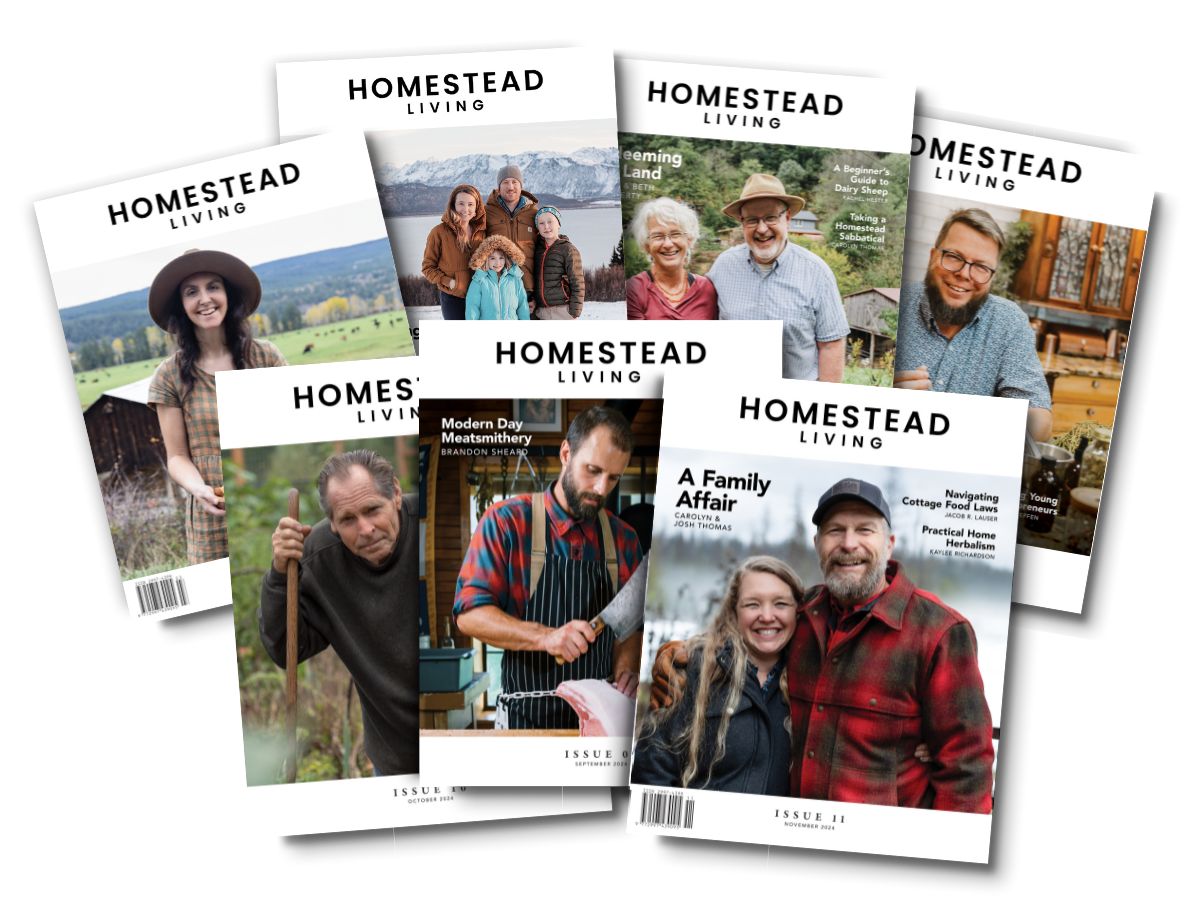
This Episode of The Coop is brought to you by Homestead Living Magazine
Homestead Living magazine sets the standard for inspiring wisdom-filled homesteading content: actionable tips for organic growing, food preservation, delicious recipes, and uplifting true stories that feed body and soul.
Learn more: https://homesteadliving.com/homestead-living-magazine


Leave a Reply