
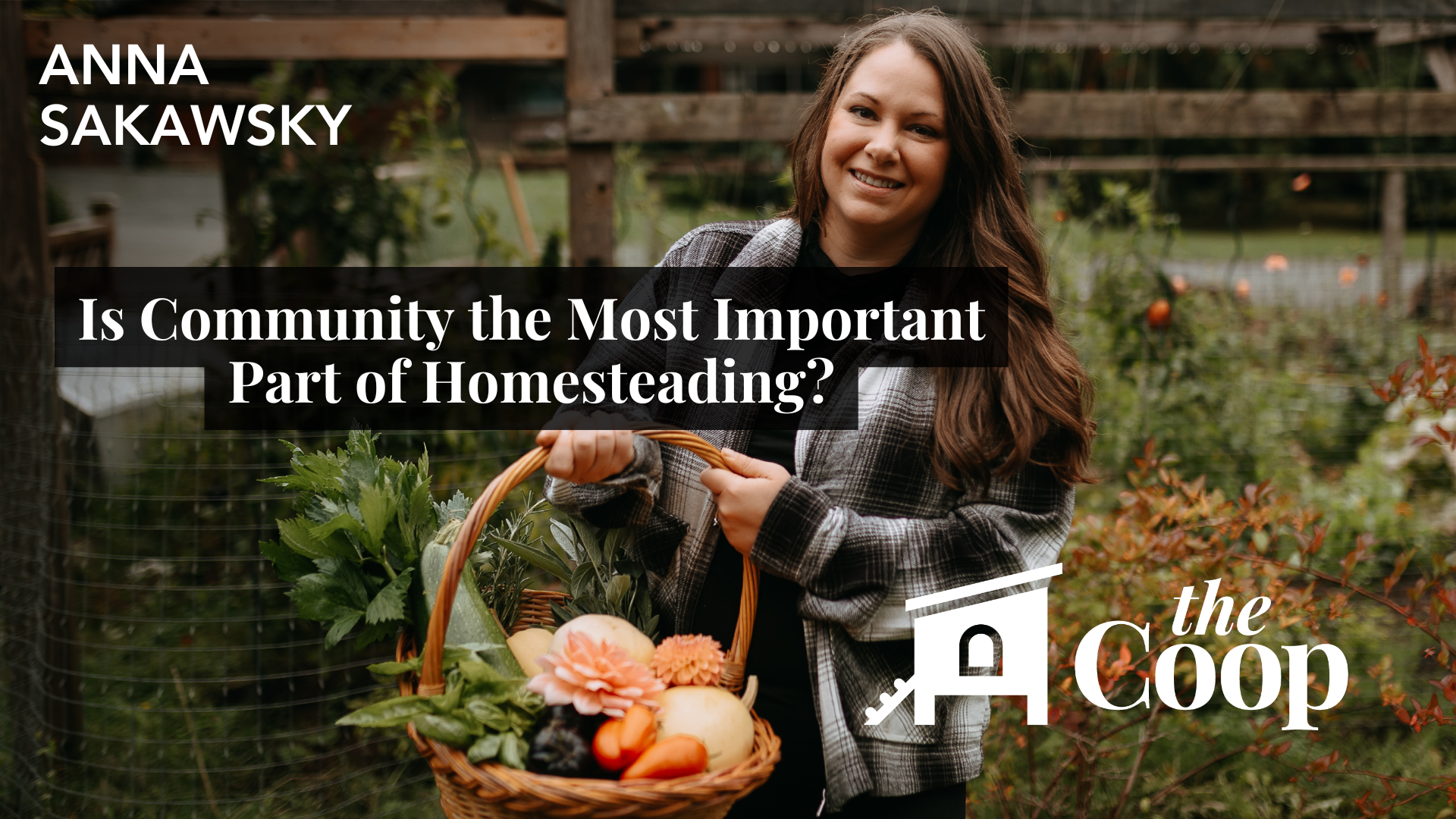



Homesteading can feel incredibly rewarding … but it can also feel lonely when you’re the only one in your circle growing food or raising chickens.
In Episode #22 of The Coop, host Anna Sakawsky reflects on why true self-sufficiency has always depended on community, and how we can start building stronger local networks today.
Drawing from real-life examples (like neighbors helping clear snow, friends with excavators stepping in, and the power of sharing garden extras) Anna shows how investing in relationships with those around us creates resilience that no lone homesteader can achieve on their own.
She also shares practical encouragement for connecting with like-minded people, whether through online groups, local events, or simply reaching out to neighbors with some offerings from the garden or chicken coop.
This episode is a timely reminder that homesteading was never meant to be done in isolation. The strongest, most resilient homesteads are the ones surrounded by good neighbors and a supportive local community.
In this episode, Anna discusses:
- Why even the pioneers relied on community more than we realize
- Practical ways to build relationships with neighbors, family, and friends (even when you don’t see eye to eye)
- How to find and connect with like-minded homesteaders
- The importance of supporting local farmers and small businesses
- Why giving first (eggs, seedlings, help) often comes back around
The show notes …
00:00 – Introduction
01:29 – The Myth of Going It Alone
06:59 – Building Local Relationships & Reciprocity
20:54 – Supporting Local Farmers
26:58 – Navigating Differences & Finding Common Ground
35:13 – Finding Like-Minded Homesteaders Online & In Person
48:51 – Final Encouragement
Anna Sakawsky:
The less we depend on each other, the more we depend on that bigger system that doesn’t really care about us or have our best interests at heart. And the sooner we all realize that and realize that we are stronger together and then we all have more in common than not, the better off we’ll be and the more power we take back from that system. Remember that building relationships and community is just as important for self-sufficiency as building garden beds and chicken coops. Arguably more so actually. Before we jump into today’s episode, I want to tell you all about one of my favorite new sources for toxin-free home and body products. Rustic Strength is a family-owned company out of Missouri that makes super effective non-toxic cleaners, laundry, and body care products. Everything is made in small batches using high quality ingredients you can feel good about bringing into your home because what we use in our homes and on our bodies is just as important as what we put in them.
No harsh chemicals, no synthetic fragrances, just clean toxin-free products that actually work. So if you’re tired of toxic cleaners but still want your laundry to come out fresh and your home truly clean, head over to rusticstrength.com and check out their entire line of products. Again, that’s rusticstrength.com. Tell them the coop sent you. Hello everyone and welcome to episode number 22 of The Coop. I’m your host, Anna Sokowski, editor-in-chief of Homestead Living Magazine. And today I want to talk about something that is not always the first thing we think about when it comes to homesteading and living a more self-sufficient, sustainable life, but that’s actually one of the most important aspects of self-sufficiency nowadays, especially as we try to disentangle from our reliance on fragile global systems and industries and build resiliency closer to home. And that thing is community. So today we’re going to talk about why community is important, perhaps now more than ever, how to find it as a homesteader because it can be a lonely road when you’re the only one out of your friends and family on this journey.
And most importantly, we’re going to talk about how to actually build community and community sufficiency no matter where you live. So first off, why does community even matter? So many of us think of homesteading in the pursuit of self-sufficiency as being very individualistic. The idea of the rugged individualist carving a life for himself out in the woods or the family living off grid without ever needing to go to town are popular tropes, but is that truly realistic? The short answer is no. Honestly, even in the pioneering Little House on the Prairie days, homesteaders relied on community. In fact, they naturally relied on community more than we do today because they couldn’t just run to the grocery store or Google somebody to hire when they needed something built or fixed. They relied mostly on their own skills and what they were producing and on the skills of others and what they were producing.
There was no global market at that time. Everything was local. And while there was usually like a general store that they could go to town for and source things like flour and sugar and things they couldn’t produce themselves, they were on their own for most other things. Since it’s pretty much impossible to produce everything yourself or to have the skills and knowledge and even just the sheer strength and capacity to tackle every project on the homestead alone, homesteaders learned to lean on each other to help them survive and thrive. People depended on local blacksmiths, farmers, midwives, neighbors, et cetera. But in today’s world, we’re so disconnected from each other that in some ways it’s harder to build that community even though there’s more of us. We’re more connected in many ways, but we’re often disconnected from the people that are closest to us. And we’re struggling to find that community.
When it comes to community as homesteaders, I think we often think of this ideal like the Amish, for example, and how all of the members in an Amish community will pitch in and help raise a barn and they do it in record time with only basic hand tools. And that’s a great example of how many hands make light work, as they say, and how self-sufficient we can really be when we work together. Self-sufficiency in this context, meaning not reliant on anyone outside of our community or on the larger systems or institutions to provide for us. Without that community, the Amish might even cease to exist. As I imagine, it would be very difficult to maintain the sort of lifestyle they do without help. But while this is a shining example of the power of community, it can also feel pretty unrealistic or unattainable for most of us who didn’t grow up in an Amish community.
Like I say, nowadays, many of us grew up in towns or cities where we don’t even know our neighbors and are accustomed just to outsourcing all of our needs. And then when we decide to start homesteading, it can feel even more isolating in some ways because maybe we’re the only ones in our neighborhood who are growing a garden or raising chickens or maybe we move out to the country to start homesteading, but we haven’t taken the time to make the connections with others in our area. So we’re left going it alone and when we come up against something that’s out of our wheelhouse or too big to handle alone, we either kill ourselves trying to do it alone anyway, or we slip back into the kind of familiar pattern of outsourcing it by purchasing what we need from the store or hiring somebody that we find online or in the phone book or I don’t even know.
Do they make phone books anymore? Either way, we’re kind of slip back into that like, “I’ll just hire somebody else to do it or go get it. ” And that’s often what we’re trying to escape by homesteading in the first place. So what’s wrong with this? And like inherently nothing is wrong with it. And this is part of the issue sometimes is I think that people can hold themselves to a very rigid standard of you’re not a homesteader unless you’re doing all of these things yourself. If you go to the grocery store, like you’re not a homesteader or if you hire somebody to help build or fix something for like, you’re not a real homesteader. And that’s not true either. I think there’s absolutely a place for that and we still rely heavily on the grocery store for most of our food needs, quite honestly, but we’re trying to do as much as we can on our own and that’s I think where most of us are at in the modern homestead context.
We’re just wanting to produce a litle bit more ourselves, but it can get to the point where we feel like we have to do everything, right? If we’re not making everything from scratch or doing everything on our own, then we’re not really being self-sufficient, right? And I mean, honestly, learning new skills and attempting to tackle things ourselves is a noble goal. There’s nothing wrong with that and there’s nothing wrong with asking for help either, right? But if we veer too much in either direction, it can be detrimental to what we’re actually trying to accomplish. Not to mention we’ve learned firsthand over the past few years how fragile things like global supply chain systems and even things like our healthcare system where the construction industry really is. I’ve heard lots of stories over the past few years about people waiting months for somebody to come out and fix something as simple as a leak.
So here’s kind of a case in point. A few years ago we had an unusually cold and snowy winter. So where we live, we are on a cul-de-sac at the end of a no through road. And I always kind of joke that we’re kind of one foot in the city and one foot in rural living. And city, when I say that where we live, it’s more of a town, right? More of a small city or a large town, I guess. But where we are, we live about three properties away from the property line where the city technically ends and then at the end of that road and where our cul-de-sac is, we are considered rural, but what happens when it snows, for example, is the city will come down and clear the road until the city line and then the regional district where we live that’s responsible for rural snow removal and that sort of thing, we kind of get forgotten.
We’re kind of in this weird pocket where we get forgotten because they have to come down a city road just to get to us. And so when something like a massive snowfall happens, we’re usually left fending for ourselves. We called, I remember that year multiple times us and other neighbors be like, “We need the snow removed because it was so high and so thick and so packed that if we did need to get out to get to the store or if there was an emergency and somebody needed to get to the hospital, we couldn’t get out. We were snowed in. ” And so finally a neighbor that was down the road, and we didn’t actually know this neighbor personally at the time, but we knew other neighbors that have been here longer than us that knew him and he was able to come with like a Bobcat or a tractor of sorts and clear the snow for us and that was wonderful, right?
All of a sudden our road was cleared. It was thanks to a neighbor, not thanks to the city or the regional district that our tax dollars are technically going towards or to support that they really should be the ones that are coming to help us with that, but they didn’t come. And so we’re not for having a neighbor with that machinery and those skills and whatnot and having the connection to that neighbor, we would have been snowed in until the snow melted pretty much until we dug ourselves out by hand. So that’s just one example. Another example is last year we were tackling a big project. We were actually trying to fill in a ditch out front and put in a culvert and we had to clear a lot of really big rocks and we did kind of as much as we could by hand, my husband more so, me as well, but he definitely like really pushed hard just doing it by hand to clear these boulder sized rocks.
But it got to the point where we really needed an excavator to finish the project since we don’t have one of our own, we usually rely on a local tool rental place for those bigger pieces of equipment when we need them, but we looked into it and renting an excavator was just out of our budget. It was going to be probably around $600 or more for the weekend and we just couldn’t afford it at that time. So luckily we have a friend with an excavator who volunteered to help us. So this friend happens to be, our connection with him actually was through our daughter. He’s a father of one of our daughter’s best friends, but we ended up connecting with him over other shared interests too. So he’s also a gardener and we kind of connected over that and bonded over. We’d share seeds and seedlings with each other and like this year he had all these extra strawberry plants that he let me come and dig up and I was able to plant out our strawberry bed with some of those and then in return I gave him some strawberry rhubarb pie filling that I caned last year and that’s kind of the type of relationship that we’ve established with this particular fellow and luckily having built a bit of that relationship ahead of time when we were mentioning to him about what we were trying to do and needing an excavator, he said, “Well, I got an excavator and I can help you.
” So he came and spent an afternoon clearing what we needed to clear and getting the job done. And we did end up paying him. We paid him a couple hundred dollars for his time and we fed him while he was here, but it was a lot less expensive than it would have cost us had we needed to rent the tools. And if we didn’t have a tool rental place at all, then we would have been pretty much stuck, right? So those are just two really practical examples of how people within our local community have showed up for us when we’ve needed them. But of course it’s important to reciprocate that and also show up for your own community when they need you. I found that the best way to do this is to build those relationships first without any expectations and to be the one who offers help first before you need it yourself, right?
So my husband, for example, he’s pretty skilled at building and fixing most things. He’s a mechanic by trade. So when the neighbors or friends, our friends and family need help with something that’s in his wheelhouse, he shows up and helps them. For me, I’m not great with those things, which is why I rely on my husband. There’s always some sort of reliance, right? And oftentimes you find that even within families that like no one person can do everything and props to you if you can, and especially to those that are homesteading on their own, like I can only imagine how much harder that is, but that’s why a strong family unit first and foremost is really important if you are in a position where you can build that. But then beyond that, looking at each of your strengths, I’m not great with building or fixing or running an excavator, although I can certainly help with projects, but my strength comes from, I grow a large garden and we have laying hands and I cook and I bake and I can food and I make all sorts of different things that I happily share with friends and family and neighbors, right?
And there’s always this feeling that comes up, not always, but in the past there has this been a feeling that comes up of like, “I could keep this for ourselves, right? This could help us. I could preserve more of this for … Should I give this away or is it more beneficial just keep this for ourselves?” But I always think of it in the context of that it’s more worth it to give some of those things away because that’s also an investment in your community and by giving those things away sometimes or by offering to help or by giving of yourself to others, it’s kind of like money in the bank. You’re kind of making a deposit. And again, I think you should always approach this as don’t ever expect anything back, but it’s a bit of a deposit in the bank of like, “I’ve helped you and so therefore if I ever need something, I don’t feel like I’m knocking on somebody’s door that I’ve never spoken to before.
I’ve built a relationship with them. I’ve offered them things and offered help and whatever it is just because I want to build that community.” And then if I do ever need anything, hopefully then at that point those relationships are strong enough that I can go to my neighbors and I can ask for something, right?
I’ll do things like if I’ve got extra seedlings or eggs or veggies from the garden, I just offer them to the neighbors and I never expect any payments. I understand that there are people who are doing this as a business. Maybe you’re selling those type of things and like you’re not necessarily just going to give them away, but I’m just, from my own experience, we don’t do that. We’re just homesteading for ourselves. We’re not doing it for money or anything. And even if you do, if you’re trying to build local community and build relationships with some of your neighbors and that sort of thing, it’s something to ponder that maybe you just offer something to them free of charge at times just to kind of … It’s like almost like as a peace offering, right? Almost just to say, “I’ve got your back and hopefully they’ll have yours at some point.” And what I have found is that gets reciprocated over time, right?
They return the favor. So when our next door neighbors have extra veggies from their own garden, they offer some to us, right? Sometimes we’re growing something and we offer it to them and they’re growing something different and offer it to us. And when our chickens escape and get into their yard, they’re cool about it instead of freaking out, which also just comes from taking the time to talk to them and get to know them. I’m the first to admit I’m an introvert by nature and our garden happens to be in the front of our house where all of our neighbors can see and so often we’ll have neighbors that either, as they’re passing by on a walk, they’ll want to stop and chat or see what we’ve got going on. We’re out there a lot so naturally the neighbors are there too and they want to interact with us.
Our next neighbors are usually popping their head over the fence and, “What do you guys got going on now?” And there are definitely times where I do feel like, “I’m too busy for this. I can’t stop and chat right now. Please leave me alone.” But I always remember too that that is part of the life I’m trying to build, right? I’m trying to become more self-sufficient and part of that is building those relationships with neighbors and with my local community.
Another example is like, we hashed some eggs last year and if you’ve ever hatched eggs, you know that it’s a bit of a crapshoot. You might end up with some roosters. You’re not going to be guaranteed all female laying hens. And so we did, we actually ended up with two roosters. We’re down to one now and that’s a story for another day, but we have kept one, but where we are, we are technically rural and we are allowed to have a certain amount of chickens, but you’re only allowed where we live to have laying hands on your property because we are also under an acre. We’re only on a quarter acre. And so you’re not technically supposed to have roosters because of course they’re loud and we’re close to our neighbors and so that can create a disturbance. But because we’ve developed really good relationships with our neighbors over the years, when we had this rooster, we talked to all of them and they were like, “No, no, no, no, keep the rooster.
It’s totally fine.” Actually, most of them are like, “Do not get rid of that rooster. We love the rooster.” They like it, right? They’re like, “We live rurally for a reason, even though we’re kind of close to each other on a cul-de-sac, most of them are of the mindset that we live out here because we like that. We like to hear the cows lowing off in the distance and we like to hear the rooster crowing and like, don’t worry at all about it. ” As a peace offering in, we offer them all eggs from time to time, not all of our eggs because what would be the point of that then, but like every once in a while we’d be like, “Here’s a dozen eggs to our neighbors.” And it’s gone a long way. And so not only that, but when we were away, we took a family trip to Mexico a couple months ago and turns out we forgot to close the door to the run.
So luckily we have an automatic coop door that lets the chickens out and closes when they go in at night, but we had accidentally left the door open to the run. And so I had my mom coming over to check in on things, but only every so often she doesn’t live super close and so we were able to call the neighbors and be like, “Hey, would you mind going and just closing the door?” And again, because we had developed that good relationship with them so far, they were absolutely more than happy to do so. And not only that, they kind of just, even without being asked, took it upon themselves to just go check on the chickens every day and my mom was showing up going, “I think somebody’s been here already because the eggs are collected and everybody’s fed and watered and like everybody’s good and they’re happy to do so because we’ve built a good relationship with them.” So getting to know your neighbors, offering them something first, even if it’s just companionship, even just getting to know them.
I think that that is the first step in building a strong foundation for a resilient community and ultimately for community sufficiency and it helps you get to know who you might be able to rely on or ask for help with certain things if and when you need it as well. And again, I stress the point of don’t go into it thinking, how can this person help me? I mean, maybe you can think about that, but don’t expect it that I’m doing this so that you’ll help me in return. But if you give willingly, I find that that’s often reciprocated. Another example is at Christmas last year, my kids and I put together little boxes with some homemade cookies or toffees or whatever we made and some little packets of saved seeds from our garden and we delivered them to each of our neighbors on the block and one of the neighbors ended up giving us a bar of her homemade soap as a thank you.
I know at the time that she made homemade soap, but now I know. And so I mean, hopefully the stores will never run out of soap, but if they do, I know who I can ask, right? “Hey, do you have some soap that maybe you made lately I know that I can go to a local source and hopefully get that. And so I always talk about neighbors and friends and family first because that’s really your innermost circle when it comes to community. But beyond that, we’ve also made an effort to get to know and support the local farmers in our area and to make connections with people who source their seafood from local fishermen. We’re on Vancouver Island and so we’re close to the ocean and so fishing and we have lots of rivers and that sort of thing and salmon and all sorts of stuff that’s local to us and rather than having to go buy it from the store, we actually don’t have a connection directly with a local fisherman, for example, but our neighbors do.
And so they’ll ask us, they’ll say,” Hey, our friend just brought in a bunch of salmon or halibut or spot prawns or whatever it is, they’re offering this rate as kind of a friend’s rate. Did you want some? “And because we built those relationships with them, we can get it directly from the source, right or people who are just running their own businesses in town, right? Small businesses need our support more than ever, right? Small businesses are struggling more than ever and we want to keep those people in business, to keep our money local, to keep a strong and resilient local community and to support them and just to ensure that we have access to the things that we need locally if and when we ever need them anyway. So as far as local farmers go, we don’t purchase a … Well, I mean, I’m not one quite honestly, as much as I’m like, ” I think you should go to the farmer’s market.
I think I encourage that all the time. I’m not one to go to the local farmer’s market a lot simply because of we’re busy. We just don’t usually make it in the timeframe that that farmer’s market is open, but that’s a great way to start. If you have a local farmer’s market, go there. We’ve now kind of graduated, I guess, beyond that to just going straight to the source. So in the summer, for example, we grow a lot of our own produce, but for things that we don’t grow or for things that we’re not growing enough of that I want to preserve. I have a few farmers locally now that I know and have built connections with that. I just go directly to the source. So if it’s like sweet corn that I’m after or I need more canning tomatoes or whatever it is, or just want to source things from somebody local that we’re not producing ourselves, I try first and foremost to go to the farmers first.
So whether that’s through your local farmer’s market or direct to the farmers, that’s one thing. Then for us specifically, we don’t produce our own meat. Again, we’re only on a quarter acre. I have our own chicken every now and then, usually what a rooster needs to be called, but we have to outsource most of our meat production and we get almost all of our meat from local farmers, which doesn’t just save us money in the long run and I’ve done the math on it, especially nowadays if you actually compare apples to apples if you’re talking organic, free range, ethically raised meat, if you’re looking at what that costs in the grocery store, the way we do it anyway is with our beef and our pork for example, and some of our chicken too, but we purchase by in bulk, right? We’ll purchase a quarter side of beef, which is usually enough for our family.
You do a side of beef, you can do a whole cow, but we usually do a quarter side of beef and a half a hog and we have a local farmer that we get that from. I just put in our order for the year, we pay a deposit in the spring and then we pay the balance when that animal is ready in the fall and we pay some butchering fees and then we get to stock our freezer for the year and now we’re on that farmer’s list and so we get first dibs kind of every year because we have purchased in the past and he goes, “Do you want some this year? Let me know. I’ll put some aside for you. ” That sort of thing, right? So not only does that help fill our freezer and by my calculation for the quality of meat and everything that we’re getting, it’s actually a better deal than going to the grocery store, especially when you’re buying in fulk.
It’s a bigger expense maybe upfront, but in the long run, it’s a better deal than buying, especially some of the cuts a week because we get the nicer cuts as well, right? You get all the tenderloin and the cuts that would cost you a lot of money at the store, you pay a hanging price per weight and it saves us money in the long run on that. But beyond that, it also ensures that we have a local connection for those things so that even if something happens where we can’t source them from the grocery store, maybe the prices just get so insane or it’s just the shelves are not stocking that anymore. We can go directly to those farmers and say, “Hey, can I get this from you? We already have that connection built.” But on top of that, supporting them now and supporting your farmers and local businesses and all that in good times, that helps to ensure that they will hopefully still be operational if and when we really need them in bad times as well.
If we’re not supporting them in good times and they’re not making enough money, then they might cease to exist and then when all of a sudden we need them and this happened during COVID, right? All of a sudden everybody was turning to the local farmers because things were running out of the grocery store and everything. So supporting them all the time ensures that they’re still running and able to provide you with what you need when you actually need it. So these are just a few of the ways that we can start building community locally. If the thought of raising chickens has ever intimidated you, consider this your assigned to stop putting it off. Murray McMurray Hatchery has been helping first time chicken keepers succeed for over a hundred years. They offer the widest selection of day old chicks and poultry, super low minimum orders, sometimes as few as one bird and the best guarantees in the business, live arrival, 48 hour livability, and 90% sexing accuracy.
Plus they’ve got everything you need to raise happy, healthy birds right from the start. Rooters, feed, incubators, the works. It’s never been easier or safer to start your own flock, so visit murrayhatchery.com and tell them the coop sent you. Again, that’s mcmurrayhatchery.com. But there’s another question that comes up for a lot of folks these days, especially for those of us in the homestead community. And that is, how do I actually build community with people who maybe don’t understand or support what I’m doing and/or how do I find a community of people who thinks like I do? That’s what I hear a lot when conversations around community come up is like, “Oh yeah, that’s all well and good.” Okay, talk to my neighbors and like, okay, right, but like what if I feel like I’m still in it alone, right? Nobody understands what I’m doing or I have different political beliefs or whatever where I don’t feel that connection with others, right?
I’ve thought a lot about this and I think there are two sides to this coin, so I’m going to offer some suggestions for both. So on one side, I would first of all say don’t let the fact that others think or live or believe something different from you stop you from building community with them anyway. If possible, try to find the common ground and connect with them on that. So I live in an area where a lot of people hold very different political views than I do, even within the local farming and agricultural community, but what we do agree on is that building and maintaining a strong local food system is really important. So I focus on that and I connect with them on that and I let everything else fall by the wayside. I focus on what is our shared common ground. I also have a lot of friends and family members who have no interest in homesteading whatsoever, some who probably think we’re crazy for pursuing the lifestyle that we are or who just don’t understand it and I know that and I respect it.
And while I would love to have more people in my inner circle face to face locally who I can talk to about growing food or our plans for our property or even our thoughts on what’s going on in the world and the bigger picture reasons why we’re actually doing this, I tend to just steer clear of these topics when I’m with those people and I just only talk as much about it as I sense they’re willing to hear or talk with me about without it ending in a disagreement. And most importantly, I really try to be cautious of acting snobby about it, I guess, or like I’m somehow better or smarter than them because I’m working toward a more self-sufficient life while most of them are still happy to be part of this system that I’m trying to escape. That’s my choice. It’s not theirs.
And so long as they respect my decisions, I’m absolutely, I’ll respect theirs as well. So I’ve just found that over the years by simply living this way without pushing it on others, for Friends and family members have kind of naturally taken an interest. Maybe it’s taken them a while. We’ve been doing this for more than a decade now, but one of my best friends still lives, he lives in the city, he has a small south facing balcony and he called me just a couple weeks ago to ask me what he could grow on his balcony. I gave him some suggestions and he ended up building a tiered planter and planted an herb garden and a few pepper plants. I told him how proud I was. I said, “It’s a slippery slope from here and in a few years you’ll have chickens.” But he called again the other day and he FaceTimed me because he wanted to show me the teaspoon worth of dried basil he harvested from his own plant and he dried for future use and he was so proud.
He was like, “It tastes better. It just tastes better than anything I’ve got from the store.This is amazing.” I’m again, more than a decade into this and I could have scoffed this tiny amount of basil and bragged about my massive basil harvest last year and how I dried all this basil and I have all this pesto still in my freezer, but that might have just discouraged him. I don’t want to be gate keepy about this because that’s how I started too. I started with basically a teaspoon of basil. It was like, “Look at my little herb plant. Look at my little jar of something I preserve. Look, I put blueberries in the freezer.” And so I think we should just be really cautious of just being really careful to never discourage anybody from this lifestyle because we think we have it all figured out or we’re ahead of them or whatever.
There’s room for everybody here and the more people we can bring in. And again, that’s kind of that old adage of you catch more flies with honey than you do with vinegar. So how can we be sweeter, more like honey to our friends, family, neighbors. And not that we’re trying to coax them or try to get them to be a homesteader too or whatever, but that’s just a bonus. If we just by simply living and showing like, “Hey, look what I’m doing.” Even if it takes years like it did with my friend, he finally was like, “Hey, that’s kind of cool. And I actually have a balcony where maybe I could do some of those things too. What could I do? ” And I’m like, “Hey, you purchased time from the grocery store, some rosemary, good for you. ” And you’re growing it and you’re doing it and you just dried a little teaspoon of basil and that is amazing.
So again, just like not being pushy about it or I know again, we want to talk about what we’re doing and we’re excited and we deserve to talk about this and to be excited about it, but just knowing who you’re talking to sometimes and just kind of evaluating like how much should I share versus like just show by doing. And oftentimes I’ve just found that that kind of brings people in and makes them want to learn more.
But beyond that, even if we’re miles apart from what we value and believe, I still maintain those relationships anyway because our friends and family are still the closest thing that we have to a support system that is going to be there for us through thick and thin no matter what. And if you’ve had a rift with any friends or family members in the past, especially in this day and age when we are so divided and unwilling sometimes to talk to each other if our views differ or we have different political opinions or whatever, I really encourage you to put those differences aside and try to repair those relationships if possible. And that is often going to take you being the bigger person and being the first to reach out.
Call me a conspiracy theorist, but I believe that a lot of the division is manufactured and as we continue to fracture along ideological lines or whatever, the system becomes more powerful. The system that we’re trying to escape gains more power. And I think that’s the same as like when we’re trying to do everything ourselves and not build those community relationships and networks, the system just becomes more powerful because it knows it, I don’t even know, but the people running the system, they know we can’t do everything on our own. So by fracturing us more and more, dividing us more and more until we’re essentially all just individuals trying to do everything ourselves, they’re going to break us. The less we depend on each other, the more we depend on that bigger system that doesn’t really care about us or have our best interests at heart.
And the sooner we all realize that and realize that we are stronger together and then we all have more in common than not, the better off we’ll be and the more power we take back from that system.That’s just my two cents. But now for the other side of the coin, how do you find or build community with like- minded people, especially when no one in your inner circle homesteads or understands what you’re trying to accomplish? So that’s where I think online communities and in- person events can be actually super helpful. So when I started homesteading officially, I guess, about just over a decade ago. So I think I shared my story in a past episode, but we moved from the city in 2015 to where we live now on Vancouver Island and we did so with the hopes of homesteading with starting to grow fodding, but I had no experience at the time.
So I turned to the online world to learn these things and one of the first people that I found who was teaching these types of skills was Melissa K. Norris, who actually happens to be one of the co-founders of Homestead Living. But Melissa, I used to listen to her podcast and she used to do some live video stuff where she would take questions and help people out and then she started an online community. It was called the Pioneering Today community, I guess. I don’t want to get that wrong, but Pioneering Today. And that was the first online community that I actually became a part of. So I actually was one of the first people in her community and it was so cool because not only was I learning from her, but all of a sudden I was connected to a whole bunch of other people that were doing this as well and we were sharing things we were doing.
We were sharing tips and actually it was, that’s how I first got into, not got into blogging. I had started actually blogging about my homesteading stuff because a lot of us want to share what we’re doing and that’s a way that we can share with others when you feel like, “I want to talk about this, but nobody else wants to hear it. ” There’s a whole online community that does want to hear it. And so I got into blogging like a lot of people do and I started sharing about our homesteading journey right from the beginning and I shared something in that community and I remember to this day what it was and it was a recipe for pickled garlic scapes. And funnily enough, my husband and I are going camping tonight. We are actually going to go take a weekend. My mom is taking the kids.
We’re going to have a weekend that’s just mom and dad, which will be so nice. And we pickled some garlic escapes last year and I said, “Oh, let’s bring the garlic escapes. We’re going to have some Caesars while we’re away.” So we’re still making this recipe. Anyway, it just kind of brings me back. But that was the recipe I shared in the community and I was just sharing it to be like, “Hey, here’s a new recipe that I’ve been making that I love and here’s a little blog post I wrote on it. ” And Melissa actually came to me and was like, “Hey, you’re blogging about stuff. Could you maybe help me with some of my blogging stuff?” And that’s how I first got involved with Melissa and I ended up doing some guest blogging for her and eventually in a roundabout way that ended up leading to me becoming the editor of Homestead Living because Melissa, like I say, is a co-founder here too.
But all of that kind of aside, the cool thing was that it was the first time I actually became part of a community where when I wanted to talk about something to do with homesteading specifically, or I wanted to converse with other people who got it, I would go into that little community and I’d post in that group and I’d have all these responses and people who were cheering me on and that sort of thing. So as many drawbacks as social media and the online world has nowadays, I think it can still be a super powerful medium, I guess, for finding like- minded people who get it as well because while I do think it’s important to build local communities regardless of whether other people in your community are homesteading or understand what you’re doing or have the same beliefs or whatnot, I also understand that it is important to find others who get what you’re trying to accomplish because it can feel lonely otherwise.
We can still feel like we’re alone in a crowd if we don’t find that sort of community with others who get it, right? I would just say that start there, if you’re not finding people in your local community, I would look to the online world, right? That’s again, that’s one of the benefits of having that nowadays. Start building those connections by either joining an online community or just by putting yourself out there. It doesn’t even have to be a paid community, right? This one happened to be a membership, but there are lots of Facebook groups, local Facebook groups. I have lots in my areas, like local gardening groups and local cannon groups, whatever. Find those groups in your area and then don’t be afraid to put yourself out there and message people on there. Maybe you could create a bit of a connection or you’re chatting back and forth with somebody and like, go ahead and send them a private message and say, “Hey, this is so cool, whatever.
I’m glad that we’re connecting on this. Maybe we could get together sometime.” I think we’re so afraid to do that nowadays because I mean, even, sorry, I hate to … I’m not hating on the younger generation at all, but because I think that the younger generation has maybe been raised in a world where everything’s online or everything’s by text or whatever, like we’re starting to see this erosion of like just being able to talk to people face to face or send people a private message or talk on the phone with somebody, right? Don’t be afraid to just put yourself out there and be like, “Hey, this is really cool, this conversation we’ve been having online, would you ever want to come over and like hang out in my garden or maybe we can do a cans and pickles together this summer, whatever.” Sometimes it just takes you being the brave one to make that first step and a lot of relationships, especially nowadays, start online, right even like romantic relationships, look at how many of them, like start online, but it’s about then trying your best to then take that off of online or offline, I guess.
If it’s somebody in your local community, take that leap and make that first step, message them and be like, “Did you want to get together?” Clearly we have some shared interests, right? But even if people are not in your local community, just having that back and forth online again, you can develop a relationship, a friendship outside of that, even if you’re not meeting face to face, but finding those online communities where you know already, like these people are into the same thing that I’m into because they’re part of this group that I’m a part of, that’s a great first step to finding like- minded community. And then the next thing would be to actually attend an in- person event. So there are lots of homesteading events that are popping up all over the place and that’s a great place to start, but we don’t have, for example, any homesteading specific events where we live, like right where we live, but there are local workshops and events and retreats for learning things like gardening or herbal medicine and things like that.
So those are places I could go to find local people who are into similar things and spend some time with them in person. Personally, I’m starting to get a litle bit more involved with our local exhibition, which is run mostly by our 4-H community and the agricultural community here. And while I don’t have the kind of time I wish I had to get as involved as I’d like to be with that at this point, just showing up, like we showed up to a fundraising event a couple months ago and just chatting with people that I know are running this and just sharing ideas with them or just sharing what small ways I could help with, that has helped me to make connections with the folks in that community and just to get more involved in local agriculture, right? Just build those connections again. And I hope at some point my workload, everything else that we’ve got going on subsides a bit so I can dedicate a little bit more time to that, but it’s important to make some time for that and to put yourself out there, I think.
But another thing is these homesteading conferences. I attend the modern homesteading conference every year since its inception now, which I think was 2022, I want to say maybe 2023 and I met all kinds of awesome people there. So the first year my family and I, we made a road trip out of it and our whole family attended just on our own. It was just for fun. It was the very first time this conference had popped up. It takes place in Cardille in Idaho and we’re on Vancouver Island. So to go from Vancouver Island down through Washington State and over to Idaho was a reasonable road trip. So we did it kind of for fun and it was awesome. And I got to connect with a bunch of people that I’d actually met online before, but I’d never met in person that were there. So that was cool.
But then just as you’re attending speaking events and everything else, you get to just chat with people that are there and if you can make connections where you can carry those on, great. But even just going to this in- person event, there’s a vibe when you get to these things that’s different than anything else, different than online or whatever. When you’re with hundreds or thousands even of other people that are all there to learn the same things because they have the same motivations or whatever, right, it’s this very reassuring feeling that like, I’m really not alone. Look, I am in community here right now, even if I don’t know any of these people. So we did that the first year on our own. The second year I was actually asked to be a speaker, which was a huge honor. And then now I’m privileged to get to attend with the Homestead Living Team each year since we are actually the official bookstore of the modern homesteading conference.
So one of the coolest things though that they do at this particular conference is that at the end on the last day they host kind of like a meet and greet where you can go and connect with others in your area. So what they do is you kind of all gather at this end point whoever wants to come and then they have little areas set up. So it’s like maybe you’re in the southwest of the states, maybe you’re in the Southeast, maybe you’re in the Northeast, maybe you’re in the Midwest, maybe you’re in the Northwest, right? Maybe you’re in Canada. Canada gets its own all the time and being Canadian, I naturally find myself with the Canadian group and just because of location where this happens to be, I find that most of the folks that are down there are from Alberta because Idaho, like where it is is just kind of south of Alberta.
I’m a little bit farther from the west coast of BC, but still I get to mingle with local Canadians and like when you come into this group, it’s just so amazing like, “Hey, come on in and yeah us too.” You’re like us, we’re the same. And it’s just this amazing feeling of like, “Oh, I found my people. ” And then again, that offers, then people are exchanging phone numbers by the end, they’re exchanging email addresses and social media accounts and like, “Let’s stay connected.” It’s just so cool. We actually a couple years ago, so we did that first year, we did the road trip down and then the second year when I was asked to be a speaker, my family all came to support me. So we did another road trip down there and we camped while we were there and then we were at this campsite and the people that were staying next to us looked over and they were like, “Anna?” And I said, “Yeah.” And they said, “Oh, we were at the conference.
We watched your talk.” I’m like, “Oh, how cool.” And they were like, “Hey, did you want to come for dinner?” And we sat with them and they cooked dinner for us, which was amazing and they had kids around our kids’ age and the kids played together and it was cool. We were hanging out and just chatting with people that we had. We already knew we had something in common with now because we had been at this conference together. So if you can make it work, one of the things that we’re actually doing right now with Homestead Living, if you’re a subscriber to the magazine is we publish a map. Actually at the end we’ve got kind of a regular section where now we’re publishing a map of all the in- person homesteading conferences that we’re aware of anyway. And if we’re missing any, you are more than welcome to email in and let us know and if it aligns and everything, then we will add it to the list, but it shows all of the different homesteading events throughout the states anyway.
Most of them, it’s interesting is once you put them on a map, most of them are in the Eastern states. So if you’re in the Eastern States, there’s probably a lot of options for you. So I highly recommend you check that out. If you’re in the West, there’s fewer, but there’s more popping up. The one in Idaho is a big one, but if you can make it this year, for example, we’re actually heading to the Modern Homesteading Conference again very soon on the 26th and 27th of June 2026 we will be heading to the Modern Homestead Conference again. So if you live in that area near Kurdland, Idaho, Spokane, Washington, I was close as well, where you’re able to make the trip, I highly encourage you to come check it out and come say hi. But again, if you’re just looking for something in your area, check out the map.
If you’re a subscriber, you can take a look at the map in your latest issue, see if there’s an event or a conference near you, but you can also view the map on our website. So the easiest way is probably just Google homestead living events, but we’ll include a link to the map as well in the show notes below. So check it out. And if there’s something that you can attend locally, that’s a great way to start making those connections and building community with like- minded folks and find people in your area. You never know. You could find somebody who’s like down the street from you that you didn’t know, but they’re into the same thing, right?
And finally, a great way to stay connected to the homesteading community and learn from others is just things like listening to this podcast regularly, right? Because we bring on a lot of great guests who not only share valuable knowledge and wisdom, but also remind you that you’re not alone on this journey. And I think that’s a big part of it is just feeling alone, feeling like you’re pushing a boulder uphill by yourself and you’re kind of going against the grain of everybody else, that you’re just alone in this. And that’s absolutely not true, right? So just things like listening to this podcast. I know there’s other podcasts out there, but just I find sometimes it’s just even if I’m not conversing with those people, just hearing them speak about the things that I’m doing, struggling with, trying to achieve, whatever, it’s just really reassuring, right?
And then of course, make sure you’re subscribed to Homestead Living Magazine, because every issue of the magazine is filled with practical hard one wisdom from homesteaders who don’t just talk the talk but actually walk the walk. And honestly, it’s nice to have a print resource that won’t disappear if the internet goes down or that you can refer back to again and again. We’re working on some things right now to build more of a community around the magazine too. So hopefully someday there will be even more opportunities to connect one-on-one with others, but for now I’ll leave you with just like one final word of encouragement, which is just a simple reminder that you’re not alone. There are thousands of others, maybe more, who get it and who are cheering you on and supporting you on your home sitting journey, even if you haven’t met them yet.
So put yourself out there, talk to your neighbors, offer them some zucchini or tomatoes from your garden. Lend a hand whenever you can support your local farmers and businesses. Reach out and make an effort to mend rifts if you need to, right? Be that person. Connect with people online and attend an in- person event if you can. And remember that true self-sufficiency is about more than doing everything yourself. It’s about building strong networks with other people so you can become less dependent on the bigger, more unstable, often more predatory systems that benefit from the division and are happy to chew you up and spit you out and leave you in a lurch without warning. Remember that building relationships and community is just as important for self-sufficiency as building garden beds and chicken coops arguably more so actually.
United, we stand, divided, we fall, right? Finally, remember that I and all of us here at Homestead Living are here to support you and we’re rooting for you. Until next time, friends, keep building what matters and I’ll see you all back here next time on The Coop. Before we wrap up today, I just want to thank you, our listeners for being a part of this community. If you’ve been listening for a while and haven’t yet joined us as a subscriber, this is your sign to start your subscription to Homestead Living Magazine. A Homestead Living subscription includes six beautifully printed issues each year and they’re designed to be kept, dog eared, bookmarked, pulled off your shelf and referred back to you again and again. Every issue is filled with practical skills, seasonal guidance, and trusted voices who’ve put in the hours and learned the hard way so that you don’t have to.
Right now, a full year, all six issues is just $49 and it is one of the best ways to support the work that we do here while building a home library that you’ll return to again and again. As the editor, I may be a little bit biased, but if you value thoughtful, authentic, grounded guidance from people who don’t just talk the homesteading talk but actually walk the homesteading walk, then this magazine was made for you. So you can start your subscription now by heading to homesteadliving.com/subscribe or click the link in the show notes.
Resources/Links
- 2026 Homesteading Events
- Modern Homesteading Conference
- Download Episode Audio File
- Subscribe to Homestead Living Magazine
Brought to you by
This Episode of The Coop is brought to you by Rustic Strength
Family-owned in the Ozarks, Rustic Strength creates powerfully clean laundry, home, and body care products using high-purity, toxin-free ingredients …
This Episode of The Coop is brought to you by Murray McMurray
Trusted since 1917, this Iowa family operation hatches premium poultry for homesteaders and enthusiasts, delivering healthy, hand-packed birds and all the supplies you need to start your flock right …
Leave a Reply