
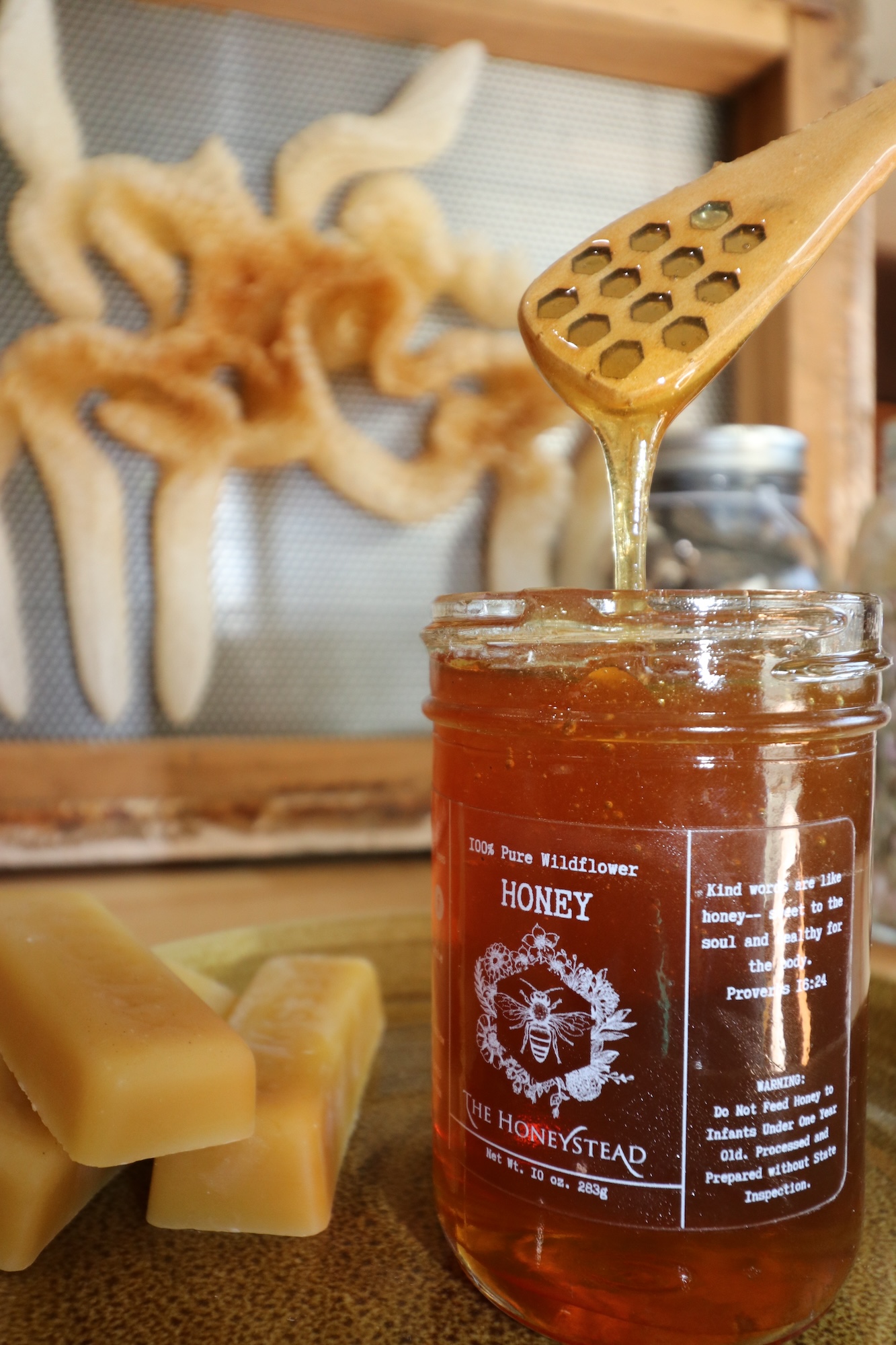
“Kind words are like honey—sweet to the soul and healthy for the body.” Proverbs 16:24
When one reads this Bible verse, the emphasis is often placed on the sweetness and uplifting feeling associated with “kind words.” However, as a beekeeper and herbalist who focuses more on the holistic approach, I couldn’t help but reflect on how amazing it is that honey was known to heal the body long before modern-day science was able to study and confirm its health benefits.
For thousands of years, this liquid gold has been used for much more than just a sweetener. But before we explore the many benefits of honey, I’d like to share with you how honey is made. I believe this knowledge will help you cherish and appreciate the millions of worker bees that travel many miles and visit many flowers to produce the only substance created by an insect that mankind can eat.

How Honey is Made
We are all familiar with honey bees, but did you know that only female honey bees actually make honey? The male bees are known as drones, and their sole purpose is to mate with the queen. The honey bees that you see among your flowers are known as worker bees, and they are all female. Throughout their life, they will have various roles, and when they are roughly 22 days old, they will begin to forage and collect pollen and nectar from a variety of flowers within a two-mile radius of their colony. They use their straw-like tongues called proboscis to drink the nectar out of the flowers and then store it in their crop and carry it back to their sisters in the colony.
The forager bee then regurgitates the nectar directly into the crop of a “processor” bee at or near the entrance to the hive, then she heads back out to forage for more nectar and pollen. The processor bee will then pass it back and forth between other worker bees. This sharing promotes the evaporation of water that is in the nectar and froths it in the process. Once they know it is ready, they take the nectar to the designated hexagon-shaped wax honeycomb cells and dispense it into the cell, but she also adds an enzyme called invertase every time she does this. The nectar consists largely of sucrose (table sugar) and water, but the invertase breaks the sucrose down into two even simpler sugars: glucose (blood sugar) and fructose (fruit sugar).
After the cells are full, the worker bees need to dry out the nectar and allow it to ripen. They fan their wings to create an airflow, which evaporates the water out of the nectar. This action prevents the honey from fermenting. They then seal the cell with a wax coating and store it until it is needed.
One of the most remarkable facts about honey bees is the sheer amount of work a single bee will do in her short lifespan. During the peak of the nectar flow, a worker bee will live for roughly 42 days. She will have visited 63,000 flowers to produce approximately one 12th of a teaspoon of honey throughout her lifetime. To put it into a different perspective, the forager bees have to visit roughly two million flowers and fly 50,000 miles just to make one pound of honey. It’s no wonder where the phrase “busy as a bee” came from! And honey isn’t the only thing these bees help to produce; they’re also responsible for pollinating many of our crops, which would cease to exist without their hard work. Looking at it from the bigger picture, you can’t help but realize how magnificent and perfectly created honey bees truly are!
Medicinal Benefits of Honey
Now that you’ve gained a little more insight into how honey is created, let’s talk about the medicinal benefits of what it has to offer…
According to the National Honey Board, there are more than 300 different varieties of honey produced worldwide. While all honey shares the same delightful sweetness, each type has its own unique characteristics, including variations in color and flavor based on the nectar collected by honeybees in a specific area. As for nutrients, honey is made up of 95 to 97 percent carbohydrates, as well as proteins, vitamins (primarily vitamin C), amino acids, and approximately 31 different minerals, including phosphorus, sodium, calcium, potassium, sulfur, magnesium, and chlorine. Honey also contains organic acids—which are responsible for its acidic properties—as well as fructose, glucose, flavonoids, and polyphenols.
Flavonoids and polyphenols are special compounds in honey that act as antioxidants. They help protect the body from harmful substances and play a role in the honey’s health benefits. The types and amounts of flavonoids and polyphenols in honey can vary. This variation depends on factors such as the types of flowers the bees visited, the climate of the region, and the geographical conditions where the honey was produced.
Some specific bioactive compounds in honey include galanin, quercetin, kaempferol, luteolin, isorhamnetin, naringenin, and hesperetin. These compounds offer various health benefits and medicinal properties, such as:
- Antioxidants: They protect cells from damage caused by free radicals.
- Antimicrobial: They inhibit the growth of microorganisms.
- Anti-inflammatory: They reduce inflammation in the body.
- Antiproliferative: They inhibit excessive cell growth.
- Anticancer: They show potential in preventing or treating cancer.
- Antimetastatic: They inhibit the spread of cancer cells to other parts of the body.
I know this all may seem very scientific, but in understanding the makeup of honey, we can see how it truly is much more than just a sweetener. If you’re still not convinced, here are a few more incredible health benefits of honey (and some of the main reasons I became a beekeeper myself):
Cellular Protection
Raw honey is one of the most treasured items in my home apothecary as I take a spoonful every day instead of a multivitamin. It is a perfect combination of a variety of plant chemicals that act as antioxidants to help protect your body from cell damage due to free radicals. Free radicals contribute to the aging process and may also contribute to the development of chronic diseases such as cancer and heart disease. It offers amino acids, enzymes, and essential vitamins and minerals that my body needs.
Wound Healing
Raw honey has wound-healing properties that can help your body fight off bacteria or fungi. Not only does it inhibit bacterial growth, but the properties in raw honey promote tissue growth and are used today on wounds, burns, and even in wounds that are not responding to today’s medicine. Its viscous consistency forms a protective layer over the wound, keeping bacteria out and preventing dehydration. The high sugar content creates an osmotic gradient, pulling fluid up and providing glucose for cell growth. Honey’s low pH enhances tissue oxygenation, and its antioxidants remove free radicals, preventing tissue damage.
Colds & Coughs
Raw Honey is also used to help alleviate sore throats and coughs, and is a wonderful alternative for children (over the age of one) who may not enjoy over-the-counter cough medicine. Honey is a demulcent and offers effective soothing properties along with antioxidants for support. Studies also show that it boosts the release of cytokines, suggesting potential antimicrobial effects.
Digestive Health
Honey has been shown to diminish the severity and duration of diarrhea. When ingesting honey, it promotes the increase of potassium and water intake, which is helpful for warding off dehydration when experiencing diarrhea. Honey also nourishes your microbiome and boosts your immune system by supporting your gut health. The antibacterial and anti-inflammatory properties in honey have been used to treat gastrointestinal conditions for thousands of years.
In addition to all of the above, honey has traditionally been used as a treatment for eye diseases, bronchial asthma, throat infections, tuberculosis, fatigue, dizziness, hepatitis, constipation, worm infestation, piles, eczema, and ulcers. And it doesn’t end there—many more uses of honey and studies are still being evaluated to this very day. But all modern research aside, I still rely on the simple wisdom that was written into the Bible thousands of years ago:
“Kind words are like honey—sweet to the soul and healthy for the body.” Proverbs 16:24







Leave a Reply