
Buying a share of meat from a local farmer can feel intimidating—but it doesn’t have to be. Finding the right farmer, knowing what questions to ask, and navigating the logistics of partnering with other families are just the beginning. If you care about how the animals are raised, what they’re fed, and the conditions in which they live, these become key considerations when purchasing a meat share for you and your family.
You might not know where to go, who to ask, what questions to bring up—or how to balance it all with your family’s budget. But when it comes to buying a share of beef or pork, in almost every case, you’ll end up saving money. Yes, you pay for the share upfront, but then you have a long stretch of time when you won’t need to buy beef or pork from the supermarket at all.
We tend to take our weekly shopping for granted. We look for coupons and deals—or not—and grab what we need for the next week or two. When holidays or special occasions arise, we buy more, often justifying the higher price for the special cuts. Add it all up, and I guarantee you paid more per pound than you would have by purchasing a share from a local farmer.
Also, when you buy a share of an animal and fill your freezer, you can plan ahead for those special days. For example, if you’re like us and celebrate St. Patrick’s Day, you can set aside a brisket from your beef share and make your own corned beef. Or when Christmas or Easter rolls around, you already have a ham ready to go. With a little recipe coaching, you can turn those meals into something truly special.
Spread out over all the cuts, you really are saving money. Ground beef might seem expensive when you look at the total per-pound cost, but your tenderloins and New York steaks will feel like you’re shopping the clearance aisle.
Hanging Weight
The math can be a little confusing at first. Most farmers who raise beef or pork sell their meat based on the hanging weight of the animal. Hanging weight refers to the carcass weight after the hide (typically), head, and entrails have been removed. That’s the weight you’re typically paying the farmer for. You can expect the hanging weight to be about 65 percent of the animal’s live weight.
Some states are pretty strict regarding what offal (entrails) you are allowed to keep. That’s why it’s best to have a close relationship with both your local farmer and butcher to ensure you get access to the extras that are often discarded, either due to legal restrictions or because they’ve fallen out of favor in modern food culture.
That hanging weight, though, will lose even more weight—approximately another 30-35 percent—before it reaches your freezer. This is because when a carcass ages—especially beef—a lot of evaporation takes place, which means moisture is leaving the carcass and thereby reducing its weight. Plus, if you want boneless cuts, you’ll lose additional weight there as well.
The farmer knows you can keep the bones if you’d like—whether for flavor, making stock or soup, or even feeding to other animals—so they’re included in the hanging weight cost. I always recommend keeping all the bones!
So, if a beef cow clocks in at 1,200 pounds live, you can expect around 800 pounds of hanging weight. From there, you’ll get about 520 pounds of meat for your freezer, plus or minus some bones, beef fat, or other parts you may request. Many people want the heart, liver, kidneys, and other offal—but be sure to check with your local farmer and butcher about the legalities, availability, and so on.
The same principle applies to pork and lamb as well, by the way. A good rule of thumb is to take 35 percent off the live weight, and then another 35 percent off the hanging weight to estimate how much meat you’ll have for your freezer.
Sound like a deal? I promise, do the math, and you’ll be saving money. And don’t forget, as long as that freezer is running and you’re protecting that meat, you’re securing provision for your family if times ever get tough in your community. Think of it as contributing to your very own food security.
Whole Vs. Half Vs. Quarter Shares
When ordering a share of an animal—whether that be a cow, pig, or any other large animal—you often have the option of purchasing the entire animal (often called a whole cow or whole beef, or a whole hog in the case of a pig), half the animal (also called a side), or a quarter of the animal (sometimes referred to as either a mixed quarter or a half side).
When we sell pork, we sell them in halves at a minimum. The reason lies in the genetics of the pig. The front shoulder and the back leg have different intermuscular fat and get used differently and therefore classically have different culinary applications. So when a family wants a quarter share, it becomes “Well, which? Front or rear?” which turns into a longer conversation. Just like in pork, depending on which quarter of a beef you get, depends on what cuts you’re likely to receive.
Whether you decide to purchase a whole, half, or quarter share depends on several factors, including the size of your family, how much meat you eat, the size of your freezer, your budget, and what the farmer is willing to sell (ie. some farmers, like us, only offer whole or half animals, while others are open to selling quarters). Since the price is based on hanging weight, you’ll pay the same rate per pound regardless of the share size.
Submitting Your Cut List
There are a number of things to consider when it comes time to select your cuts. For example: how do you and your family like to eat beef and/or pork? When you’re planning dinner on a Tuesday night—juggling sports practices, faith commitments, and everything else a modern family handles—what do you want to pull out of the freezer in the garage to get that midweek meal going? Is it vacuum sealed? How long does it take to defrost? Is it cured, smoked, or already seasoned? These are all important questions to ask yourself when choosing the cuts you’d like from the share you’ve ordered.
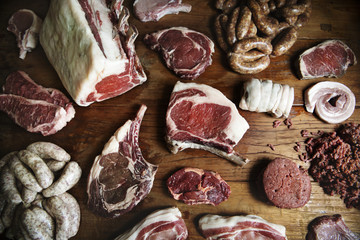
For example, a chuck roast can be kept whole for roast beef, or you can request that it be pre-cut into stewing beef cubes or turned into ground beef. Pork belly can be kept as-is, or you can usually pay a little extra to have it turned into bacon for you. You can also typically request that some of the meat be made into sausages, choose how large and thick you’d like your roasts, steaks, and chops, specify whether you want bone-in or boneless cuts, and decide how many steaks or chops you want packaged together in each pack. Depending on the arrangement, you may submit your cut list to the farmer at the time of ordering, or directly to the butcher when the meat is ready to be processed.
Other things to keep in mind, as alluded to above, are what sort of culinary experience you have—or want to gain. Some cuts may be easy to use, while others might require a bit of learning as you go.
The front shoulder of a pig—called the pork shoulder or Boston butt—can be turned into pulled pork in classic BBQ, tasso ham in Cajun traditions, or the coppa can be cut out and cured to make capicolla. You can also opt for country-style ribs, which work beautifully in any recipe that calls for pork, as they take on smoke and spice exceptionally well. Maybe all of those options appeal to you—or maybe none seem easy—but trust me, with a little coaching and by connecting with others in the homesteading community who are doing these things, you can try something new.
Sample Beef Cut List (Based on a Half Share or Side)
Sirloin Steaks: Great for grilling, fajitas, carne asada, or any meal that calls for strips of beef.
Rib Steaks: Your classic ribeye—available bone-in or boneless—with thickness cut to your preference.
T-bone Steaks: The Porterhouse and T-bone come from the same part of the cow—the shortloin—with the main difference being thickness—1.25 inches or more is typically considered a Porterhouse, anything less is a T-bone. Choosing T-bones means the tenderloin and New York strip remain connected on either side of the “T,” rather than being cut as separate steaks.
New York Steaks: If you opt out of the T-bone then you are saying yes to the New York steaks, also referred to as New York strip or striploin steaks.
Tenderloin: The “other side” of the T-bone. You can choose to keep it whole as a filet or have it cut into medallions. Filet mignon comes from part of the beef tenderloin.
Short Ribs: You can have these cut long, short, halved, or flanken-style (the classic Korean-style short rib, cut to 1/2-inch thickness). Braise in a bottle of wine with some homemade beef stock on a lazy Sunday.
Chuck Roasts: The best of the roasts—great for classic roast beef or smoked and shredded for pulled beef.
Sirloin Tip Roast: Usually tied with butcher twine and cooked as roast beef. I like it pan-seared and smoked, then chilled and sliced thin.
Top Round / Bottom Round Roast: Great for jerky or sliced thin and pan-seared. Also excellent for Italian beef and cheesesteak-style sandwiches.
Stew Meat: Stew meat often comes from the chuck or round. The only difference is that it is pre-cut into chunks which can be tossed into the slow cooker for quick and easy beef stew.
Tri-Tip: Very popular, especially on the West Coast. Leave it whole to sear and smoke, then slice thin for an excellent meal.
Brisket: Great for Texas-style smoked brisket, corned beef, and pastrami.
Burger/Grind: Whatever is left over from all of the trimmings becomes the grind. Ground beef is an elite cut! Don’t be fooled—Oklahoma-style smash burgers, big chain copycat burgers, and so much more are all prime ways to jazz up this classic cut!
Bones: A must for rich stocks and broths. Always say yes to the bones!
Other: Consider asking your farmer and butcher for the beef cheeks, oxtail, heart, liver, kidneys, etc.
This beef list is by no means exhaustive—rather, it’s a guide to cuts and meal preparations you might recognize and need for that Tuesday night meal.
Sample Pork Cut List
Pork Roasts: Great for slow roasted pork, rolled in herbs, and served as a Sunday dinner.
Pork Shoulder/Butt: The pork shoulder—also called pork butt or Boston butt—is great slow-cooked and shredded to make pulled pork. It can also be cut into country-style steaks.
Pork Chops: Chops come from the loin of the hog and can be selected as bone-in or boneless.
Pork Ribs: Best cooked low and slow with your favorite rub or bbq sauce.
Ham: From the rear leg, you can often request that this cut be brined, smoked, and turned into ham for you, or you can cure it yourself to make your own traditional ham or prosciutto.
Bacon: Bacon comes from the belly of the pig. Bellies can be cured and then smoked and cut on demand for virtually any meal. The Italian-style bacon is called pancetta and although takes a few more steps, is an uber-rich way to use bacon for your pastas and salumi boards.
Bones: Although not as common as chicken or beef broth, pork bones are used in many Asian-style broths like Ramen and Pho.
Leaf Fat: This is the fat that comes from around the kidneys and loin of a pig. Known for its mild flavor, it’s considered the highest quality fat for rendering into lard for cooking and baking.
Back Fat: Back fat can be cured and made into lardo or can be rendered, along with leaf lard to fill up several containers of lard for various cooking purposes.
Sausage Meat/Grind: all of the trim and any other cuts you designate to be made into sausage becomes the grind. You can take all or part of the trim and turn it into ground pork or in some cases you can request that the butcher turn the meat into sausages for you.
Other: Don’t forget to ask for the jowl—you can make your own guanciale (cured pork cheek), which is a great introduction to Euro-style curing. Guanciale is a classic in carbonara and other Italian pasta dishes. The hocks, when brined and smoked, are a flavorful addition to a pot of greens or beans and are a nice option if you don’t select the whole leg. You can also usually request half of the head if you’re interested—most butchers and farmers will accommodate if you ask and are prepared. There are many old-school cooking and curing methods for the pig’s head, offering an adventurous path if you’re up for it. We really like the jowls and tend to focus our efforts there, but the ear, tongue, and more might also be available. The offal—meaning the internal organs—may be offered too and are definitely worth looking into.
Along with the beef, this is merely a guide, a path you and your family could select when making the decision to purchase a share of pork or beef.
Finding a Farmer
Whether you live in the city or the country, there are likely farmers who are raising animals—responsibly—and not too far away. It is worth looking into. Ask around. Maybe the local co-op knows of someone? Check a local farmers market and ask the folks at the booths or take a drive into the country and see who is advertising on the side of the road. Give them a call or look them up online; they are there and worth the search.
Alternatively, call your local butcher. Since they see the “final product,” they can speak to the health and care a local farmer is taking in raising their animals. If it still feels overwhelming, see if another family would be interested in sharing the cost and experience with you.
Although it may feel a bit uncomfortable to commit to a share of a big animal, when buying from a good local farmer, it can make a big difference in your family and how you eat, both financially and for your health. Having a freezer full of pork, beef, or lamb is beyond just “nice to have.” Rather, it ensures food security and takes some of the guesswork out of mealtime. Plus you can feel good about helping that small farmer who worked so hard to raise that animal in the best way possible. There really are no downsides to purchasing a meat share!




Leave a Reply