
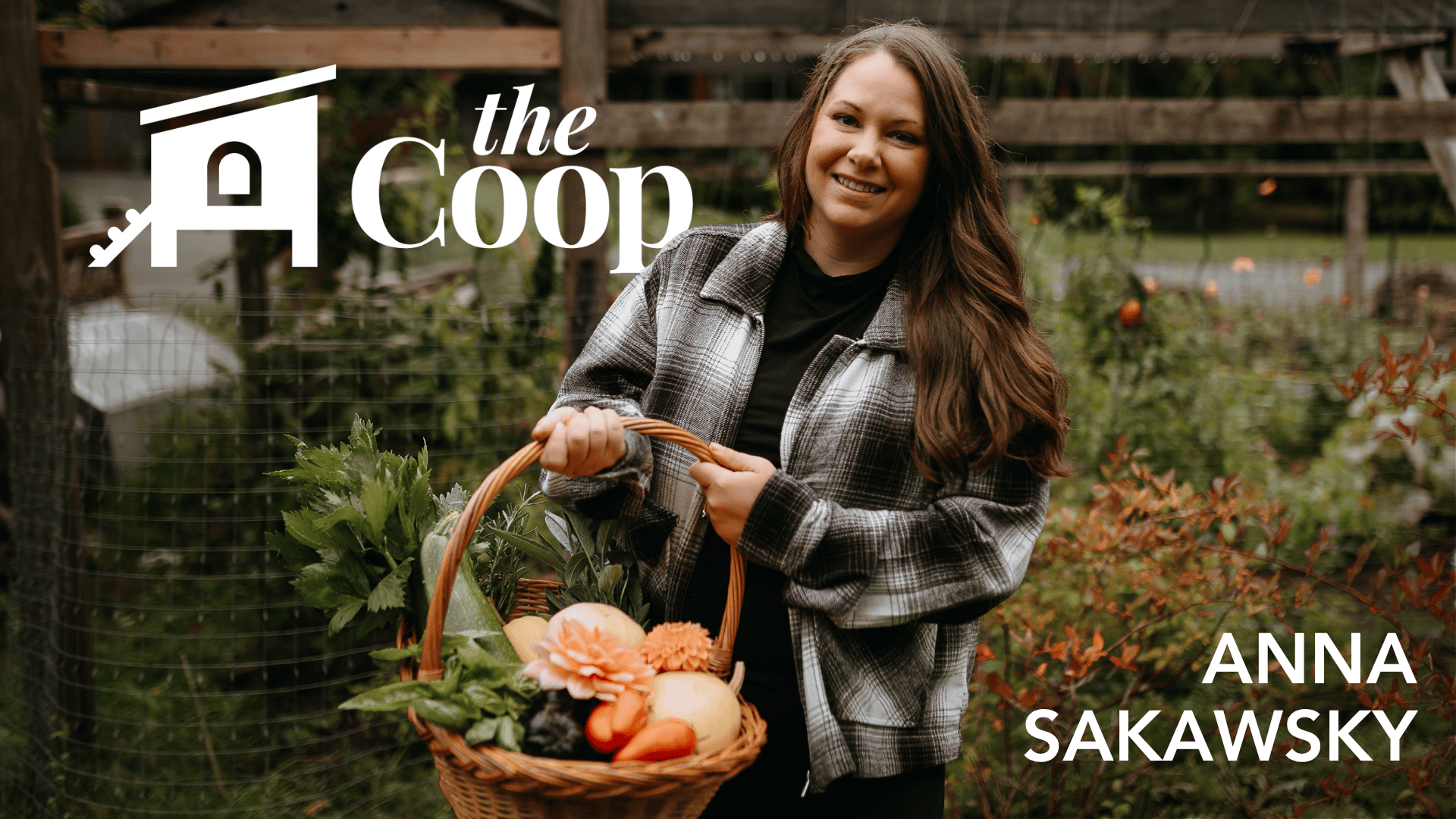



In this solo episode of The Coop, Homestead Living Editor-in-Chief Anna Sakawsky finally shares her own story.
From growing up as a city kid in Vancouver with almost no exposure to homesteading, to the stressful travel-agent days that made her long for a slower, more connected life, Anna opens up about the path that led her here.
She talks about the travels abroad that unexpectedly taught her to cook creatively and make do with whatever was available, and the early days with her husband Ryan … living with very little money in Australia and learning to turn simple ingredients into meals they actually enjoyed.
Most importantly, Anna addresses the big question so many people ask: What does homesteading actually mean in the modern world? She shares her thoughts on the confusion around the term, why definitions vary, and who this lifestyle is really for.
If you’ve ever wondered about Anna’s journey or felt unsure whether you “count” as a homesteader, this honest conversation is for you.
In this episode, Anna Sakawsky discusses:
- Her city-kid upbringing in Vancouver and early memories in her grandpa’s garden
- The stressful travel-agent job that sparked her desire for a slower life
- How traveling and living abroad unexpectedly prepared her for homesteading
- Early married life with Ryan: learning to cook creatively on a tight budget
- What homesteading means (and doesn’t mean) in the modern context
- Why there’s confusion and sometimes debate around the term “homesteader”
- Who this lifestyle is really for
About Anna Sakawsky
Anna Sakawsky is the Editor-in-Chief of Homestead Living magazine. A former city girl from Vancouver, BC, she now lives with her husband Ryan and their family, working to build a more self-sufficient and meaningful life. Through the magazine and The Coop podcast, Anna is passionate about giving a voice to real homesteaders and sharing practical wisdom for wherever you are on the journey.
The show notes …
00:00 – Intro
01:22 – Getting to Know Anna
03:52 – From City Kid to World Traveler
07:49 – Discovering the Homesteading Movement
14:46 – The First Farmhouse
19:05 – Building The Current Homestead
24:08 – From Blogger to Magazine Editor
29:56 – What is Homestead Living?
36:37 – What Does Homesteading Mean Today?
43:21 – The Reality vs. The Online Aesthetic
46:53 – Final Thoughts
Anna Sakawsky:
And there’s a constant tension between living the homestead life and working to fund it and to share it with the world. But the reality also is that if you’re really doing this and you’re really living this lifestyle, it’s messy and it’s hard and it can be stressful and all these things too. And I’m going to tell you a little bit about me, my background, my homesteading journey and where I’m at, what my situation looks like, all the things that happen on the slippery slope that is homesteading. And again, if you’re on this journey, you probably have a bit of an idea of what that’s like.
Friends, nothing says homestead life like a backyard flock that fills your egg basket every morning, and maybe even your freezer too. That’s why I’m so happy to share today’s sponsor, Murray McMurray Hatchery. They’ve been helping homesteaders raise healthy backyard poultry for over a hundred years. They also carry more than a hundred breeds of chickens, ducks, geese, turkeys, and quail, including some beautiful rare and heritage breeds. Their chicks are handpacked with care, backed by a live arrival guarantee, and they’ve got all the supplies you need to get started raising backyard poultry at home in their one-stop shop. Whether you’re adding a few new layers or starting your very first block, you can head to mcmurrayhatchery.com to order your chicks today. Tell them the coop sent you and start building the flock you’ve been dreaming about. Again, that’s mcmurrayhatchery.com. Well, hello everyone and welcome to episode number 18 of The Coop.
My name is Anna Sakawsky and I am the editor-in-chief of Homestead Living Magazine. And today I want to talk to you a little bit about just who I am and who we are at Homestead Living and what the Coop is all about and also what homesteading actually means. So it’s a little bit of an introduction episode, kind of the intro that we never had. I know it’s a little bit weird to do an introduction episode on episode 18, but I do think it’s high time that we do because some of you probably don’t know much about me. And as the host, I want to share a little bit more about my own homesteading journey so that you know who you are listening to, but some of you might also not know much about homestead living, especially if you found us on YouTube or on Apple or Spotify.
You might not know what we do or how we help and give a voice to the homesteading community. So I want to talk a little bit about our story. And then finally, I want to quote unquote define the terms here. So to talk a little bit more about what I think homesteading is, what it isn’t, who it’s for, who it’s not for, because everybody has a little bit of a different definition about what homesteading means in the modern context. We’re not talking about the Homestead Act here, which funnily enough, some people who are not familiar with homesteading in the modern sense still think of when they think of homesteading. I actually had a terrible time trying to register my business up in Canada where I live trying to register a business with the name Homestead in the title because the official definition that I guess our government still has about what homesteading actually means is getting free land, staking your claim on free land.
That’s not necessarily what we’re talking about in the modern sense, but there’s some confusion around it. And it’s a question that I ask a lot of our guests that we have on the show is, how do you define homesteading? What does it mean to you? And everybody has a slightly different answer, but there are some common threads too. So I want to talk about those and kind of address this question of like, who is a homesteader? What does it mean to homestead in the modern day? Especially nowadays when more and more people are coming to this lifestyle and more and more people are sharing it online. There’s been a lot of arguing almost that I’ve seen online lately about what a homesteader truly is and how long you need to have been doing this to be considered a real homesteader and all that sort of thing.
So I want to address some of that as well. So let’s just kind of dive in. I’m going to tell you a little bit about me, my background, my homesteading journey and where I’m at, what my situation looks like. So my husband, Ryan, and I, we first met when we were living in the city. So both Ryan and I grew up in Vancouver, BC. And so we both really grew up as city kids. We lived in the suburbs, but we were full on city kids. I didn’t really have any exposure to homesteading or farming or anything like that. The closest to it probably was when I was a little girl. I mean, my grandpa had a pretty sizeable garden in his backyard. He did grow up in an era and in an area of the province where they did do a little bit of homesteading.
They probably didn’t call it that back in the day, but they did grow some of their own food. And he had always had a garden, so that was natural for him and his mother did. And I remember my great-grandma still being alive when I was a little girl. And I remember she would always have like some tomato plants that she’d started in a sunny window and she’d grow some things in the backyard. And so that’s probably similar to a lot of people’s stories where a few generations back, like our family members were doing this and then it kind of got lost somewhere in between. But I was lucky enough to spend enough time with my grandpa that I had, I got the opportunity to go out in the garden with him and just kind of play in the dirt and that sort of thing. So I had some exposure to it anyway, but otherwise I really didn’t grow up around this at all.
So when I was a little bit older … Well, I mean, I always loved nature. That was one thing. I always felt most at peace in nature. I loved to go camping and I loved to just be connected to the land and the seasons in whatever way I could. And then when I was a young adult, I was actually working as a travel agent and it was a pretty stressful job. And I was always on call and there was always problems with canceled flights and all the stress that goes along with that. And I was working downtown very much in the heart of the city and I just was dealing with a lot of anxiety all the time. And I remember going out to visit a friend who had moved out to one of the small islands off the coast of BC and it was just so beautiful and so peaceful.
And I’m standing out there on her balcony looking out into the forest and there’s deer. And it was just so, so peaceful. And meanwhile, I’m on the phone trying to deal with a canceled flight and all of the stress that goes along with it. And I just thought, what am I doing? This is not what I want. I don’t want this kind of fast paced city life. I want this, right? I want to be somewhere where I can feel more connected with the land. So that was like my first inkling that I wanted to make a shift, but it still didn’t happen right away. I traveled a lot in my 20s and that led me all over the world. I lived abroad in Vienna, Austria for a term when I was going to school and traveled across Europe. And then I got to live in Africa for a while, just traveled around South Africa and then ended up doing some volunteer work in Senegal.
And that was a really interesting … Traveling was really opened the door for me to do things that eventually led to homesteading, funnily enough, because traveling abroad and homesteading, being very home based can seem like very opposite things, right? But it was the first time I was really on my own. I had to learn to cook for myself, especially in Africa. That was a different experience altogether where it was like very much we just had a little burner and whatever you could get at the market that day was what you had to make. And it forced me to learn a lot and get creative. And then later on, I actually also lived over abroad in Australia. And that’s where my husband and I, we had met working and travel before that, but we stayed in touch and he ended up moving over to Australia with me and we lived there for a time.
And that also continued to grow this kind of love for food. I guess in both of us, we didn’t have a lot of money. We were young. We were backpacking. We didn’t have a lot. And so we were living for a while in Byron Bay on the East Coast of Australia and basically didn’t have two nickels to rub together. And so we had to make do with whatever we had. We started watching a lot of cooking shows. That was really a big thing in Australia at that time, like master chef type stuff. And my kitchen rules was another one because we got like a free TV on the side of the road, so that was some of our entertainment. And then we couldn’t afford to eat out, but of course we still had to eat. So we were like, how can we eat for as cheap as possible, but still enjoy it?
And so we were really inspired to go to the grocery store, see what we could get and see what we could actually make a meal out of. So as silly as that sounds, that was kind of the very beginnings of this foray into homesteading for me because I learned that I really liked to do this and I now had a partner who actually really liked to do this stuff too. And so when we came home and we moved into an apartment in the city and we actually had our own kitchen though. So it was really cool because it was like, “Hey, now we can expand on this love for cooking and food and all that. ” And so one thing led to another. And then that love of cooking and ingredients, making something out of nothing in a sense, out of a few ingredients led to me looking at how can I source my food more locally, finding local farmers in the area, that sort of thing.
And then around this same time, this would have been late around, I guess 2012 was when we got back from Australia and this was around the same time that the homesteading movement was starting to pick up a bit of steam. So this was around the time that documentaries like Food Inc were coming out. That was a big kind of first exposure to Joel Salatin, for example, who is one of our regular contributors for the magazine now. But I believe it was like either that documentary or one of those. There was lots at that time that were coming out that kind of introduced us to this term homesteader, right? They were kind of comparing and contrasting the big industrial egg system that produces most of our food and then contrasting that with small regenerative farmers that were doing things differently. And then also people who were doing it on a homescale and they were calling themselves homesteaders, right?
This is kind of growing for themselves. So rather than for production where you’re growing commodity crops or you’re growing to sell, homesteaders were taking that control of their food because they were growing it at home themselves. And that really sparked something in me. And then at the same time, a lot of the documentaries on TV too were based around that. They were picking up steam. So if you listen to our last episode, I had Eve Kilter from Alaska the last Frontier Fame. So Discovery Channel had a bunch of these shows, Back to the Landers up in Alaska and homesteaders and people that were just living alternative lifestyles. And so these puzzle pieces started coming together for us where we’re like, we like the cooking, we like sourcing local, I like knowing where my food’s coming from. I’m watching these documentaries about our industrial agriculture system and our industrial pharmaceutical industry and all these things.
And I’m going like, “I know I don’t want that. ” And I’m back in the city where I grew up now and I’m dealing with anxiety again because there’s something about being in this city environment that’s not fitting and sitting well with me. And so all these puzzle pieces start to come together where it’s like, “Okay, I do want this. I do want a hand in where my food comes from and how it’s produced and processed and all that. ” And I don’t want to be feeding into this big industrial system in the way that we are now as just being kind of consumers of it. And I don’t really feel like I’m at home in the city and I think I want something else and we’re starting out, we’re getting married soon and we’re trying to figure out like, what does life look like for us?
What do we want out of life? Where do we want to be? And so eventually, I can’t remember now if it was like a light bulb kind of went off overnight or if it was just this slow burn to where we kind of just went like, maybe this is the thing. Maybe we should pursue homesteading and move out of the city and get a little bit of land and have a garden and maybe have some chickens and raise some our own food and be more self-sufficient and disentangle from this system. And so that’s essentially what we did. And the journey was slow at first because we were still living in a condo in the city, but we started, we did what we could. Again, a lot of that at that point in time looked like sourcing food locally from other food producers in our area.
I started learning how to forage for certain things that were in season. I started doing like very, very basic preserving, like really just mostly freezing at that point, but just freezing things that were in season and then getting to enjoy them throughout the year rather than just going to the grocery store and getting blueberries from, I don’t know, South America or something in the middle of the winter, right? Really trying to get more local with our food, cooking a lot more from scratch, learning a lot more about that.
And then eventually we did start to try to grow some things, but we didn’t have a lot of luck where we were. We lived in an apartment building or our apartment had a north facing balcony. So it was shaded most of the day, which is not great when you’re trying to grow food, but I didn’t know anything about growing anything at that point. And so we had some herbs that like kind of did okay, but even they kind of dwindled over time because they weren’t getting enough sunlight. I think maybe we tried to grow a tomato planter too that didn’t do much of anything. We tried to start carrot seeds indoors, which that was a total failure. Typically, first of all, you don’t start carrot seeds indoors, you just direct sew them in the ground, which I had no idea what I was doing, but we also put them inside, did not have them under direct light.
The window was like half a mile away and they were leggy and reaching toward the window and we way overwatered them and they were saturated. And I feel so bad for those poor little baby carrot seedlings that all just died. But you have to start somewhere. And so we did. That’s where we started. And most importantly, that was when I was in that voracious learning stage. And if you have ever been in that stage of homesteading or if you’re in it now, you know how exciting it is, right? That’s when everything is new and you want to learn everything. So I was taking books out of the library. I remember like the library was my best friend at that point in time and I was going and taking out books on everything to do with home setting and how to set up a small backyard garden and do a small skill homestead and how to identify certain things that you’re foraging for and how to cook more things from scratch and bake things and all the things.
I was just like, I couldn’t get enough of it. It was like a fire hose had turned on and I was there for it to lap up every drop of it. I loved it, but I wanted to like take the next step too, right? And we were limited at the end of the day with what we could do in our apartment. And so we did have a plan to get out of the city. So fast forward a couple years, I had to go back to school and we got married and then we had made a plan to leave the city and move to Vancouver Island. So that is where we live now. So we live in a place called the Komox Valley, which in the local indigenous language here means the land of plenty. And that is actually because the soil is very fertile here because it was an ancient seabed basically.
So a long time ago, this was underwater. And so there’s a lot of mineral deposits and that sort of thing in the soil here, which makes it very rich and very fertile for growing. And so it is a very big agricultural community here, lots of local food producers, lots of people that are into like regenerative, organic farming and growing and all that stuff. So that was part of why we decided on this community specifically, we did a lot of research into where we wanted to move and what would suit our needs and our goals in life. And we settled on the Komox Valley, which I am so glad in so many ways that we did. And at first when we moved here, we rented, but we luckily had to deal with the owners who my husband had worked for one of the owners when we lived back in the city and they happened to have a property over here that had been in his wife’s family forever.
Her grandfather actually built the house and her father had grown up in the house and she had grown up in the house. And then when her father, I guess, had passed, the house was empty and they wanted to move back here when they retired or when they were ready and restore the house. It’s a beautiful old farmhouse. But in the meantime, it was sitting there not being lived in and they wanted to get some work done on it. So we kind of made a deal with them. Luckily I have a very handy husband and so he agreed to do some of the renovation work on it and we got to live there in the meantime. And that was great because we had animals that we were bringing and everything and it’s, I don’t know where you live, but where we are, it is very difficult to find rentals that will allow you to have animals as well.
So it was a good deal always around. And we were super lucky that they did not charge us rent while we were there, which was just like another leg up for us. But in exchange, there was a work exchange for it. But so this farmhouse was on about, I want to say it was about an acre, just under an acre, but it also shared a few acres with the neighboring property and the neighbors were fantastic there and they had free range hens, free range chickens who would wander over and we’d get our eggs from them. And so that was like another, like my first toe dip into living somewhere where like we got chickens running around and I can just get my eggs off the neighbor now. And there was a really big old apple tree there. And when it was apple harvest season, we just had hundreds and probably thousands of pounds of apples fall off this tree.
And I was so excited because I got to actually preserve them. That was my very first time canning was I canned a whole bunch of applesauce. And so that was how I got my toes dipped into that. And we asked if we could put a garden in and they let us put a few raised beds in. So we started to garden and then I learned how to start seeds. And then we were really cash strapped that first Christmas there. And so I decided to start making candles to give to everybody that Christmas. And so then I got into making things like candles and home and body products and that sort of thing. And just it started to snowball from there where one thing led to another, canning led to dehydrating, led to fermenting, led to all the things that happen on the slippery slope that is homesteading.
And again, if you’re on this journey, you probably have a bit of an idea of what that’s like now. For a lot of people, it’s sourdough, for example, right? Sourdough was known as like the gateway drug into homesteading and you start with that and then you move on to something else. And then the beauty of this lifestyle is that there are a never ending amount of things that you could learn or you could add or you could do. That’s also a bit of the curse with it is you have to be realistic about how much you can do and how much you can do in all at once or in a season. But so that’s how we got started anyway. And then back in 2018, we bought a house just around the corner actually from there. So we’re not too far from where we started off.
But now we own our place, but we are on a quarter acre. So it’s really not that big. A lot of people are really surprised that when they hear about our property, because I think maybe some people that do know me or follow along, would assume that I have some big homestead and we don’t. We just have a quarter acre that is basically, we’ve got one foot in the suburbs and one foot in more rural living. We are technically zoned as rural, but we’re three properties away from the property line from the city. We live on a cul-de-sac in the front, but we back onto a green belt. So we’ve kind of got a foot in both worlds. We’re down at the end of a dark no through road, but then at the same time, we’re right around the corner from Costco and the hospital.
So in many ways, it’s actually the best of both worlds. Eventually, we would like to maybe upgrade and move out and get farther out, but for now this is a really good stepping stone. And on our quarter acre, we actually produce a fair amount of our food. So we have a large garden. Our whole front garden is basically garden beds, or our whole front yard is gardens. So we have four big in- ground beds that are, I call our market rows, because that’s where we kind of grow for production, grow a lot of our stable crops. And then we put in four more raised beds last year, one of which is our medicinal herb bed that I’m building out. And then the other three are kind of a mix of, I’m doing flowers now as well as a lot of our vegetables we grow. And we have a cattle panel trellis where in the middle of that where we grow our peas and our beans and all that sort of thing.
So we’re trying to really work on how to maximize production on a small property. That’s our main goal. Just adding things all the time, grapevines and apple trees and cherry trees we added last year. And we have about … We have eight chickens. Eight chickens righ now? Yeah, eight chickens. We have one brooster, we call him Randy, Randy the rooster and seven hens at the moment. We have had rabbits here before, but we don’t for now, but we do have a pen where we could have them again, or we’ve thought about maybe doing some meat chickens, although we have not done that yet. We are currently building a greenhouse. We are currently, well, starting to convert back behind me, if you’re watching the video, is the door that leads to our laundry room/pantry. And we’re kind of working on converting that into a bit of a prep kitchen because we do a lot of preserving in the summer.
And so having that be where we do some of the canning so it doesn’t take up our whole kitchen, have my dehydrator and my freeze dryer back there and we’ve got building out an expanded pantry because we’re also just in a rancher. We’re on a quarter acre and we have about a 1200 square foot rancher, right? It’s not huge. So we’re really trying to make the most of what we got. We also had a garage that we converted into a rental. So that’s all part of our homesteading plan though too, right? Is how can we be more productive on this land, earn an income from this land, whether it’s working from home or having a little bit of rental income come in, how can we produce more through what we’re growing and doing and producing? So that’s kind of our story in a nutshell and where we’re at now with homesteading.
And quite honestly, I am so happy to be here. Yes, we have dreams of having more land and doing more eventually. I also have a nine-year-old daughter and a three-year-old son, and we are very busy. And I don’t know, quite honestly, if I could handle more than what we’re already doing.
We source our meat, for example, locally because we’re not producing most of our own meat. We do have our chickens for eggs, but for the most part, we’re sourcing locally. We have a freezer full of beef and half a hog and are very lucky that we live in a community that also is full of food producers and small farmers and that sort of thing that we can support and that we can lean on for the things that we are not producing. So that is kind of our story. In addition to that, and maybe this kind of leads into the next thing about who is homestead living and what is my part in that? This episode is brought to you by Azure Standard. Family owned since the 1970s, Azure Standard is on a mission to make real food more accessible by delivering it straight to your doorstep or to a convenient local drop point near you.
Everything they offer is completely organic, non- GMO, and free from junk additives you don’t want in your home or in your body. With more than 13,000 carefully vetted products, Azure standard makes it easy to stock up on what really matters from bulk grains, nuts, and healthy oils to fruits and vegetables, frozen meats, pantry staples, and even clean household goods. And the best part is you skip the grocery store markup. You can order exactly what your family actually needs, save big on high quality food and pick it up alongside neighbors who care about the same things you do, health, sustainability, and supporting ethical producers and head to azurestandard.com right now to get started. Again, that’s azurestandard.com. I decided to start a blog back in 2017, I believe now. And this of course was in the age of bloggers and homestead bloggers. And I certainly wasn’t one of the pioneers.
There were a number of bigger homestead bloggers that had come before me, but this was still in the heyday of blogging and all that. And I have always loved to write. The first time I went to university was for journalism. I’ve always loved to … I have a magazine that I made for a school project when I was about seven or eight. So it was always something I’d like to do, write and edit and do that stuff. And then I went back to school to be a teacher, realized that wasn’t for me. I loved to teach, didn’t love to manage a class of kids. And then when I had my own kids, I had to be able to manage my energy to be with them. And anyway, so I decided I wanted to stay home with them, but I also wanted to still pursue something that was meaningful for me.
And so I started to see these other homestead bloggers doing this as a living. I didn’t realize this was something you could actually do for a living, but they were, and they were sharing about homesteading and they were sharing what they were doing online and they were creating a bit of an income from it as well. And I was looking for a way to combine all of my passions and also be home with my kids. And so I launched my blog, which is called The House and Homestead back in 2017 and grew a little bit from there. It was never like a huge blogger, but I made it okay. It was supplemented our income and it was something, it was something that kept me extremely excited about what we were doing and excited to share it with everybody. And then in 2019, I decided to launch my own little magazine called Modern Homesteading Magazine.
And I cringe now when I look back at the first covers of that, it was so bad, but I just put it together. It was just free at first. I just wanted to be able to have it to be something to give away to my readers in more of a printable compact form rather than on a blog. And it kind of took off. The people that were reading it really enjoyed it. So I just kept doing it every month. And then I did that actually for almost four years and people really wanted print. That was what I was realizing was that the homesteading community, it’s so funny because print is dying in so many ways. A lot of magazines are shutting down and just going digital now because people aren’t buying magazines like they used to, but the homesteading community, they like tangible things that they can hold in their hands and they can keep on their shelves and they can dog ear and actually hold onto in case they can’t access it online for some reason.
I think that’s kind of part of this wanting to go back to the old fashioned, to this, maybe an analog, lifestyle, whatever the case may be. But with Homesteaders, we want to kind of go back to those things that are real and tangible and the things we can hold. And so I was getting a lot of requests to go to take the magazine to print, but being that I am actually based in Canada and most of my readers were in the US and printing and shipping costs, and this was already what, 2022 or 23, I guess. So we were already into the age of supply chain issues and inflation and that sort of thing after COVID. And no matter how many times I crunched the numbers, I couldn’t make it make sense. It was just not going to be a sustainable business model. I couldn’t do it all myself and bring it to print and ship it and everything.
And so I decided to do a print issue for my very last issue, just as a thank you to all my readers and then shut it down. And right around that exact same time, I think I announced that online and Melissa K. Norris, who is one of our co-founders here at Homestead Living, reached out and said, “We are looking to take our magazine, Homestead Living print, and we need an editor and I’ve been watching what you’ve been doing and would you be interested?” And for a little bit of context, Melissa, and I do go back a little bit because she was one of the very first homesteaders that I ever started following that I learned most of what I know probably from. I learned how to garden from her and I learned how to bake sourdough bread from her. And I learned a lot of the preserving aspect of homesteading.
I learned from her as well, canning and everything. And then I got to do some work with her on her blog back in the day. So did some guest posting there and helped her transcribe her podcast for a while. So we had a little bit of a relationship, but when she asked me to come on as the editor for Homestead Living, it really was kind of serendipitous. It was just like divine timing that they were looking for somebody to take that role because they were going to print and I was leaving and it took me months of deliberation and quite honestly praying over it and really listening to my intuition. And it was saying, “It’s time. It’s time to close this door.” And I didn’t know what was next. I just followed that intuition and I closed that door and literally the door to Homestead Living opened right at that time.
And so I came on as the editor of Homestead Living Magazine in January of 2024, and that is when we officially went to print. We had done one trial print run before then and we started going to print in January and that’s been my role ever since. So I’m still running the house in Homestead on the side. If you want to ever go check that out, I’ve got lots of resources on there for anybody getting interested in homesteading or lots of gardening and preserving and cooking and baking and all that sort of stuff you can find at the houseinhomestead.com. But my main role now is as the editor-in-chief for Homestead Living. So that Brings me to who are we and what do we do? So for those of you who don’t know, first of all, The Coop, the podcast that you’re listening to is brought to you by Homestead Living.
So we are a full media company who is committed to equipping people worldwide with practical education to fuel their homesteading journeys. That is our official mission and we do that in a number of ways. So number one is through the magazine, that’s how we started. So we actually started co-founder Melissa K. Norris and her co-founder, Daryl Vesterfeld, founded Homestead Living back in 2022 because they saw that there was kind of a bit of a gap in the market. And there were some certain magazines that had been around for a long time that cater to the homesteading or back to the land crowd. But there was nothing really speaking to a lot of the more modern homesteading crowd, people that have come to it in the last 10 years or so. And so they wanted to give a voice to these modern homesteaders. And it started off as just a really basic digital magazine and it grew.
And of course, the homesteading crowd was demanding print, right? Probably louder than they were with mine. I saw a lot of the comments online and people were like, “This is great. Let me know when it comes to print and then I’ll buy it. ” So it took a couple of years of them growing it to the point where they could take it to print, but then that’s ultimately why we went to print is to serve the homesteading community who largely wants, like I say, something they can actually hold in their hands and keep on their shelves. So it started with the magazine. We’ve continued to grow from there with the magazine. And we have also grown into a publishing company. So we actually have six published titles to date, so books, including some titles that hopefully you know or maybe even have on your shelf already.
Some of them are behind me. It’s a little bit small, so you probably can’t see them. But our first one was Everything Worth Preserving, which was by Melissa K. Norris. So a full comprehensive preserving book kind of covering all of the different preserving methods from canning to dehydrating to fermenting and all the different crops and how to preserve them. So there was everything worth preserving. Daily sourdough, which has I think been our top seller by Lisa Bass of Farmhouse on Boone. So Lisa is really well known for her sourdough baking. And this, again, because I think sourdough is so accessible to so many people, it has been wildly successful. This book, if you don’t have a copy of daily sourdough, definitely check it out. You can get all of these books to on our website, so at homesteadliving.com or check them out there. So we had everything worth preserving, Daily Sourdough, Freeze Drying the Harvest by Carolyn Thomas of Homesteading Family.
And there are some other freeze-drying books out there, but this is really, I’d say, like the definitive comprehensive guide to freeze-drying. The produce that is either coming out of your garden or that you’re purchasing from farmer’s markets in the summertime. If you are able to invest in a freeze-dryer, then absolutely it makes sense to have this as a companion book, but freeze-drying the harvest. Then of course there was Cheese From Scratch by Robin Jackson. So Robin is a fellow British Colombian up here. I actually first met her back when I interviewed her for Modern Homestead Magazine. She reached out to me and was like, “Hey, did you want to chat about cheese making?” And at the time I was like, “Yeah, I do. I don’t know anybody else in this space doing cheese making.”That was even for homesteaders, that was next level if you were making your own cheese and milking your own cow.
So we’ve got cheese from scratch by Robin Jackson and then the Beekeeper’s Apothecary, a foundational guide for becoming your own herbalist, a beautiful coffee table worthy book on herbalism essentially. It is a little bit deceiving because you don’t actually have to be a beekeeper to partake in the knowledge that Kaylee shares in her book and to make some of the recipes and be able to benefit from the herbs and the bee products like honey and that sort of thing that she uses in all of her recipes. And then our most recent release is Gardening with Chickens by Elisa Steele of Fresh Eggs Daily. So this is actually a release, a 10th anniversary re-release of Gardening with Chickens. And of course, she’s just got a decade more of experience under her belt to share about how to garden alongside your chickens in a way that’s symbiotic so that your garden is benefiting from your chickens, your chickens are benefiting from your garden.
And also your garden is not being destroyed by your chickens because that is a messy reality sometimes of homesteading. And I actually, we did an episode with Lisa Steele not too far back, probably three episodes back, I think, where we talk all about gardening with chickens. So if you want to learn more about that, go check that out. But if you’re interested in any of those titles or any of those topics, you can check them all out at homesteadliving.com. So we are a magazine, we are a publishing house, and then we also launched The Coop, which is this podcast, as a live show back in January 2025, and then we decided to turn it into a podcast in the fall of 2025, and that pretty much brings us to today. So our mission as a team, as a company, as an entity is to inspire a healthy and sustainable life.
And of course, that’s important that we all live that ourselves, right? So we don’t just preach it. We really try to walk the walk, right? We’re doing it right alongside you. And I’m not going to lie, pouring into work and into growing a business and a magazine and a podcast, that can be all consuming work. And there’s a constant tension between living the homestead life and working to fund it and to share it with the world. And if you miss the last episode, I mentioned I talked to Eve Kilchure all about finding balance as a homesteader in the modern world, because let’s face it, right? We don’t have all day to churn butter by hand these days. And man, sometimes I wish that we did, but I’m also happy to live in an age where we don’t have to spend all day churning butter. But that also does mean that we live in a time where we are trying to balance lots of different demands on our time and full schedules and all of … It’s not like most homesteaders nowadays go, “Okay, I’m going to be a homesteader, so I’m going to forego all of the modern conveniences and technology of the modern world, and I’m just going to go back to the land and live that way.” No.
What it means in the modern context is that we’re doing some of that stuff, but we’re doing alongside all of the demands of modern life, right? We’re trying to somehow fit it into an already very full schedule. And so that kind of brings me to my last point here, which is what does homesteading actually mean in its modern context, right? Because I mean, if we’re not spending all day churning butter in our kitchen, what are we even doing? Or can we even call ourselves homesetters? So the short and direct answer to that is yes. Yes, we can call ourselves homesetters and not be doing that. Homesteading is not all or nothing. It can look like running a herd of cattle on 10 acres or 50 acres or 500 acres, or it can look like turning your backyard into a garden or keeping a few chickens or baking sourdough bread and preserving food from the farmer’s market in your urban apartment, right?
That is homesteading too. Homesteading in the modern context isn’t about staking your claim on a free piece of land. All the power to you, if it can mean that as well, but it’s more so about the way I like to define it. And again, I ask most of our guests this and everybody’s got a bit of a different answer, but almost everybody touches on the fact that it’s like a mindset more than anything. And I believe that as well. And I think for me, the way I would describe it is it’s the mindset of being more of a producer rather than simply a consumer and being resourceful, doing what you can where you are with what you’ve got. So that can scale up and it can scale down, right? You don’t have to be doing it on a large scale or have a lot of land to just become a little bit more of a producer in your own life.
Maybe that just means baking some bread in your kitchen. You can do that anywhere. If you got a kitchen and you live in the 21st floor of a downtown apartment, you can bake a loave of bread. You can cook a meal from scratch. You can preserve something, right? You can something probably. And of course, then you can scale up from there. So when I was thinking about this and what is modern homesteading and how did it kind of evolve to where it is today? I wanted to just touch on what the history of modern homesteading is. And homesteading, the actual history of homesteading, I mean, really, it goes back to ancient times, right? Because growing our own food and producing what we need, that is just how people lived for centuries and millennia. Of course, they didn’t call it homesteading then, but that was just life, right?
And there’s a constant argument too between people about like, “Oh, well, this term homesteading and just why don’t you just do it? That’s just called life or that’s how I grew up or whatever.” But it’s helpful to be able to define it because it helps differentiate between people who are growing, for example, for themselves and their families versus growing for market or growing for the public. I think there’s a difference between farming, obviously in the conventional sense and maybe hobby farming and then homesteading. It’s just helpful to kind of be able to define, “Well, what do we mean when we’re talking about that? ” But we’ve been doing this, our ancestors did this forever. And then it kind of fell out of fashion in the age of modern convenience. It was actually really big. It had a couple waves where it came back and was really big during the first and second World War and during the Depression when people had to, again, turn to producing things for themselves to deal with not having the money to purchase things and to deal with supply chain issues and having to send all the food to the boys flight in the war.
So you’re encouraged to grow your own at home to supplement that. But then after World War II, I think is really where it fell off because we all of a sudden had all these modern conveniences. We also had all these chemicals left over from the war that people were trying to figure out how do we put these to use? And they were converting them into being used for pesticides and things like that. So that was where modern agriculture really started to take off and we, the people stopped producing as much of our food, right? Stopped having that connection to it. And it got lost over the next couple generations. There was the wave of kind of back to the landers in the 1960s and 70s, and that’s, I think, where maybe you would say the OG modern homesteaders came from, like the people that maybe called themselves homesteaders back in the day that were choosing it rather than having to live that way because that was just the way you had to live.That was probably the real first wave of people who were choosing to go back to the land, choosing to live a homesteading lifestyle.
And of course, that’s where some of the publications that we’ve known for a long time like Mother Earth News popped up around then. And then again, it kind of maybe fell out of fashion a little bit over the next couple decades. And then I’d say homesteading in its real modern context probably started to take off again around 2008. And that’s actually what I’ve noticed, but also what I’ve heard from people that I’ve interviewed and spoken to was that they really saw that there was an uptick back in 2008. And of course there was the recession, makes sense when times are bad or hard times, people start flocking to something that feels safe, right? It’s the same reason that people start buying gold when the economy feels shaky because they want to hang onto something that feels … I was going to say something that feels stable as I shake my screen, but they want something that feels like that it’s solid ground that’s not going to be ripped out from under them.
And homesteading offers that to people, right? It’s something that you can control in a world where it feels like a lot is out of your control, right? And so a lot of people started coming to the homesteading movement then. That’s also the same time that social media and blogs were taking off. And so that’s, I think, how this whole marriage of the homesteading bloggers kind of happen is they were just two movements that were taking off at the same time. And then it held pretty steady over the 2010s. And like I say, I came into this in 2017 and to the actual … Well, I mean, that’s really when we started homesteading as well. I guess 2015 was when we moved out to the island, but 2017 was when I started blogging about it and then COVID happened, right? And so 2020, 2021, 2022, a lot more people, right?
The latest kind of wave of homesteaders came in. Of course, we saw sourdough bread take off and we saw home gardens take off. And that’s when a lot of people came to homesteading. And then now we’ve got this other, like the latest movement, I guess, or people who are coming into it. And I know I’ve seen a lot of debate about this online, about just the fact that the online world is just saturated with homesteading content creators now. And a lot of them are really trying to put forth a persona or an image and really romanticize the lifestyle. We’ve got this vision of the beautiful woman in the long flowing prairie dress out in the garden and everything just seems very romantic. And honestly, I don’t think there’s anything wrong with that. I love the beautiful romantic side of homesteading because that is what draws us in.
If it’s not beautiful and romantic, at least some of the time, why are we even doing this? But the reality also is that if you’re really doing this and you’re really living this lifestyle, it’s messy and it’s hard and it can be stressful and all these things too. And again, I keep talking about the last episode we did with Eve Kilture, but it’s really worth a listen because we really dive into all of these challenges that we face as homesteaders and trying to balance it in the modern world and the hardships that come with it and all that sort of stuff. So all of that to say that our goal at Homestead Living is really to show the reality of this lifestyle.
I want to show what it’s really all about. I want to show homesetting and all of its glory, right? The good, the bad and the ugly, but we want to do it. We want to package it and present it in a way that still feels beautiful and inspiring and draws you. And we don’t want to turn you off of a lifestyle. We want to bring you in. And there’s a reason why people that live this lifestyle tend to keep living a sweat lifestyle. Yes, there are people who give it up. I believe from what I’ve seen, a lot of people that give it up or walk away from it, it’s because they took on too much, either too fast or just too much. It was more than they could handle. But again, I think if we look at homesetting as a spectrum, right, from the apartment city dweller growing some sprouts on their counter, herbs on the balcony and cooking some meals from scratch all the way up to the cattle farmer on a hundred acres or whatever, home setting is a spectrum and it looks different for everybody.
And for some people, like being out there in their prairie dress in the garden, flowing around, that is authentic for them and all the power to you if it is. I just don’t want anybody to ever feel like it’s unattainable or that if you don’t look like that or you’re not doing all those things or you’re not … I hear a lot of people online now arguing about like, “Well, I was doing this before before it was cool.” And then somebody else will come in and be like, “Well, you’ve only been doing it for 20 years. I’ve been doing it for 60 years and I was the first one doing it before it was cool and I’m the pioneer.” It really doesn’t matter. I mean, for me, I’m just happy to see more people coming to this movement and I just want that you, you who’s listening right now, no matter where you are or what your experience level, I want you to know that you are a homesteader and you are welcome here.
And this is for everyone, right? Again, I think it comes down to a mindset, right? This mindset that drives us to want to become a little or a lot more self-sufficient, produce more of what we consume and ultimately have a little more control over and connection to our food and the land and to the things that sustain us. And there is a big spectrum and a big scale of how we can do this and how this shows up and looks in each of our lives, right? It’s going to be unique to everyone.
So that’s a wrap for today, friends. Thanks for joining me for this, I don’t know, stream of consciousness. I hope it wasn’t too rambly. Yeah. I mean, let me know. Let me know what you thought. If you like these solo episodes, let me know. Or if you’d rather me just shut up and bring more incredible guests on who probably know a lot more than I do about homesteading, then we’re going to do that anyway. We’re going to do that anyway. But if you do like these solo episodes, maybe I’ll start to throw a few more in. So if you did enjoy this episode, be sure to like, subscribe and leave us a review because honestly, that is how we are ultimately going to reach more people and bring even more homesteaders into our growing community. So most importantly, thank you for being a part of our community here.
And until next time, keep building What Matters wherever you are using whatever you’ve got and I will see you all next time back here on The Coop. Before we wrap up today, I just want to thank you, our listeners for being a part of this community. If you’ve been listening for a while and haven’t yet joined us as a subscriber, this is your sign to start your subscription to Homestead Living Magazine. A Homestead Living subscription includes six beautifully printed issues each year, and they’re designed to be kept, dog eared, bookmarked, pulled off your shelf and referred back to you again and again. Every issue is filled with practical skills, seasonal guidance, and trusted voices who’ve put in the hours and learned the hard way so that you don’t have to. Right now, a full year, all six issues is just $49, and it is one of the best ways to support the work that we do here while building a home library that you’ll return to again and again.
As the editor, I may be a little bit biased, but if you value thoughtful, authentic, grounded guidance from people who don’t just talk the homesteading talk, but actually walk the homesteading walk, then this magazine was made for you. So you can start your subscription now by heading to homesteadliving.com/subscribe or click the link in the show notes.
Resources/Links
- Download Episode Audio File
- Subscribe to Homestead Living Magazine
Brought to you by
Murray McMurray
Trusted since 1917, this Iowa family operation hatches premium poultry for homesteaders and enthusiasts, delivering healthy, hand-packed birds and all the supplies you need to start your flock right …
Azure Standard
Family-owned since the ‘70s, Azure delivers real food to your doorstep or a local drop point.
Completely organic, non-GMO, no junk additives …
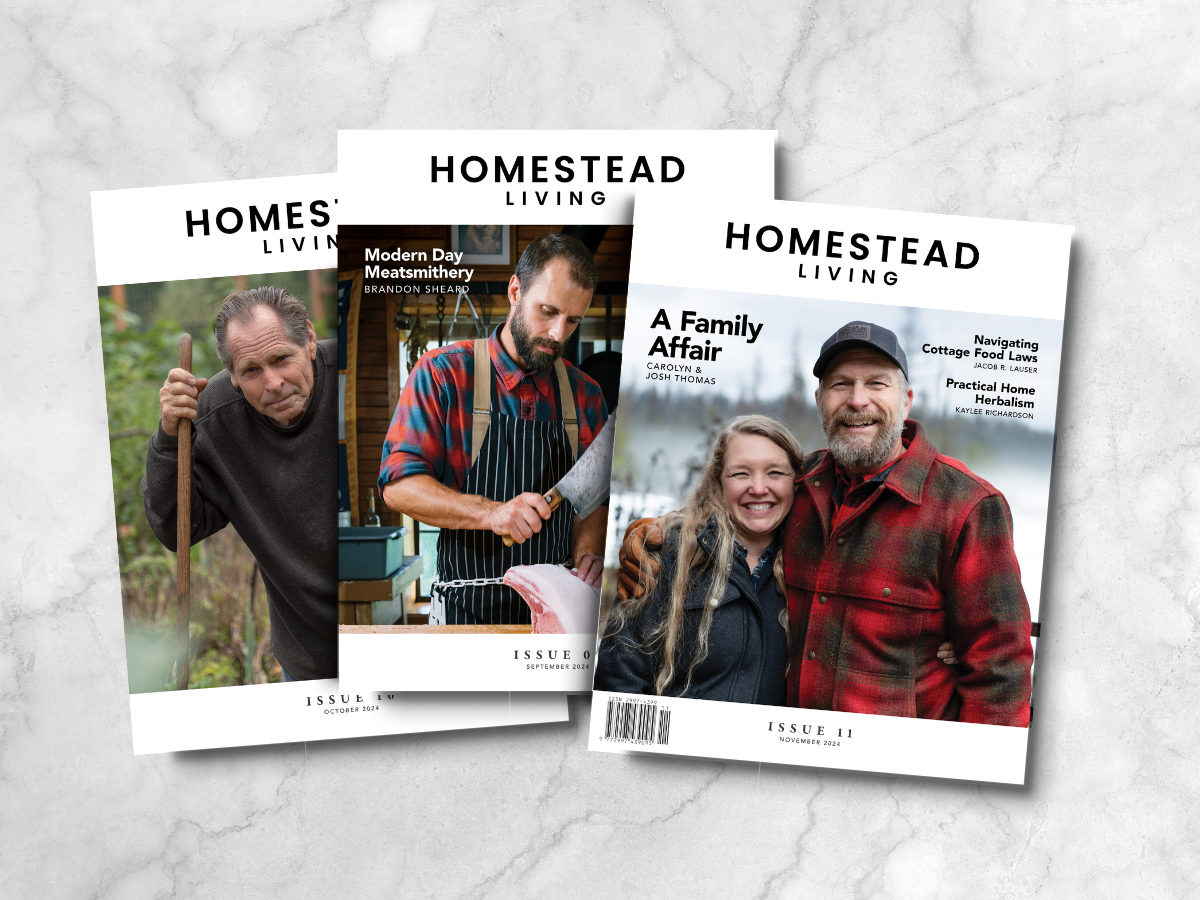
This Episode of The Coop is brought to you by Homestead Living magazine.
More than just a publication, Homestead Living is your go-to homesteading mentor, filled with advice, wisdom, and inspiration for homesteaders by homesteaders.
Leave a Reply