
For example, on our farm, it’s illegal for me to mill a black walnut log on my bandsaw mill, build that wood into a chair, and sell it to a neighbor. According to the zoning ordinance, that’s manufacturing, which is prohibited in our agricultural zone. Firewood can only be sold by the cord, not the pound, even though pounds are a far more accurate measurement of BTUs than volume.
Most crafts are not regulated, including things like engraving signs, photography, or anything to do with fabric. These all have a clear history of being cottage industries, but more than that, they are considered relatively benign. Typically no one dies from a poorly sewn dress.
Dairy, meat and poultry processing, and value-added food are in a whole different category. I don’t have time in this column to explore all the nuances of regulations in the food and meat sector, but a couple of aspects are important. Some foods are considered hazardous and others are not. Many states have cottage food laws that allow a wide array of baking, jams, and jellies to be made in the home and sold directly to customers without government oversight because these are considered nonhazardous foods.
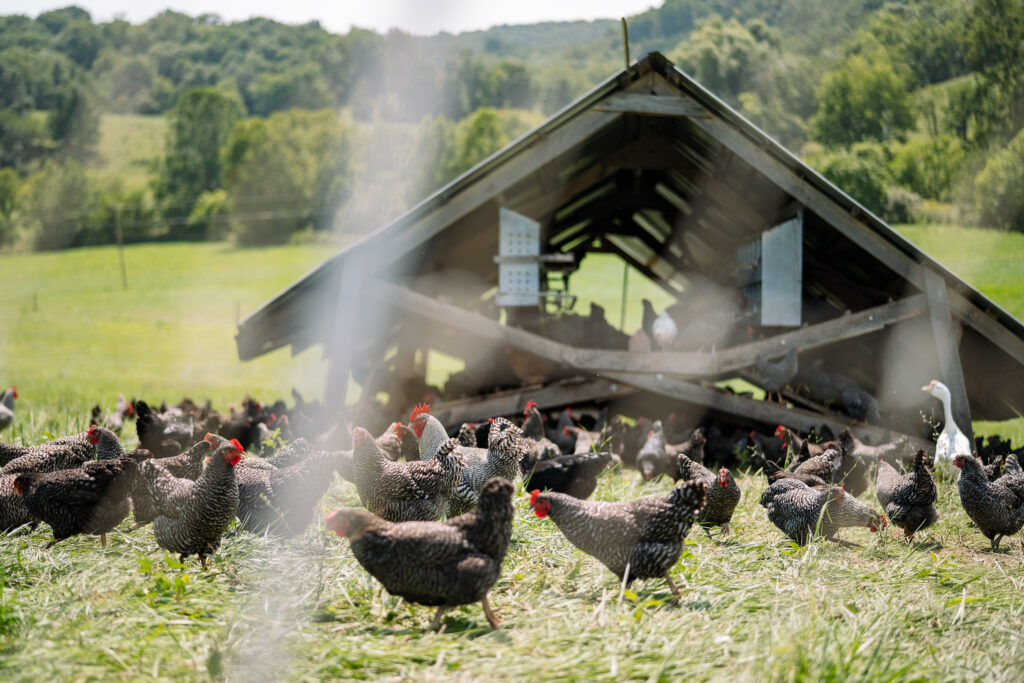
Through the unwavering efforts of the Weston A. Price Foundation, most states now allow some degree of unregulated dairy, including raw milk. Often a numeric restriction exists to preserve small-scale sales, like three cows. Poultry enjoys the federal PL90-492 exemption, known as the Producer-Grower Exemption, which allows a farmer to raise and process up to 20,000 birds per year without inspection.
Some states are more restrictive, but virtually all allow 1,000 without saying anything to anyone. For precise clarity, join the Farm to Consumer Legal Defense Fund. Interestingly, not all birds are the same. No regulations exist on quail and pheasant; you can produce and process 100,000 pheasants without any license or permit. I don’t know why anyone would want to raise 100,000 pheasants, but if you wanted to, you could. Ha!
Meat is far more stringent. In America, not one pound of beef, pork, goat, or lamb can be sold without going through government inspection. Because onerous regulations have put many local abattoirs out of business over the years, the whole nation is now grossly under-slotted (slots are processing appointments). Not only are abattoirs few, but they are also often far away. For a small outfit, hauling an animal 200 miles to an abattoir makes the processing cost prohibitively expensive.
As a result of these regulations, many homesteaders seek and need a circumvention technique. We often raise more than our family needs and want to sell an animal or two, or a portion of them, to neighbors and friends. How can we do that without getting the terrifying knock on the door from a badge-flashing government agent informing us of illegal activity? I’ve been through that, and it isn’t fun. If you want the full skinny on our battles, read my book Everything I Want to do is Illegal. It’ll make you laugh and cry at the same time.
Fortunately, liberty-minded people tend to be more creative than bureaucrats and are coming up with techniques to circumvent rather than comply. In any society, when compliance becomes too onerous, circumvention becomes preferential. John Moody and I started the Rogue Food Conference (RFC) several years ago to showcase the creative circumvention models various people are developing around the country. The next one is May 12-13 here at our farm in Virginia (www.rfc.org).
I’m not an attorney, but let me explain the foundation of all these circumvention techniques. First, realize that written legal rulings establish that right now no American has a right to food choice. The Bill of Rights guarantees all sorts of God-given rights, but it does not mention food. As a result, the food regulatory agencies take a very broad view of their jurisdiction. Of course, they say that all of this oversight is done in the name of public safety. Most folks in America believe if we gave people freedom of food choice, they’d patronize filthy farmers and die in droves from unsafe food.
So far, however, this oversight is limited to “in commerce.” Interestingly, courts have ruled on the difference between a sale and a non-sale. While this may seem picky, it’s fundamental to understanding circumvention. If you can keep a food transaction from being “in commerce,” you can keep it away from government oversight jurisdiction. For example, I can butcher a hog in November in my backyard and give you some sausage and that’s perfectly legal. It’s a gift.
Gifts are not “in commerce”. An interesting nuance is that wild animals can’t be sold unless you have a license and control your inventory—like deer contained in a high fence. But you can shoot a wild deer on a 70 degree F day, drag it through the squirrel dung and sticks and rocks, prominently display it on the hood of your Blazer as you promenade through town in the heat of the afternoon sun, hang it up in your backyard for a week and then cut it up, giving pieces to the neighbors and their children (perish the thought) and all that is considered being a great patriotic American. All of this is done without any governmental inspection whatsoever. But if you sell one pound of it, you’re a criminal.
By the same token, you can be as clean and temperature-appropriate as you want with a cow, pig, goat, or lamb in your backyard, and give it away legally — but if you sell one pound, you’re a criminal. Clearly, the food safety laws are not about safety; they are about market access. Which brings us to commerce, and the definition of what qualifies as a sale. The point is this: if you can transact food trading without that transaction being counted as a sale, then you can do so without inspections, permits, and tangling with the food police.
There are reasons this issue is now more important than ever. First, as a nation, we’ve never had such a deficit of abattoir slots. Second, the homestead tsunami funnels thousands of animals into a community-centered, decentralized platform that is now dominated by centralization and export/import models. Finally, a plethora of consumers distrustful of big agriculture, government oversight, and mainstream distribution networks desperately want to procure alternative provenance.
Various courageous innovators offer remedies. Niti Bali in North Carolina has a bona fide food church, wherein membership offers the perk of food. It’s not public. John Moody runs a buying club in Louisville that offers farmers a venue and eaters an opportunity to transact business without a sale. You join as a member with dues and the food is a dividend on your investment. When your tab runs out, you re-invest.
Perhaps one of the models receiving the greatest interest right now is the Private Membership Association (PMA). Modeled after golf country club charters, it’s not subject to things like nondiscrimination, handicapped access, and other public requirements. To be sure, the folks who invented this legal framework years ago were absolutely prejudiced and perhaps not the kind of people with whom you’d want to associate. But to their credit, they wanted to get together without a bureaucrat telling them who or what they had to do and just wanted to be free to pursue their friendships the way they wanted.
Most of us can appreciate that kind of desire, to just be left alone. Many if not most of us homesteaders, share that mentality. We’re not anarchists throwing bricks, lighting fires, and blocking interstates; we just want to live quiet, peaceable lives in our communities without being scared that big brother will tell us we can’t pee behind the shed or sell a homemade quiche to a neighbor.
One of the distinctives of a sale is risk. If I go into Costco and buy something, I take no risk; someone else produced it, packaged it, marketed it, and put it on the shelf. I can take it or leave it; in many cases, I expect that some government oversight agency has validated its safety and confirmed the accuracy of the label. This is not the case if I buy stocks on Wall Street. That is not a sale; it’s an investment with no guarantee of return. Dividends are not products; they are returns on investment.
Membership and the perks thereof in a PMA, therefore, are not in commerce; they are dividends of investment, or perks from membership. Applying the PMA country club platform to food is a brand new idea, but it is taking off like a race car. Perhaps the largest in the country is Amos Miller in Pennsylvania, with a 4,000-member membership around the country. He butchers on his farm, makes cheese, and sells milk—all without any inspection whatsoever.
This attracted the food police way back in 2018 and he’s been in and out of court ever since. A horse and buggy Amishman, Miller, unfortunately, has not had good legal representation until recently and has signed consent orders that now confuse his legal issues. Instead of his case being a clear first battle over PMA applied to food, it’s a case over contempt of court and enforcement of judicial consent.
With good representation now, however, his legal team is going on offense and using the Religious Freedom and Restoration Act as well as the American With Disabilities Act to sue the government on behalf of members who say their rights are impaired by being unable to get the food he offers. So far, the food police are allowing him to continue shipping his dairy products and home-processed water buffalo (he calls it freedom beef). Exotic animals enjoy special dispensations not offered to common domestic livestock.
To my knowledge, no one else using PMA in food is facing legal battles. Here’s the bottom line — our food system is in a similar place as our education system was in the late 1970s when homeschooling burst onto the scene. The right to home education took several years, lots of legal battles and courtroom fights, and courage to withstand the education police. But gradually, homeschooling won. Today, it’s food. Take courage! Let’s hold the food freedom banner high and lead the way until society catches up.

Leave a Reply