
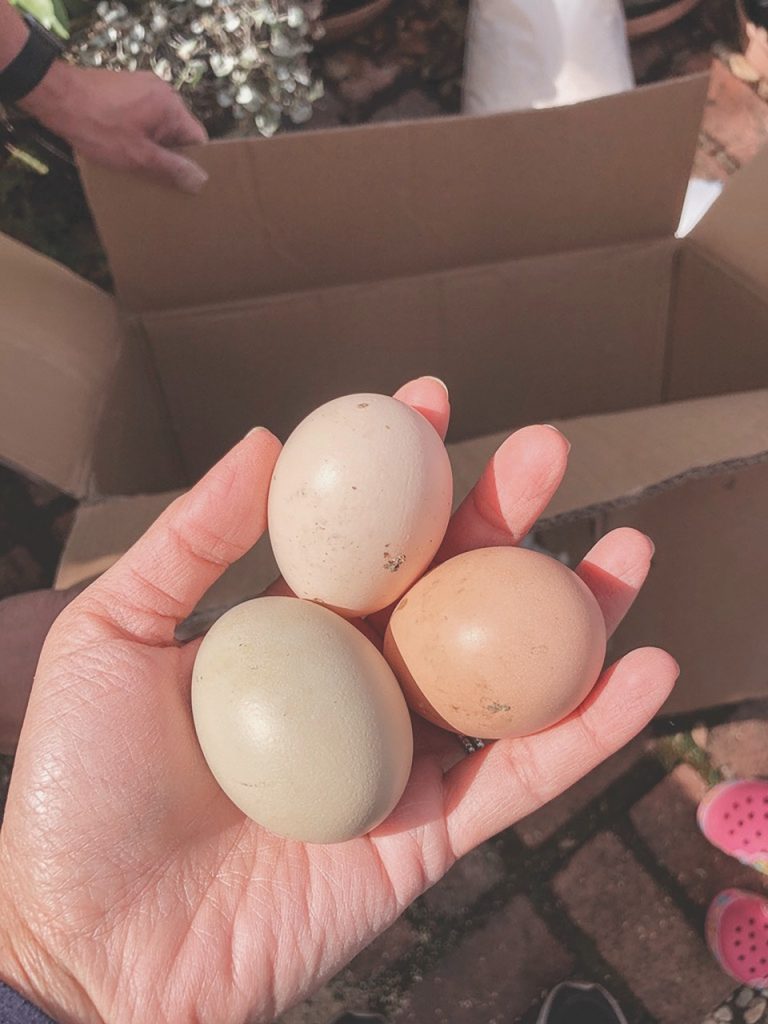
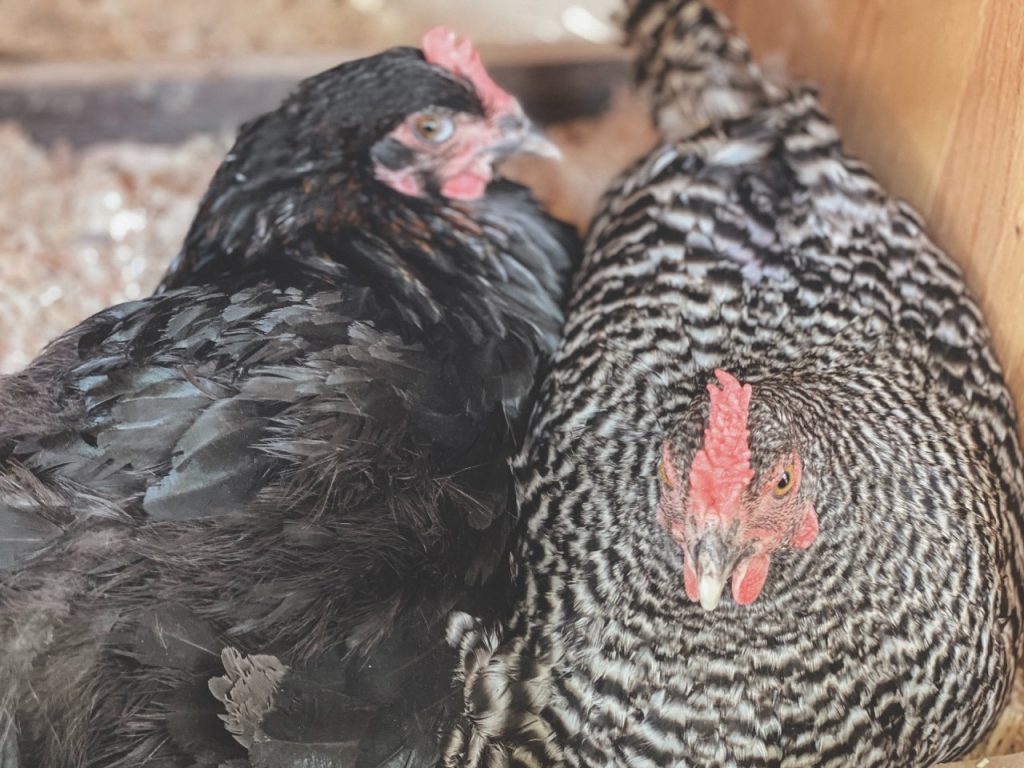
“I never want to worry about feeding our family on three eggs a day again,” my wife Sophia said to me as we were driving over the San Francisco Bay Bridge on the night of March 16, 2020. In our back trunk, we had a cardboard box holding three heritage egg-laying hens that we bought for $300… each! On the day California had threatened us with lockdowns and curfews, the trajectory of our lives changed, and in an instant my priorities shifted from focusing on home sales as a residential real estate agent in the Bay Area, to how to become self-sufficient and double down on growing our own food and increasing our food security.
That next morning, our family woke up with Christmas-morning level anticipation, eager to open up our box of birds. To our surprise, when we opened up the cardboard box we discovered they had already laid eggs! There was something incredibly liberating about holding our very first egg from our own hens. We were hooked. The feeling of buying one less item from the grocery store became a challenge for our family every week. How could we continue to disentangle ourselves from the current food system built on modern convenience?
It’s embarrassing to admit that in the state of panic we were in the night before, we were missing just a few of the basics: a chicken coop, chicken feed, and even a waterer. It was a good thing we didn’t wait until we were ready, because by the next day, the chicken woman had sold out of all her laying hens!
Our family continued taking small steps toward becoming more self-sufficient, and started growing herbs and produce on our quarter-acre lot in the San Francisco Bay Area. The events that occurred in 2020 accelerated our food journey and we ended up purchasing six acres in Northern California. It was a pivotal year because that was the year we chose to answer the call to farming.
Answering the Call to Farm
It was never my lifelong dream to become a farmer. Growing up, my plan was to become a General Officer in the US Army. When my grandfather emigrated from China to the United States, he fought on the beaches of Normandy, and I wanted to follow in his footsteps. After graduating from West Point, I was deployed to Baghdad in 2007, where I served for 18 months. By the grace of God, I was able to bring every one of my soldiers home, and after leaving the military, I continued my mission on home soil.
My subsequent career as a realtor has allowed me to continue to serve others and help veterans achieve home ownership, which has helped me gain a deep sense of fulfillment. In 2021, with the combination of historically low interest rates and people confined to their homes, together with my spouse and mortgage broker, Sophia, we exceeded $50 million in home sales–our best year! However, once Sophia caught wind that interest rates were going to rise dramatically in 2022, rather than build upon our real estate success, we made the decision to take a tactical pause to focus our efforts on growing our own food for our family within a strong community. That led us to move our six-acre homestead from Northern California to the Appalachian Mountains of Tennessee.
I’ll be the first to admit that this was not a decision that was made lightly. I can relate to those who struggle leaving the life they’ve grown accustomed to, the feeling of security and stability, similar to how I felt while serving in the military. There are many parallels between transitioning out of the military and starting a homestead. Both require leaving behind a familiar structure and set of expectations to embark on something entirely new. In the military, I thrived on having order and purpose. Homesteading, on the other hand, is a constant learning curve, a journey of discovery and adaptation, which I learned to embrace. These experiences made me stronger, more resilient and less rigid, as well as more creative at problem solving with limited resources. Through these lessons, I am able to help serve others who pursue this life and help them avoid making costly mistakes so that they can be successful.
As a homesteading real estate agent serving clients all throughout the country, I hear so many stories from people who struggle with analysis paralysis and a failure to launch. This is why I wanted to share some of my experiences being both a homesteader and a real estate agent, helping aspiring homesteaders and small farmers find their property to grow and raise food on for themselves, their families, and their communities.
To accomplish this, I have a proven process that I follow when helping my clients find the right land to homestead on. It begins with your reasoning in pursuing this lifestyle, because, frankly, it’s not for everyone. There are many who have tried but failed because they didn’t fully understand the changes that needed to be made and were unwilling to do what needed to be done. To ensure that you don’t fall into this category, seek out opportunities to experience this lifestyle and test your grit through farm stays or programs like WWOOF (World Wide Opportunities on Organic Farms).
The Importance of Casting A Shared Vision
If you are planning to partner with another to build your homestead, I highly recommend that you begin by discussing your goals, and find common ground in a shared vision. You don’t need to have all of the details figured out, but get on the same page with why you are homesteading, what you hope to achieve from it, and when you want to begin. A shared vision will help facilitate your property search rather than sabotage it. This step helps separate the dreamers from the do-ers. Below are a few questions to guide your conversation:
What is motivating you to answer the call to farm or homestead now?
How do you define homesteading? Is it a small garden where you grow produce? Do you want to own hundreds of acres for livestock? Or is it a blend of both?
Are you planning to build your homestead in phases? If so, how many months or years? Or do you wish you started down this path years ago and are on a mission to get there as quickly as possible?
First Steps When Searching For Property to Homestead On
First thing’s first: get your finances in order. Sharing the same goals and dreams is great, but having the means to see them to fruition is another. Knowing your financial options and interviewing your mortgage lenders should not just be boiled down to the lowest rate. Pay particular attention if you are in a unique situation or are self-employed. Big banks will typically not go out of their way to help if you have any extenuating circumstances that need to be taken into consideration. Getting your finances in order and understanding what you have to work with in terms of your income, savings, and debt will provide you with a baseline on what sort of budget you’re working with.
Once you’ve established your budget, conduct your research to find the right communities to search for properties in. You can perform online research, but nothing beats meeting people and having frank, open conversations where you can ask questions to determine if the area is a good fit. This means getting a good read on people’s values to see if they align with yours. Once you’ve narrowed down the communities you want to live in, you can begin the fun part of exploring properties and walking the land.
When it comes to land, there are several things to note when evaluating whether or not a property is suitable to homestead on. Below are a few important things to look for:
Identify sun exposure.
Identify all water sources.
Is there any fencing? What is the condition?
How is the soil? Is it clay-like, sandy, or rocky?
What are the neighbors growing?
Legal Considerations
Knowing the state and local laws for the communities you are considering will help you identify what you can and cannot do on your prospective property. Each individual has differing priorities. Be sure to note the things that apply to you or that could affect your goals on your new property.
Are building codes and restrictions important to you?
Are homeschooling laws and resources important
to you?
Does the county have any restrictions on livestock?
Conduct A Security Recon
When you pour your time, money, and energy into producing high quality food for your loved ones, there is nothing worse than losing it to a predator. As you conduct your recon—both online and in person—always take security into consideration and identify any vulnerabilities. If you want to homestead, you probably have a healthy sense of suspicion and already think this way.
As an Army Engineer, I was trained to be defensive-minded as my job was to build fortifications and reinforce fighting positions by thinking like the enemy. When I walk any property, I instinctually identify likely avenues of approach for all predators, both human and animal. A telltale sign is noticing worn paths because they will almost always choose the path of least resistance. From the home, how far out can you see and where are your blind spots? Another thing I do is inspect the outer perimeter of the property and make notes on what I can see as an outsider looking in. All of these notes will help determine how to implement the different layers of security with the goal of making your property a hard target so that the predator moves on to an easier one.
Other Common Pitfalls to Avoid
Never buy any property sight unseen. Always conduct a recon and do your due diligence. If you have to do a virtual tour to put an offer in because the market is hot, be sure to have an inspection contingency included in your offer to give you enough time to see it for yourself.
Don’t buy a “bug out” spot and think the local community will have your back. It takes time to build trust and relationships, which cannot be rushed. Being in community with people who align with your values is priceless. In the Army, I slept soundly at night knowing that my brothers and sisters in arms had my back because I had theirs. This is the level of trust and love that you should strive to build.
Refrain from purchasing any livestock or dogs without having proper fencing in place first, otherwise the money you put into purchasing them—along with their food—will be at a loss when they venture off your property, or worse, are taken by predator.
Finding A Place Of Your Own
By following this process, I’ve been able to successfully guide my clients toward a path of self-sufficiency. But the fight’s far from over. That’s why I created the “Finding the Right Property to Build Your Homestead Course.” You’ll gain the knowledge and confidence to navigate the often-tricky world of rural real estate, avoid costly pitfalls, and find the perfect property for your dream. (Be sure to secure your copy on homesteadingrealtor.com.)
As your Homesteading Realtor, I’ve leveraged my real estate expertise to reclaim hundreds of acres of land that are now being nurtured by passionate small farmers and homesteaders. Imagine the feeling of putting your hands into your land and scooping out soft, crumbling black soil. Picture the joy of raising healthy livestock on sprawling pastures. These are the realities I’ve helped countless families achieve because homesteading is a mission I wholeheartedly believe in.


Leave a Reply