
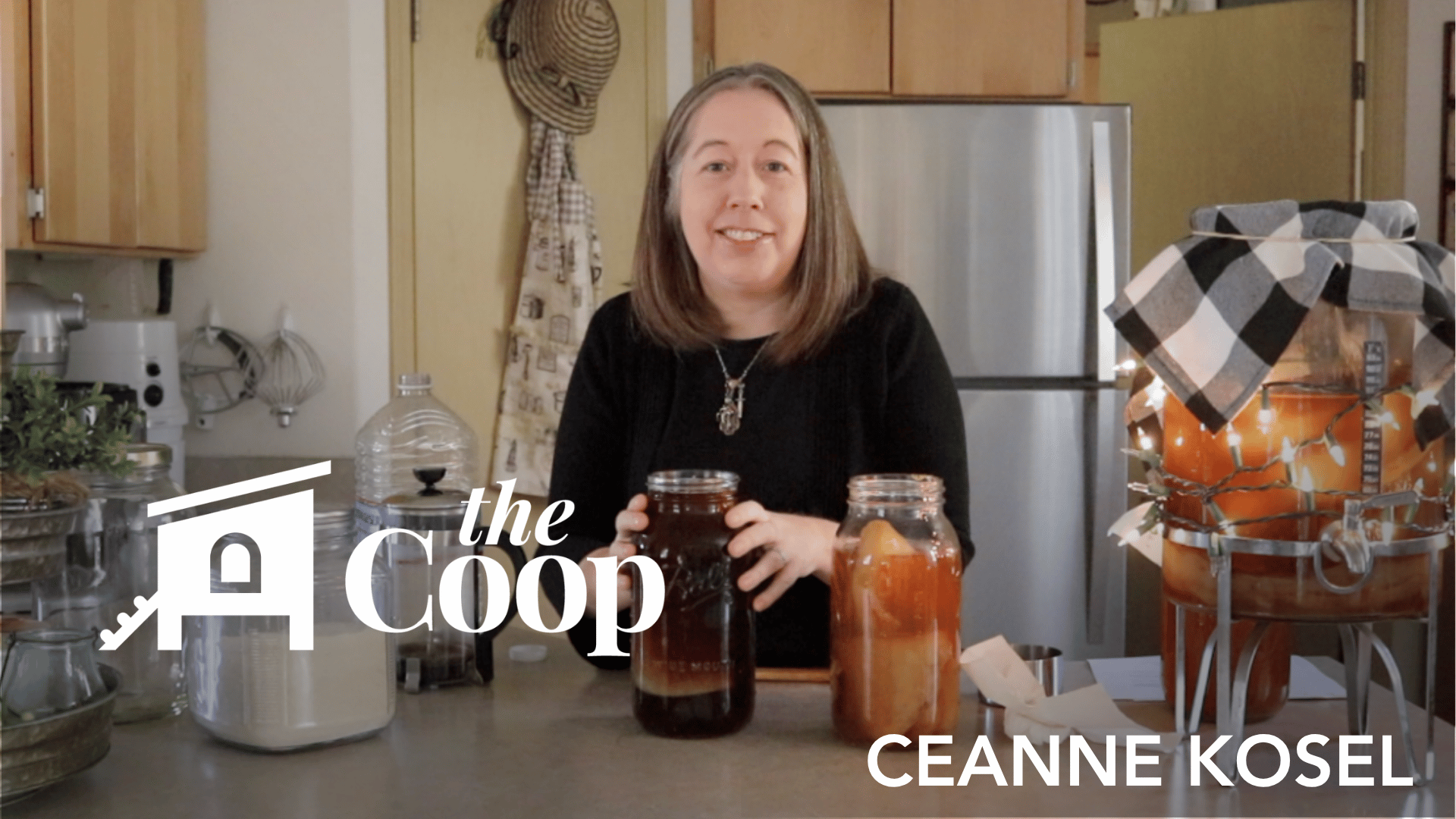



In Episode #23 of The Coop, Anna Sakawsky sits down with longtime friend and fellow homesteader CeAnne Kosel of Farmhouse Teas to talk about creating delicious, better-for-you drink alternatives at home.
CeAnne shares how her journey began with growing calendula flowers and expanded into making teas, salves, and eventually healthier replacements for coffee and soda.
After developing a sugar allergy that caused her throat to swell and becoming sensitive to caffeine, she started experimenting in the kitchen. What began as personal necessity turned into a thriving business creating healthy, flavorful herbal tea blends and flavorings for homemade sodas, kombucha, and more.
In this conversation, Anna and CeAnne discuss:
- How CeAnne developed her popular “Not Coffee” alternative and a wide variety of soda syrups (vanilla cream, root beer, fruit flavors, and more)
- The basics of making kombucha, water kefir, and ginger bugs as healthier fizzy drink options
- Practical tips for busy families … including how to store ferments when life gets hectic
- Why homemade versions can be more budget-friendly and taste better than store-bought options
- The importance of starting simple and finding what works for your family’s tastes and schedule
If you’ve been wanting to move away from conventional sodas and coffee without feeling deprived, this conversation will give you the inspiration and practical starting points you need.
About CeAnne Kosel
CeAnne Kosel is a wife, mama to 4 adopted kiddos from around the world, co-owner of Farmhouse Teas & Grow Create Sip, and a homesteader on just under 2 acres in the Pacific Northwest. She helps homesteading families turn common herbs into powerful medicines in order to create health and wellness, without the fuss. A home herbalist for over a decade, CeAnne sees tea as the simplest vehicle to learning herbalism – and that includes fermenting tea into tasty, bubbly, fizzy drinks like kombucha!
The show notes …
0:00 – Introduction
4:46 – How Farmhouse Teas got started
9:49 – Coffee Alternatives & Drink Flavorings
14:27 – A Sugar Allergy
18:25 – How to Make a Simple Syrup
25:45 – Healthier Sugar Alternatives
31:28 – How to Store Homemade Syrups
34:37 – Understanding Kombucha
46:31 – Understanding Water Kefir
54:24 – Fitting Homemade Drinks into Daily Life
1:00:09 – How to Start
CeAnne Kosel:
Sugar makes my throat swell. So I had all these reasons that I can no longer drink my favorite drink coffee anymore. Eventually I decided to make my own alternative.
Anna Sakawsky:
You kind of focused on how we can get back to a little bit of what sodas used to be because historically they weren’t developed as just kind of a sugary treat. They kind of were developed as a health tonic.
CeAnne Kosel:
It’s super simple to those of us who have fermented before, to those who haven’t, it’s super scary.
Anna Sakawsky:
If the thought of raising chickens has ever intimidated you, consider this your sign to stop putting it off. Murray McMurray Hatchery has been helping first time chicken keepers succeed for over a hundred years. They offer the widest selection of day old chicks and poultry, super low minimum orders, sometimes as few as one bird and the best guarantees in the business, live arrival, 48-hour livability, and 90% sexing accuracy. Plus they’ve got everything you need to raise happy, healthy birds right from the start. Brooders feed incubators the works. It’s never been easier or safer to start your own flock so visit mcmurrayhatchery.com and tell them the coop sent you. Again, that’s mcmurrayhatchery.com. Well, hello everyone and welcome to episode number 23 of The Coop. I’m your host, Anna Sokoski, editor-in-chief of Homestead Living Magazine. And today I am joined by another one of our contributors and a longtime friend of mine, Sian Kosal.
So if Cianne’s name sounds familiar, you might know her as the owner of Farmhouse Teas, which she runs with her husband and four children. Their work centers around traditional methods for blending tea, herbs, and botanicals for everyday home use. Cian also educates through writing, video, and print, including through her blog, YouTube channel and Grow Create Sip Magazine. She recently wrote an article for the latest issue of Homestead Living Magazine all about healthier alternatives to soda. And with hot summer weather now upon us, soda is a popular go- to beverage for children and families looking to cool down and enjoy a sweet treat. But as we all know, the sodas that we find at the grocery store are loaded with sugar often in the form of high fructose corn syrup as well as artificial colorings and flavorings and other junk ingredients. So as a mother myself, soda is one of those things that we really try to avoid bringing into the house and I really limit how much my children drink, but I always find there’s a bit of an uptick in demand during the summer months, whether it’s for my daughter’s summer birthday party or as a treat while we’re camping or at the concession stand at the beach or with a hot dog on the patio or the many other excuses that summer offers us to reach for a cold fizzy beverage.
And I’m sure I’m not alone. I know that no matter how strict or healthy you try to keep things, kids will be kids and sometimes water just won’t cut it. But luckily there are some healthy alternatives to traditional store bought sodas. So today we’re talking about what some of those alternatives are and how to make them yourself because let’s face it, healthier store bought beverages are typically priced quite a bit higher than regular old soda and with prices for everything continuing to rise and so many people looking to save money, learning how to make your own anything at home is a good way to cut cost and still ensure that you’re feeding your family well. So with that, I would like to welcome Sian to the show. Hello. Hello. Thanks so much for joining me here today. I’m really excited for this conversation because as I mentioned, you just recently wrote an article for us on, I think the title of it was called Old Fashioned Homemade Sodas and you kind of focused on how we can get back to a litle bit of what sodas used to be because historically they weren’t developed as just kind of a sugary treat.
They kind of were developed as a health tonic and they included a lot of herbs and botanicals, things that were actually meant to support our health, but obviously we’ve gotten away from that. And so you kind of talked about that in your article and about how we can kind of get back to making some of our own healthier soda alternatives at home by going back to using some of the ingredients that they used to use. So I’m excited to get into that and then also to talk about a few of the other alternatives if we’re looking for kind of just a sweet fizzy beverage, but something that’s going to be health supportive rather than just junk food. So we’ll get into all that. But before we start, I always just like to start with a little bit of your background story. So I would love to just know a little bit more if we can share about the story behind farmhouse teas, your background, what led you to start the business and what you offer today.
CeAnne Kosel:
Yeah, sure. So farmhouse teas is going to be a teenager this year, 13, 12, somewhere in there. I had to do the math later. So we’ve been at this for a little while, but it started back. We were living in a tiny little duplex on a main street in town, not what you might expect from someone that’s homestead minded, but we were just learning. And I bought this packet of, it was a box of seeds, different kinds of seeds. It was some discount deal. It was like five bucks or like 10 packages of seeds and I had no idea what they were. It was like a mystery box. And so I get these and I knew nothing about gardening or anything. And then there were some calendula flowers or one of them and they happened to be the ones that grew really well. And I have kind of a black thumb, at least when it comes to things inside the house.
And I discovered with those calendula that it wasn’t so black outside of the house. And so I had all of these calendula flowers and I’m like, “What do I do with all of those?” Because being me, I had got to make something or do something, make it productive, not just go, “Those are pretty and stick them in a vase.” And so I started reading about calendula flowers and stumble into all the medicinal benefits, which at the time I didn’t know much about herbal medicine or anything. And so that was my first flour. And one of the things that I made first was calendula salve but also tea because calendula is really good for skin and digestive issues. And I had a bazillion of these flours I needed to do something with. So that’s kind of one aspect of how farmhouse tea started. The other is that I used to be a coffee drinker and I tease that when I met my husband, I was on a coffee diet.
I drank coffee for breakfast and for lunch and for dinner and I didn’t really eat anything.
Anna Sakawsky:
Sounds familiar.
CeAnne Kosel:
Yeah. I think a lot of coffee drinkers can relate to that. But eventually that started getting to me. I’m sure some of that was like the food aspect, but the caffeine started bothering me. I’m quite sensitive to caffeine and I think it hit my adrenals a little harder than most people. I was jittery all the time. Everybody thought I was lots of fun, but I was just really caffeinated. And then just some coffee drinkers like creamer better than coffee. I think I was one of those and that included like all the syrups and all the flavorings and eventually those got to me too. I found out I have a sugar allergy, sugar makes my throat swell. So I had all these reasons that I can no longer drink my favorite drink coffee anymore and some of those turn into medical problems and the doctor’s like, “Well, you need to cut back on the caffeine that can make it worse.” So I went to the coffee shop to find an alternative because I was there already anyway and tried tea and it tasted like someone mowed the grass and stuck it in the cup.
It was horrible and I’m like, “Well, that’s not going to work. I can’t drink those not coffee.” Decaf wasn’t doing it because it wasn’t just the caffeine. There was other stuff going on. Eventually I decided to make my own alternative. So we tried a few store bought ones and I didn’t like them. And so we ended up coming up with our own, it’s a tea, but it’s a coffee replacement called Not Coffee.
And it wasn’t just that drink, but since I had the sugar allergy, there were desserts I couldn’t have. I used to have those York peppermint patties. Those were my favorite. And if anyone’s looked at the back of those, they’re full of corn syrup and probably any more, not much chocolate in them actually.
And so I started replacing those things with like, we have a peppermint patty tea so I could drink it even though I couldn’t eat it. And then we had other people start asking us, “Do you have this kind? Do you have that kind? I can’t have this anymore. Is there something you can make me for that? ” So a lot of our blends are more alternatives to other drinks that people enjoy. I don’t think of them so much as tea like you would pinkies up, sit down for tea time in England kind. They’re just replacement drinks for things that people can’t enjoy anymore. So that’s kind of how we got started. It just kind of snowballed from one of those to the next
Anna Sakawsky:
Team
CeAnne Kosel:
And so on. And then we got into bulk herbs because the teas are more for like health purposes and not like a cure all, but just a healthier lifestyle. And so with that comes herbal medicine and bulk herbs and sabs and the whole shebang.
Anna Sakawsky:
Yeah. Well, and in addition to the teas, yeah, you mentioned the coffee, is it called sugar makers not coffee? Is that what I’m- I have a pack in my cupboard, so I’m trying to remember what it says on it. And I do actually, I’m trying to get a lot better with coffee because I’m a coffee addict as well and I used to drink a lot, but I really love a latte, right? And a lot of lattes can be fattening and everything too. So I’m trying to keep those to the weekends. I’m actually doing a thing now where I’m doing the bulletproof coffee in the morning, which funnily enough is more fattening, but I’m on a plan where they’re like, “No, if you do this, it’s cutting back on dairy, but it’s also, it keeps you satiated longer so it goes with a fasting plan.” Anyway, I won’t get into the details of that.
But now that I’m doing that and then I’m only having one of those and so that means any other coffees I would have are black, which I’m not a huge fan of. So I’m just drinking last coffee. I can’t get it down. Yeah. I mean, I can, but I don’t tend, so I’m not drinking as much coffee now and I’m sticking to before noon, but I am finding I’m being a lot better that if I want something in the afternoon, I’m reaching for your coffee alternative. And it really, especially if you do compare it to drinking a black coffee, it tastes very similar. So it does. If nobody told me that it wasn’t coffee, I probably wouldn’t know the difference.
CeAnne Kosel:
Yeah. It’s got that same thickness, which is super helpful, especially for those who don’t like it black and I want to put
Anna Sakawsky:
Stuff
CeAnne Kosel:
In
Anna Sakawsky:
It. But then in addition to that, you also have other things they offer too. So you’ve got your kind of regular tea blends, your coffee replacement, you mentioned bulk herbs and some topical sabs and that sort of thing. But then you also do, I guess they’re technically tea blends as well, but they’re more geared toward flavoring certain drinks, right?
CeAnne Kosel:
Yeah. So they’re mostly known for flavoring kombucha. It’s a dry blend, so it looks similar to a tea. It’s formulated differently. You wouldn’t want to drink it as a tea because it’s not formulated for a water extraction. It’s formulated for kombucha, which is more like a vinegar extraction. So it works a little different and the flavor comes out different that way. But you can use those, not just in kombucha, but like for instance, we have a root beer flavoring. So you can use that and skip the kombucha and you can turn it to a syrup instead. And so instead of just putting the dry mix in kombucha and it acting like a vinegar extraction, you put it in water, but you’re going to simmer it like a decoction and make like a syrup. So
We have some soda syrup specifically that work that way as root beer and cola because root beer, as you said in the beginning, old fashioned sodas didn’t used to be this way. They were like health tonics. They weren’t just purely for flavor and fizz. There was a purpose to why they made them the way they made them. And root beer is like a fabulous example because of the things that used to be in it. Some of these we can’t use anymore, but sass barilla for instance, trying to think of the other one. Sometimes they’re like interchangeable. Winter green is one that’s more used now to get similar flavors. But all of those things, they were used for tonics and they weren’t intentionally making a drink. And then as we go through time, we kind of lost that aspect and now it just becomes this drink we drink because we enjoyed it and we lost sort of the history and reason behind why these things are made.
It’s kind of like a fermented food. They didn’t make it to get the probiotics like we do now. They made it because they were trying to preserve this stuff and the probiotics just were an extra they didn’t even know about when they were doing it.
Anna Sakawsky:
Right. Well, and in some ways the soda’s almost in reverse, right? Like now we’ve got these great health benefits that we’ve discovered from these fermented foods when before it was just a practical way to preserve things, whereas sodas started as really health focused or at least they were meant to. I know that you mentioned there’s ingredients in colas and root beers and stuff that maybe we wouldn’t use nowadays because they’d either be classified as hard drugs or they’re like things that can be dangerous, especially in too much quantity. But the idea anyway was that they were supposed to stimulate something and help us in some way. And then obviously over time as many things do, it kind of got corrupted by industry and capitalized on and probably had something to do with lower cost input and using up things and trying to kind of cut costs on things like even the sugar, right?
Like I mentioned, it’s not even natural sugar anymore. It’s like high fructose corn syrup, which is worse and all these artificial ingredients. I’m actually interested too, because you mentioned that you have like a sugar allergy. So is that to all sugar? Because you do use some sugar and like you make some homemade sodas and some things like that. There is some sugar content to that. How do you do with that?
CeAnne Kosel:
I call it a sugar allergy because no doctor’s been able to give it a name and that’s just like the most paint’s the most realistic picture of what happens when I consume sugar. My throat swells. It’s not anaphylactic like a bee sting or something, but it’s more like somewhere there’s some infection that no one can spot and the sugar makes its well, I think is what is going on. So that’s like a short answer. So how do we deal with that here? The sodas that I make at home are usually for my husband and my children. My husband was the soda drinker. I was the coffee drinker, never really drank soda and he did all my taste testing and everything for me. So I have real soda drinkers doing taste testing, but it’s not as I can’t try it myself. With kombucha, the sugar is the food for the kombucha and so it consumes the sugar and there’s really not much of it left and it doesn’t tend to bother me.
Sometimes I’m more sensitive than others so I may or may just not consume it. The sugar problem has mostly to do with like a concentrated dry sugar. So I can do honey and maple syrup,
But then like I can’t do coconut sugar. I can’t do white sugar, solid. I can do date sugar. It just depends on where it is on the glycemic index and how intense it is. Sometimes I can get away with sugar like in a random hamburger bun if we’re out somewhere because it’s dispersed within the flour and it gets past my throat. I don’t usually feel very good later, but I don’t have the swelling reaction. So it’s an interesting problem to have. Most people aren’t too sympathetic because they wish that they had some restraints.
Anna Sakawsky:
I was going to say it’s kind of a good and bad problem to have.
CeAnne Kosel:
It’s like, “Oh, I wish I couldn’t eat that. ” And I’m like, “You don’t realize how much is in everything, everything.” I eat the simplest ways and have to cook everything because I can’t go and it’s in everything.
Anna Sakawsky:
Yeah. I mean, not to get off track, but you’re so right. I’m trying to follow a fairly strict diet plan right now and it’s like low to no sugar and no seed oils and all that stuff. And it’s like I bought some organic pasta sauce from Costco and it’s organic and it’s tomato sauce and I look and it’s like got sugar and vegetable oil or whate I’m like, “Oh man, okay. Well, here we go. Making this from scratch again.” Okay. Let’s get into sodas specifically and what we can do as an alternative to sodas because like I said, whether it’s for you or your kids or whatever, we don’t drink a ton of soda as is. I can’t remember the last time I bought soda and brought it into the house, but every once in a while I feel like that or my kids feel like that.
And so we’re looking for kind of alternatives to the traditional kind of Coca-Colas and that sort of thing you buy at the store. Now the simplest place to start I think is probably kind of what you covered in your most recent article, which is making your own syrups and then just adding them to carbonated water. And I really like that too, because even the carbonated water, you can purchase that easily, but we also have a soda stream. So that makes it really easy to just take water and turn it into soda like we’re not having to buy anything extra, doing extra, and we can have fizzy water and then just mix it with some juice or some syrup or a little bit of flavor. So let’s start there and kind of walk us through that process and that method. So how to make, just in general, how to make a simple syrup, what kinds of ingredients you like to use and how close to the final result do you think it is to store bought for people that you really like the taste of store bought and you’re looking to recreate that?
CeAnne Kosel:
We have a lot of flexibility here. So I love lots of ideas and general kind of just like general list of things. I know a lot of people are like, “I want a recipe.” That’s probably where the magazine article is helpful there. So there’s an actual recipe because I have more ideas than I have time to make things, but us basically are making a simple syrup, which is a foundational herbalist kind of recipe or even just in the kitchen, trying to think lavender is like one of the most known ones and you’re just taking cool parts of a sweetener and water and you’re making a syrup. You could do that and just make a sugar syrup if you wanted it. It’s most basic foundation. You just have sugar and you have water and you’re turning it into a syrup. You’re not letting it get to a hard cracked stage or anything, making candy.
Anna Sakawsky:
Is it in general is about a fifty fifty ratio? I’m trying to think.
CeAnne Kosel:
Yeah, usually a lot of it has to do with how hard your boil is and how much you’re watching it. If you’re standing there and it’s really consistent, but things happen. If you have propane versus electric, it’s going to boil faster on one than the other. So that’s part of the art part, I guess. So you can make just a sugar syrup that way. You could add a teaspoon of vanilla, now you have a vanilla syrup and you have … I’m forgetting the word for the vanilla soda. It’s not
Anna Sakawsky:
Vanilla. I think was yours a cream soda? Cream soda. Cream
CeAnne Kosel:
Soda. Yeah. So right there you have a cream soda. You just make this half and half put as much vanilla in there as you want it to come out in the flavoring.
Anna Sakawsky:
Just quickly on that, because I found this so interesting and I can’t remember, I think you, because you actually shared a recipe for classic vanilla cream soda in your latest article. So again, if you’re a subscriber and you have the May, June issue, make sure to check out Sean’s article, but make sure you save those recipes because they look really delicious. I haven’t tried them myself yet, but they’re like on my list to try. I think you shared a vanilla cream soda and a fresh orange soda and a lemon lime soda that’s kind of supposed to mimic like a seven uppers. Cream sodas though, were they traditionally made with cream, like with actual cream?
CeAnne Kosel:
It could go either way because then you get into the Italian soda with cream and I think it probably depends on who you talk to. There could be a lot of maybe back and forth on which one was first. Is that actually the name you give that one or in terms of cream soda, is it just an Italian soda with cream?
Anna Sakawsky:
Right. But you can, you could add a little splash because I remember, I think it was actually Jill Winger’s Prairie Homestead cookbook that she shared like a cream soda and it calls for a splash of cream. And I just remember thinking, “Oh, that seems so odd to me. ” And then I’m like, “I guess that’s why they call it that. ” I never really thought about that, but it’s actually really delicious.
CeAnne Kosel:
Yeah, with the vanilla. I’m like, “It’s not vanilla soda. What is this cream?”
Anna Sakawsky:
I just wanted to check your article and you do say if you’d add a small splash of cream, I guess-
CeAnne Kosel:
I remember writing that. I’m like, “Which way do I put this in there?” Because like you,
Anna Sakawsky:
You’re
CeAnne Kosel:
Like, “Oh, I didn’t realize it had cream.” But then in the research is like-
Anna Sakawsky:
But there’s so many things like that that if you never thought, I’m like, “Yeah, I never thought that that’s why they called it that, but that makes sense.” So okay, yeah. Yeah, adding things like vanilla, herbs and spices, obviously you shared some fresh orange soda, lemon lime, so fruits.
CeAnne Kosel:
You could do a lavender. We actually have a coffee company in California that buys our tea in bulk in the summer and they do sparkling teas, which is basically just a soda. They’re making a syrup with our tea.
So same concept, you’re doing the half and half, but instead of the water being water, it’s tea. I like a concentrated tea and then you’re making the syrup and then you’re adding it. If you’re doing a 16 ounce glass, you’re using about a third of a cup of syrup. You can adjust that up or down. Depends on if you’re coming right off soda, that stuff’s really sweet and intense. So I might use the upper end of that and then maybe you work your way down or whatever you’re comfortable with. That’s the great thing about making a home. You get to decide like, “Well, that’s too sweet and they just put a little bit less in and you’re good to go. ” So basically it’s super simple. It’s just coming up with the flavor profiles you’re looking for, which is kind of why we came up with the kombucha flavorings.
Those can be used in the same way. You just take them and you make a tea with them, a decoction. It’s going to be like a long boiled tea and then you take that and use that as your liquid and use your sweetener and then you just add the soda syrup. So you can use a soda stream or just, or not the soda syrup, the sparkling water
Or the soda stream and add that. So there’s like a million things you could do.
Anna Sakawsky:
Right, right. Yeah. What would you say? I know there’s probably just endless combinations and I think that’s where it gets really cool too when you start doing this at home. You can get creative with it. Try different spices, botanicals, that sort of thing. Try different flavor combinations.
CeAnne Kosel:
You what you have maybe. I have a lot of elderberries this year and a lot of raspberries or something. So I have an elderberry raspberry soda.
Anna Sakawsky:
Yeah. We have a lot of grape juice left over from last year that I can because we have a Concord grapevine. So we’ve been doing a lot of that. And then rhubarb is another one that I’m like, rhubarb. I feel like there’s only so many things you can do with rhubarb. And we just get tons of it off one plant. It’s just way too much. And so I do a rhubarb simple syrup kind of thing that I can as well, which is nice and a shelf stable and then you can just add that. And honestly, even for mom and dad sometimes, every once in a while we might want a cocktail and half the time it’s like, “Well, what are we going to make it with? ” And so just having something like that on hand is nice because we can just do a little rhubarb cocktail or something like that.
What about sugar-free? Obviously you kind of mentioned that you can kind of play with how much sugar is in something. There are people that … I’m sure you probably know a handful of people in your own life. There seem to be those people that are addicted to diet drinks. They’ll just guzzle diet Coke or whatever it is, which we all know by now that those aren’t the healthiest either, even though they’re low to no sugar. The sugar alternatives that they use in the soda industry, aspartame and things like that are not really good for us, probably worse than just regular sugar. But if somebody’s looking for a sugar free or an alternative to sugar alternative for a homemade soda, have you tried anything like that and what sweeteners might you recommend?
CeAnne Kosel:
So when I originally tested the soda syrups myself, I didn’t use sugar. I used maple syrup and honey. It does adjust the flavor. Sugar has a … You don’t really taste a flavor with it like maple syrup or honey and then you have your different kinds of honey depending on what the bees were around and that changes the flavor. So it does change the flavor, but you can definitely use them. You have to use a little bit less water because they’re liquid forms instead of solid. You can use coconut sugar. You can basically pick any sweetener. You just may need to adjust the ratio a little bit depending on if it’s a solid or a liquid and then it will kind of mess with the flavor.
Anna Sakawsky:
What about things like Stevia or erythritol and some of those other things?
CeAnne Kosel:
Yeah. Well, we’ll preamble this by saying Stevia in its original form is a plant, but a lot of it has a sugar derivative added to it to make it white because Stevia is a green plant like a mint. So I like to clarify that. We have lots of customers ask those kind of questions. So if you’re using like a Stevia extract is basically like a tincture That would be for the original plant. If you’re using anything else, it’s probably got a sugar added to it and I wouldn’t touch those actually. I put those in the same category as Sweet and Low or any of those other additives and even the
Anna Sakawsky:
Ethyrolethritol. I’ve never used it either, but I know these are some … Or monk fruit, I think is another one. I remember I look at like those keto recipes, I always see them come up.
CeAnne Kosel:
Right. Monk fruit, I don’t know about its processing. I haven’t actually read about that, but I would look into how it’s made. I think before I decide to use one and see, like if it’s super processed, a lot of them are. I don’t really see them as different and you could even look up online like the, what do you call the, like how fast the sugar hits your blood and look that up because I don’t think it’s probably different. I know there’s a lot of like herbal sodas coming out on the shelf, but if you flip them over and look at them, they’re usually using a weird sweetener and they’re usually a natural extract, which is just a chemical creation in a lab and then some fizzy water. So they’re probably lower in sugar in terms of the grams on the back of the label, but in terms of what it’s doing to you, I don’t know that they’re entirely different.
I do have a list here of sugar numbers for certain things. Soda runs 25 to 40 grams of sugar
Sugar. It could be corn syrup. Sweet tea or lemonade from the store, like pre-made 20 to 30 grams, so not any better because there’s sweet tea and I know we have a lot of customers in the south. Sweet tea is like what summer’s about. Homemade soda, five to 15 grams just by making it yourself, you have less sugar by half kombucha, two to 12 grams, water kefirs three to eight, switchel five to 12. And then if you just have plain iced tea at home is zero to 10 grams. So you can see like everything aside from soda is like under half the amount of sugar just because you switched to something else at home.
Anna Sakawsky:
Just kind of like anything, right? When we make our own food at home even, right? Even if you’re ordering something that’s healthy when you’re out, it just tends to still be healthier because of the types of ingredients and just the way that we prepare foods at home.
CeAnne Kosel:
Yeah. Raising your own chickens. I always think of this because you buy chicken in the store, like I don’t know what it ate, right? No idea. Even if it’s from a farm, unless I know the farmer, I have no idea what the thing ate. And then I have my own chicken that I’m prousing and all of a sudden I’m worried about the 20 ingredients on the back of the
Anna Sakawsky:
List. Yeah. Or whether your feed is GMO or whatever. Yeah. You know what’s so funny? We had a chicken we did for, it was San Code Mayo yesterday. So let’s do chicken enchiladas. And I said, I’m just going to pick up one of those roasted chickens from the store. Make that part easy. And so I got one from one of our grocery stores and then we had to stop at Costco and I was like, oh, I should have got it here. It’s like five bucks less. But then I looked at the ingredients on the Costco chicken and it was like vegetable oils and all sorts of added junk, which there was some added junk in the one that I bought, but not to that level. I’m like, well, for the five bucks, I’m glad I spent the extra one. I’m like, but even have to think about that, you think, oh, it’s a roast chicken.
But if you’re not preparing it yourself, they’re doing all sorts of things to that. I know
CeAnne Kosel:
They make yourself all of a sudden you’re worried. So I think just the awareness part instead of buying that, I’m just going to make something at home and be aware of it and all of a sudden it’s just healthier just because you started looking at it.
Anna Sakawsky:
Okay. Well, let’s talk about some other alternatives in just a sec, but before we get away from this conversation about making syrups and that sort of thing, I had mentioned, for example, we have a rhubarb plant that I have. I have a recipe that I followed from the ball book of canning for a rhubarb syrup. So you can can some of these things, but in general, if somebody wanted to make a big batch of something and preserve it, what’s the best way to do that? Or how long does it have to be stored? Can you store it at room temperature? Does it have to be stored in the fridge? How long does it last for? What do you recommend?
CeAnne Kosel:
With the general syrup, I wouldn’t store it with the water added because you’re going to lose your fiz. I suppose if you use a swing top bottle, you could. We’re usually not drinking it that consistently for me to do that. We would do that with our kombucha would go in a swing top bottle. The syrups because it’s just sugar water will live in your refrigerator forever. Usually I end up getting rid of them just because they didn’t get used and had been two years or something. But I do lots of experimenting, don’t always use all of the things that I make. So I know, but I know they sit there and they’re still fine. It’s just they’re taking up space. You could freeze them like an ice cube trace, but you definitely want to preserve it some way. I wouldn’t leave it on the shelf.
You’re probably going to get it either fermenting into alcohol or you might acquire some mold somehow. Some of them you could probably can. I’m not the canning expert. If there’s any homestead thing that I don’t really do, that’s canning. I usually talk to Carolyn or about canning.
Anna Sakawsky:
Yeah. I do quite a bit of canning and I would probably just say to anybody, because I tend to get those questions a lot too about certain recipes, can I can this? And sometimes it’s like, well, technically yeah, you should be able to, but I always just say, just follow a tested recipe. It
CeAnne Kosel:
Hasn’t been tested yet.
Anna Sakawsky:
Yeah. Just to be safe. Even if you’ve got high acid ingredients and all that stuff, it just kind of depends on what the ratios are. So I would just say, unless you’re following a tested recipe, just probably choose one of those other methods for refrigerated or freeze it.
CeAnne Kosel:
Right. I just find that easier anyway. I mean, because I don’t know. I suppose if you’re using your rhubarb, you would be canning a whole batch and make it worth it. But if you’re experimenting with … It’s going to depend on how much you consume. If you’re drinking soda every single day and you’re going through a quart of syrup every single day, it might be worth it to figure out if you could can that or not. But for us, it’s more a treat and for one or maybe four different flavors, it wouldn’t be worth running it through the canner for us. Right.
Anna Sakawsky:
Okay. So let’s talk about some alternatives because you mentioned kombucha a few times as well. And probably most people are familiar with kombucha at least by now. If they haven’t tried it, then at least it’s been in kind of the popular vernacular for some time now. It kind of took off what maybe a decade ago and became really big and like healthy. It’s been a
CeAnne Kosel:
While now.
Anna Sakawsky:
Yeah. So I’m sure that people have at least seen it or heard of it, but if there are, I’m sure are some people out there that don’t really actually understand what it is. So can you explain a little bit like what is kombucha and what if you wanted to make it home, what do you need to do that? If you’re a mom like me, then you probably know what it’s like to spend way too much time worrying about what’s in the everyday cleaners and body products we bring into our homes and use on and around our families. In fact, a few years ago, I completely overhauled our cleaning products and started making my own vinegar cleaner, baking soda, toilet scrub, and homemade laundry detergent. And while those have honestly worked pretty good, I don’t always have time to make my own cleaners. And if I’m being honest, I don’t always want every surface of my home to smell like vinegar.
And that is why I love Rustic Strength. Rustic Strength offers a full line of non-toxic laundry, home, and body care products all made in small batches by a family owned company in Missouri. Their formulas are safe and effective for real for real and free from the junk you don’t want in your home, on your body or near your kids. Clothes come up clean without overpowering scents. Surfaces shine without the lingering scent of vinegar or toxic chemicals and you can sleep soundly knowing that you don’t have to worry about what’s in your cleaners and skincare products. So if you’ve been thinking about making the switch to cleaner, non-toxic home and body products, then consider this your sign. Head over to rusticstrength.com today and see why so many moms have already made the switch. Again, that’s rusticstrength.com. Tell them the coup sent you.
CeAnne Kosel:
So kombucha is basically fermented tea. So if you think it’d be in the same category as yogurt, water, milk, kefir, fermented vegetables. So it has a similar process. So basically you make like a sweet tea, all those things I just read to you about sugar, but the kombucha will eat the sugar. So you basically make a really strong sweet tea and then you’re going to add the starter to it, which usually you’ll see like a Scobie. So it’ll be like a gelatinous kind of disc. It depends. It takes different shapes. Some people will like hand off a chunk of it or something. That X is kind of a sponge and soaks up some of the fermented tea liquid, which is like a finished kombucha. The liquid is a really, really important part, but most people refer to the gelatinous disc as a scobi. Its technical name is a pellicill and mostly it’s just a sponge that forms from the ferment.
So if you think of apple cider vinegar, for instance, that has the mother in it, most homesteaders probably familiar with the little slimy bits that form at the bottom. It’s kind of a similar idea. And so you would use this Scobie with the liquid. You have to have the liquid. We used to sell a dehydrated Scobie and I can tell you that those do not work at all and you have to have the liquid. The company we got them from that would process and quit selling them because it didn’t work.
So we’re human. We see the thing and think that’s it, but it’s actually the things we can’t see in the liquid that’s doing the work. Anyway, so you add the starter. It should come with both. It should come with a Pelosi Scovie and some liquid together. Or if you get it from a friend, you can do that too.
Anna Sakawsky:
And can people order that through you? Do you provide
CeAnne Kosel:
Those? Yep. We carry the liquid and the Scobie through our site, but you can get one from a friend who does kombucha, you
Anna Sakawsky:
Can- Facebook Facebook Marketplace. I know I’ve got some off there. I want to be a little bit cautious, but …
CeAnne Kosel:
You want to know where it’s coming from. You can make one from plain kombucha from the store. That wouldn’t be the way I’d suggest. I’ve done that a few times and it doesn’t always give you the most consistent brew. They do some different things when they process kombucha commercially that we don’t do at home and it can mess with your brew. Anyway, so you have your tea and you add the starter. Think of it very much like sourdough. You have your starter you’re adding to your flour. It’s very much the same process. You’re just using tea and sugar and this other starter. And then you’re going to let it ferment seven to 14 days. It’ll depend on the temperature on your counter and your house and it’ll start the Scovi, which is an acronym for symbionic colony of bacteria and yeast. Those bacteria and yeast are going to eat the sugar in your sweet tea and they’re going to put off little everescent bubbles, which kombucha is known for.
And then you’re going to trap the fizz in like a swing top bottle and then you have a fizzy drink much like a soda. Because it’s eating the sugar, it does tend to be more tart, especially if you’re coming straight from a Pepsi or a Coca-Cola. Don’t expect it to taste just like that. I usually recommend people go to the store and try a flavor here and there. Do note that it’s going to taste a litle different at the store because you have all the control at home and at the store it’s sitting on the shelf continually eating the sugar until somebody buys it. So you might catch it at a different stage that you don’t like. And then just flavor profile wise, you have the freedom at home to make whatever flavor you want. At the store, you’re limited. If you don’t like those and that’s your first experience, you may not like kombucha.
But I always recommend you try the store because it’s a low risk kind of way of deciding if you want to commit to making it at home, just like sourdough, it’s something you need to take care of. Yeah, a little bit more than sour dough.
Anna Sakawsky:
Yeah. Well, I was going to say too, and it’s a good way to start for sure before getting a Scobie and getting set up. Although I will say kombucha, you don’t have to invest in a whole bunch of fancy equipment or I think- You just really need-
The culture. And we use just a large gallon jar that I got for free, was passed on from a family member. I got my original Scobie was for free from a friend and then I just buy the loose leaf black tea. And then like you mentioned, once that starts to ferment seven to 14 days, then you bottle it and that’s that bottling with the swing top and you’re closing all that carbonation in is when that’s how you get that fizz that can kind of replace the fizz in a soda or fizzy drink. And at that point when you’re bottling it, that’s when you can flavor it as well, right? Yes.
CeAnne Kosel:
That’s where you would add either like fresh fruit, frozen fruit, dried fruit. You could add the syrups, you could add the dry kombucha flavorings. You need something sweet
Because it’s going to continue to eat the sugars in the bottle that makes the fish. So it needs to be sweet or ginger also has the components for making it fizzy. If you didn’t want it sweet, you could just have a ginger. I don’t know if we might talk about later, but a ginger bug is essentially you’re combining the two things in one jar. So yeah, you want to add some sweetener, that bottle would probably be the aside from the starter, the one thing I’d invest in because it’s going to get you the most fizzle and it’s usually why people are doing it. I do have a few people that don’t like fizzy drinks. I want to know how you make flat kombucha. They’re far and few in between, but most people are looking for soda alternative. So that’s the ideal way for keeping that fizz in there.
Anna Sakawsky:
Now, if somebody is wanting to try kombucha or make kombucha but doesn’t want the added caffeine that’s in black tea, can they make it with herbal tea or what’s the alternative there?
CeAnne Kosel:
You can. So like with coffee and I was sensitive to the caffeine, I’m not as sensitive to the caffeine in the kombucha because of the fermentation. I’m not sure exactly why it doesn’t affect me as much and it might be different for somebody else, but I don’t get the caffeine problem I have when I drink because I don’t drink black or green tea either because of the caffeine. I drink strictly herbal.
Anna Sakawsky:
Right. And we should mention that kombucha you can make with black or green.
CeAnne Kosel:
Yeah, you can make black or green. You need the tannins in the tea leaves. So with herbal tea, you’re using a variety of different plants, hundreds of different plants. When we talk about tea and its true sense is chameleusinesis, it comes from that specific plant, whether it’s black or green has to do with how it’s fermented or preserved, but it still comes from the same plant and that chamelessinesis plant has a bunch of tannins in it, which is part of the food that feeds the kombucha. So you really need that in there. So you could be less sensitive to the caffeine, maybe give that a try. If you’re going to do herbal tea, it’s kind of an advanced brewing kind of stage. It’s not something I’d recommend to beginners. I’d probably recommend something other than kombucha if caffeine was an issue and you’re just starting to keep it simple, but essentially you need to swap.
So one time you’re going to brew with the caffeine and the next time you’re going to brew with the herbal so that it’s getting some of the food in there. You might still technically have some in there that’s not like the cleanest way to make sure there’s absolutely no caffeine.
Probably what I would recommend if you didn’t want any caffeine is to do water kefir. It’s probably more simple than kombucha. There’s no tea involved. You could flavor it with a herbal tea syrup and use that as its food or just use it to flavor it after you’ve made it plain. So I haven’t got to experiment with that a ton yet because usually I have too many fermentations to keep alive to have them all going on time.
Anna Sakawsky:
I know. I actually recently, I’ve had my Scobies and my little Scobie hotel where I kept them all for years and I finally pulled it back out and it just was DOA. It was not working. So I have to get a new Scobi now, but that’s because I actually got into water cafe and I just don’t have between my sourdough starter and whatever I’m brewing, my counter space is taken up already, so I just couldn’t have all of them going at the same time. Keep going. Yeah. And I’ve heard too, and I don’t know what you know about this, but I’ve heard you shouldn’t keep different types of ferments too close to each other. So like the culture that’s fermenting in a sourdough starter besides say a kombucha or like that they can kind of cross pollinate almost and ruin each other. I’ve never actually had that issue and I tend to keep them all lined up in the same spot on my counter, but I don’t know.
I like to
CeAnne Kosel:
Go six feet apart,
Anna Sakawsky:
Six
CeAnne Kosel:
Feet.
Anna Sakawsky:
Yeah, right. Social distancing. So yeah, I finally let my Scobie die. It was just too long, let it go for too long. But I feel like it was pretty much a year since I had brought it out. But I did, it was because I’d gotten into doing water cafe. My kids actually love kombucha. My daughter especially, that’s kind of what she grew up on as far as when we had a sweet or fizzy drink, it was kombucha because I didn’t want her having the soda and I’ve been making kombucha for quite a while. So my husband isn’t a huge fan. He’ll have every once in a while when I know it’s sweet enough when it hasn’t gone too far and it’s a good batch. I’m like, dry a little bit. And he’ll go, “Oh yeah, that’s good.” But he’ll never reach for a glass of kombucha where I will.
My daughter will, my son loves anything that’s like a fancy drink so they’ll drink that. So since they’ve been kind of brought up with that flavor, they’re accustomed to it and they like it. And so I don’t find personally that the caffeine is too much of an issue because you’re doing quite a big batch. So it’s spread out a lot more than it would be in a concentrated cup of tea. But then also I also think like if they have a candy bar or a soda, like there’s caffeine in that, so this is probably still better than that. But you’re right, kefir, you’re not doing the tea at all. So for anybody who’s confused about all this, so what is cafe? And also, so how does it differ from kombucha, but there’s also milk kefir and then water kefir. So we’re talking about water cafe, which kind of mimics a soda.
It’s kind of like a soda-like fizzy drink when you’re done with it. So what is that? How is it different from the other two?
CeAnne Kosel:
It’s a different starter culture. These will come in like grains and they’ll be dehydrated and that’s good. You don’t need a liquid with these.
It’s kind of like if you get a sourdough starter, sometimes it’ll come in a powder form and then you’re adding it to liquid. So it’s be similar to that. You’re going to take your grains and you’re going to feed them sugar water. So you’re basically, it’s the same concept as kombucha, but without the tea. So you don’t need the tannins. They purely feed off sugar water and then you let it ferment in jar on the counter. I think it’s two to three days. It’s been a while. And so it’s faster. You can make bigger, smaller batches. You’ll still want to bottle it and flavor it like kombucha because that’s the whole trapping that fizz is what keeps it like soda.
You flavor it the same. You can add fruit and stuff to the bottle. You can put juice in there. You can make the simple syrups just like with the kombucha, the sodas and put it in there. It does consume the sugar. So eventually it will not be as sweet versus like just making a soda at home where you have all of the sugar. When you consume it, this will consume some of the sugar. So there will be some experimenting with like, how long do I leave it out to get it to the point that I like it? But you’re not having to continually feed something tea instead you’re just making sugar water and then you don’t have to have the caffeine in there. So that makes it simpler. I feel like it’s probably like the best fermenting starting place for anybody aside from maybe vegetables, salt water.
It’s super simple to those of us who have fermented before, to those who haven’t. It’s super scary because we think we’re going to kill ourselves with the stuff.
Anna Sakawsky:
Well, that’s a nice thing about fermenting is once you get past that fear or you at least gain the understanding of how fermentation works, it really is pretty much impossible to go wrong with it. Not to go wrong, but to do something that’s going to be dangerous because if something does go wrong, it’s going to be very obvious you’re not going to want to consume it, right?
CeAnne Kosel:
Right. Like with vegetables, if there’s mold, don’t eat it.
Anna Sakawsky:
With
CeAnne Kosel:
Kombucha, if there’s mold, don’t drink it, which is almost impossible. I’ve only done that once and I just neglected it for a really long time. We just had a season where we didn’t make it. I didn’t put it away or anything. It got dried out and it molded. It was nothing. It was just pure. We weren’t using it. So very rarely I did a blog post once about all the things that could go wrong with kombucha and it took me forever to find someone that had mold on their kombucha so I could get a picture because it just doesn’t happen. I mean, you’ll get a fruit fly in there before you get mold on your kombucha.
Anna Sakawsky:
Yeah. That’s probably the biggest issue in the summer when we’re fermenting is the fruit flies. Love it. But yeah, so water kaffir is a great alternative. I’ve found we really like kombucha, but you’re right because you don’t have that tea. It’s kind of like when you’re talking about making a simple syrup with just sugar versus doing it with maple syrup or honey, like that maple soap or honey, it sweetens it, but it also gives it that distinct flavor and that happens with the kombucha as well. Whereas the water kefir, I find it a lot more neutral. I’d say it’s the closest thing to just doing a simple syrup with carbonated water, but if you’re wanting the benefits of the fermentation as well, that would probably be the next step. We’ve been doing that with the grape juice that I can last year. I’ll add a bit of that and bottle the water cup here with that.
And it’s very similar to a grape soda, like the way you would just make it with carbonated water.
CeAnne Kosel:
It would also give you the like you wouldn’t have to buy the carbonated water because you’re making it on the
Anna Sakawsky:
Counter. Yes, exactly. Yeah, totally. Or the soda stream. Totally. Yeah, it is. Okay. So you did mention a gingerbug and I do want to ask about this. I didn’t originally have this on my list of questions, but I’m curious because that’s actually the one thing I’ve had it on my list or kind of the back of my mind to try it forever.
CeAnne Kosel:
Homestead or bago, right?
Anna Sakawsky:
It’s just like there’s so many things. Well, another one that I wanted to try is continuous brew kombucha, which I know you do. And we don’t need to get into all the details right now, but I just haven’t done it yet. So with a gingerbug, what is that? How does that work?
CeAnne Kosel:
That wasn’t even on my list either. I just thought about it when I was-
Anna Sakawsky:
But that’s a good one too because it does give another … It ferments, so it gives you a fizzy. Yeah.
CeAnne Kosel:
Yeah. Okay. Might be simpler than the water kefir. You don’t have to buy a starter. You buy ginger. You want to use organic ginger, make sure that it’s not sprayed. And the more natural stuff on the outside, the petter. You don’t want it dirty, but you would just dice up ginger, like really small and then you feed it sugar water. And I don’t remember the proportions. It’s been like eons since I’ve made a ginger bug. But same process, you’re just fermenting it in the sugar water and because of all the components of the ginger, it just naturally wants to ferment. That’s where your ginger beer comes from. There’s some variations there now that are newer, but it has a lot of the good bacteria on it and all the right things that it just naturally wants to ferment and then it’ll get fizzy and you just treat it the same way.
It does have the ginger flavor in anything you make. So it’s not going to be that neutralnes of the water kefir, but it will give you another fermentation.
Anna Sakawsky:
Yeah. So with the gingerbug though, so that would be more specifically if you’re looking to make a ginger beer, ginger ale type of thing, that’s where you’re going to get that.
CeAnne Kosel:
Yeah, it would go that way. I mean, you could flavor it any way you wanted it. If you wanted to add berries to it, you’d just have a gingerberry-
Anna Sakawsky:
Right. So you’re still going to get that ginger profile with it. Yeah.
CeAnne Kosel:
And then you have the ginger’s going to have different benefits to it in itself compared to green tea for instance, which is known for a lot of different health benefits, antioxidants for one, but ginger is going to have its own supportive of the digestive system and then you’re fermenting it on top of that. So it depends on what you’re looking for. If you’re just going for flavor profile or if you’re looking for some kind of medicinal benefit or the probiotics, all the probiotics of these different things are different kinds of probiotics like kombucha has sacromides in it, which is the one sacramides bolardi. The one that they use if you go to the hospital and you have C. Diff, they give you sacramides bilater. They don’t give you kombucha, but that’s in the kombucha. So if you’ve got a specific health issue, these things can be used in different ways and forms and amounts to help you out there.
Anna Sakawsky:
Yeah. Well, and even with the gingerbug, I remember growing up if I was sick or had a stomach ache, whatever, like my grandparents, “Here’s some ginger ale,” but it was the store bought, probably no real ginger in there, right? So at least you’re getting the actual benefits of that. Because you mentioned you’re busy, you’ve got four kids and a husband and a homestead you’re running and a business and everything else. How do these kinds of homemade drinks fit into your daily life as a busy mom and homesteader? Because as simple as they might be just to make, it can also just be like one more thing that feels like we don’t have time for. Or like you say, there are seasons where your Scobie dies because you just didn’t deal with it. What tips do you have for fitting it into busy life and for storing things like kombucha scobies and kefir grains and that sort of thing when you’re in a season where you’re just too busy to make those things.
CeAnne Kosel:
Right. Well, the good news, all those things can go on vacation if you need them to go. We do that. We go to the homestead conference and my kombucha doesn’t get fed for a week. Usually I come back and I have three gallons of kombucha vinegar and that’s okay. I just find a way I either use it just like any vinegar. Either I clean with it or when it gets to that tart, it’s kind of a good replacement for like alcohol and a margarita and you can make like a smoothie with the vinegar and the acidity kind of replaces that alcohol kind of flavor element or profile in the drink. You can use it as salad dressing. So even if it goes bad, usually there’s something you can do with it. You can just give it to the chickens in their water instead of apple cider vinegar.
The things like the water kefir grains, you can dehydrate those back to the state they were in when you got them and just leave them dehydrated. I usually also put them in the freezer. I actually have lots of fermented starters in my freezer because I don’t have time for them all. I would say just pick one you know you’re going to use and don’t feel like you have to use them all. Pick the one that works for your family that you like. I mean, we’re a tea company, so kombucha makes the most sense for us and that’s the one everybody likes. That’s what we grab at the store. We’re not grabbing a gingerbug at the store, ginger beer. We’re not grabbing … I don’t even know if you can get water cafer at the store already made. Anymore, I never know. There’s so many new
Anna Sakawsky:
Things. Yeah. We do have some at our local health food store, but again, I’m in Canada, so it’s Canadian prices too, but it’s like 499 a can. Or like some of these kombuchas it’s like for … You had like a quart, I guess is what it would work out to be, but it’s like $20 or something and you can make it for pennies at home.
CeAnne Kosel:
Yeah. So just pick the one and what’s your goal? Are you trying to replace soda or just trying to get somebody off soda? It’s like my husband was a soda drinker. I remember I would buy him cases of Mountain Dew when we were first married and every single day he’s drinking one of those. So if you’re just trying to get somebody onto something healthier, maybe it’s a husband who doesn’t want to do that. I have a picture in my head right now of really very crunchy reel where her husband’s trying to sneak grape juice in the kombucha bottle. That used to be my husband.
Anna Sakawsky:
I mentioned at the beginning as it’s our kids, but I think husbands actually could be the bigger problem.
CeAnne Kosel:
Sometimes. So if you’re trying to wean somebody off, maybe it is a kid and you just would like them to kind of drink something else. I would just pick the thing that’s closest to it and just like work your way that way and just do one at a time and don’t like … I tend to fully dive into everything, but don’t like fully dive in and just work your way. I teach the same thing about people trying to get off coffee for whichever reason they have. Don’t do it all at one time. Just pick one time a day, maybe you switch out the coffee and you have a coffee replacement or maybe you’re drinking kombucha instead and then just work your way, take one more soda and replace it with something else. It doesn’t even have to be fizzy or whatever it is. It works for your family.
And then the things that fit in your schedule. I haven’t made kombucha in probably a year because of various things going on. I tried to start it again and I forgot to put my … I put Christmas lights around it in the winter because we have wood heat and so it’s not consistent heat. And so I usually put lights around it. Well, I forgot and it got too cold and went bad and I just haven’t had time to get back to it. You do have to manage to like bottles because we do continuous brews. I’m not like making one and we’re drinking it. It’s like a habit in the family to just keep it going. I have a fermentation refrigerator. I’ve got pickles and whatever and sometimes that’s full and there’s not room for kombucha. So you just have to pick and choose your season, what works for you and your family and then which thing and how much of it do you need?
I feel like there’s lots of ideals out there, but sometimes that doesn’t work for everybody. It’s just you need to individualize it for your life, otherwise you’re going to get overwhelmed and you’re not going to
Make the switch.
Anna Sakawsky:
Yeah, for sure. I think we, especially as homesetters who like to do everything ourselves and from scratch, it’s like we have a tendency to go all or nothing and it doesn’t have to be that way. Well, thank you so much for joining me today. For anybody who would like to learn more or get started making these beverages at home, I know you offer a lot of products and flavorings needed to make some of these things as we mentioned through your site far From hostees.com. You also have some ebooks and I think some courses and a magazine of your own as well as a lot of free online education through your blog too. So where would you recommend people start if they want to learn more from you about this topic?
CeAnne Kosel:
Yeah. I would suggest going to farmhousetease.com and then all the way on the right or my face might just pop up and say, hi, all the way on the right is the schoolhouse section. That’s our education. If you click on eBooks, I have a free ebook on switching from SodaPop to one of these other things. So you could just go and download that and do some more reading and see if you could figure out which thing is ideal for you and your family. And then there’s lots of other education stuff on that same schoolhouse tab over at Farmhouse Tees.
Anna Sakawsky:
Perfect. Well, we will link to your site and I have seen that ebook on your site. So we’ll link directly to that in the show notes for anybody who is interested in checking that out as well. And obviously as I mentioned, CN goes even deeper into this topic in her article, Old Fashioned Homemade Sodas in the Latest Issue of Homestead Living Magazine. So if you’re already subscribed and haven’t had time to read it yet, be sure to check it out. And like I said, be sure to save those recipes. The one thing I really love actually about how we do our recipes in the magazine is we have them as kind of standalone so they’re easy to clip out and save. There you go. Even if you’re not saving the whole magazine, which obviously you should be saving every issue with- I saved them
CeAnne Kosel:
All through right next to my cookbooks.
Anna Sakawsky:
Oh, that’s awesome. Well, but even if you don’t like, the recipes are often the thing that I find I go back for over and over again. So the way they’re designed is they’re designed to be kind of one pagers that you can cut out and save for later. So be sure to check those out and to save them. And obviously if you’re not subscribed yet, we’d love to have you join our community so you never miss an issue. So you can learn more about that and start your subscription at homesteadliving.com/subscribe. And if you enjoyed this conversation, be sure to hit subscribe, leave a review and share this episode with a friend. It really helps us to grow and to reach more families who are looking for simple, practical ways to live healthier and more self-sufficient lives. So thank you again, Sian, for being here
CeAnne Kosel:
For having me.
Anna Sakawsky:
And we’ll see you soon at the Modern Homesteading Conference.
CeAnne Kosel:
I know a month away-ish.
Anna Sakawsky:
All right. Yeah, I think when this episode airs, we’ll be about a week away from that.
CeAnne Kosel:
Now you’re making me nervous.
Anna Sakawsky:
I know it’s getting close. Well, thanks so much. It’s been so nice to chat with you today and thanks to everybody else for joining us here. Keep learning, growing, creating, and sipping. And we’ll see you all back here next time on The Coop.
Resources/Links
- Website: Farmhouse Teas
- Soda Pop Drinker’s Guide to Fizzy Herbal Drinks E-Book
- Download Episode Audio File
- Subscribe to Homestead Living Magazine
Brought to you by

This Episode of The Coop is brought to you by Murray McMurray
Trusted since 1917, this Iowa family operation hatches premium poultry for homesteaders and enthusiasts, delivering healthy, hand-packed birds and all the supplies you need to start your flock right …
This Episode of The Coop is brought to you by Rustic Strength
Family-owned in the Ozarks, Rustic Strength creates powerfully clean laundry, home, and body care products using high-purity, toxin-free ingredients …

This Episode of The Coop is brought to you by Homestead Living Magazine
Homestead Living magazine sets the standard for inspiring wisdom-filled homesteading content: actionable tips for organic growing, food preservation, delicious recipes, and uplifting true stories that feed body and soul.


Leave a Reply