




Many homesteaders eventually start questioning what’s in the food they eat. For Brandon and Alicia Adamson, that question eventually extended to the cleaning and personal care products they were using every day.
In Episode #34 of The Coop, Homestead Living Editor-in-Chief Anna Sakawsky sits down with Brandon and Alicia, founders of Rustic Strength, to talk about how their family’s health challenges led them to look more closely at everyday products and eventually create their own.
Their journey began with their infant son’s severe, unexplained sensitivities and anaphylactic reactions. At the same time, Alicia was dealing with her own health issues. Frustrated by the lack of transparency on conventional products (including laundry detergent with no ingredient list), they started experimenting with their own formulas.
In this episode, Anna, Brandon, and Alicia discuss:
- How the absence of ingredients on laundry detergent became a turning point for their family
- Why synthetic fragrances, dyes, and other common additives raised red flags for them
- The long process of testing formulas until they found ones that cleaned and worked for sensitive skin
- Why they choose full ingredient transparency even when it could make it easier for others to copy their products
- Their approach to packaging and reusability through a closed-loop refill program
- Practical advice for making healthier swaps one product at a time instead of overhauling everything overnight
Whether you’ve already started reading labels more carefully or you’re just beginning to wonder what’s in the products under your sink, this episode offers a grounded look at how one family turned a health crisis into a company focused on transparency and nontoxic alternatives.
Listen or watch the full episode right here:
The show notes …
0:00 – Intro
3:26 – How the Journey Started
10:10 – Narrowing Down the Toxins & Ingredients to Avoid
16:49 – Examining Ingredients
22:58 – Phthalates, Parabens, and Prop 65
27:41 – Hidden Byproducts: What is 1,4-Dioxane?
36:24 – Formulating Nontoxic Products (And the Limits of DIY)
48:24 – True Sustainability & The Closed-Loop Container Program
58:55 – Just Make One Small Switch
Alicia Adamson:
We were baffled that there’s no ingredients on the back of a laundry detergent, something you use every day. It touches every part of you. You sleep with that because you’re washing your sheets and your towels and there’s no ingredients on there and what’s wrong? So that started our deep dive into, well, if they’re not disclosing that, what else is in other products that we’re using on a regular that could be affecting myself and my son and causing either our endocrine issues, which was what was my problem, or the sensitivity issues with his asthma and skin sensities and everything.
Anna Sakawsky:
Hi guys, it’s Anna encouraging you to skip the generic gifts this year and opt for something designed for your lifestyle as a homesteader instead. Our 2026 holiday gift guide is full of practical things from companies we love and trust, and many come with special discounts just for you. You can check out this year’s Homestead Living Holiday Gift Guide and find the perfect gift for you or the homesteader in your life from amazing partners like Azure Standard and Rustic Strength. Visit homesteadliving.com to check out the gift guide now. Hey everyone, and welcome to episode number 34 of The Coop. I’m your host, Anna Sokovski, editor in chief of Homestead Living Magazine. And today we are talking all about something that I think a lot of homesteaders eventually find themselves looking into. And that is what is exactly in the cleaning and personal care products we are using every day.
Seems like many of us go down this rabbit hole at some point on our homesteading journey. Usually food comes first. We start learning about all the additives and preservatives and chemicals that are in and on our food. And before long we start asking ourselves, “Well, if what I’ve been putting in my body isn’t good for me, then what about what I’m putting on my body or using around myself and my family?” So that’s exactly what happened to today’s guests, Brandon and Alicia Adamson. Their journey began when their infant son developed severe unexplained sensitivities and anaphylactic reactions, prompting a desperate search for answers and a pretty significant overhaul of their home. At the same time, Alicia’s own health challenges led her to take a closer look at the chemicals in everyday household and personal care products. And frustrated by the lack of options for things that they felt good about using, as well as the lack of transparency with some of these more conventional products, they started experimenting and eventually developed their own laundry detergent.
And from there, that personal journey eventually grew into Rustic Strength. This is their family-owned company that produces non-toxic cleaning and personal care products with a focus on ingredient transparency, quality and sustainability. So I’m really looking forward to this conversation because as a mom, I’m always thinking about what I’m bringing into our home and what I’m using on and around my family and how it’s affecting us. So whether you have already overhauled your household cleaners and personal care products or you’re just beginning to learn about what’s in some of these conventional products that we use every day, I think that you will find this conversation both enlightening and hopefully empowering as well. So with that, let’s get into it. All right. Well, Brandon and Alicia, welcome to the show.
Brandon Adamson:
Thank you. And thank you.
Anna Sakawsky:
So okay, you founded Rustic Strengths. This is a non-toxic line of cleaning and personal care products. You founded Rustic Strength officially back in 2018, but that came after a few years where you encountered a series of family health issues that prompted you to take a look at the everyday cleaners and body products and household items that you and your family were coming into contact with on a regular basis. So take me back to the beginning and tell me about some of these health issues that started you out on this journey.
Alicia Adamson:
So a lot of it started with my son when he was really little. He had a lot of allergy and asthma and sensitivities. And so we had a lot of fighting to figure out what those were and what the triggers were. And so he struggled for many years and we did a lot of having to remove things from the house as far as feather pillows, carpet, fake plants, all the things that would set off an allergen for him. And from there, we would kind of get him stable and then he’d react and then we’d kind of get him stable and we’d react. And then fast forward to when I got sick and we couldn’t figure out why I was continuing to stay sick. And one day Brandon just picked up the laundry detergent and was like, “There’s no ingredients on here.” And we were baffled that there’s no ingredients on the back of a laundry detergent, something you use every day.
It touches every part of you. You sleep with that because you’re washing your sheets and your towels and there’s no ingredients on there and what’s wrong? So that started our deep dive into, well, if they’re not disclosing that, what else is in other products that we’re using on a regular that could be affecting myself and my son and causing either our endocrine issues, which was what was my problem or the sensitivity issues with his asthma and skin sensitivity and everything. So that’s kind of how it got started. And we landed with laundry detergent first and Brandon was the one that was like, “Well, let’s try all of the online things that we could find.” At that time, it was way back in the day where you couldn’t find a whole lot of recipes. And so he put some things together like most of us do because we’re like, “Oh, I want to bring it back to my central core.
What can I find that I can buy that I can either grate or put together and make myself so that I have complete control over what’s in this product?” And that’s where he started and lots of concoctions that just did not work. As athletes, they have to be able to take that stink out of your clothes and none of them worked. And so we kept just experimenting. We finally landed on a formula and then launched it two years. We tested it for two years before we ever decided to go for it.
Brandon Adamson:
And this is with a lot of help from outside experts that have a lot of knowledge that can kind of help direct us to, you should be looking at this or that component. And I’m going to say the word chemicals, which chemicals has kind of been demonized as all chemicals are bad, which is not the truth because everything is a chemical. It’s just a matter of what it is and what it does and really a lot of the byproducts in them. And I know we’ll probably get deeper into some of that stuff, but once you start reading the ingredients and then researching what those ingredients are and their byproducts are, it’s a little scary and it makes you read more labels. And prior to this journey, we weren’t real big label readers. We were just like, “Hey, it’s a big company. They seem trustworthy. They probably have our best interests,” which I think there’s been a big awakening to where we know that a lot of the large companies don’t have our best interests.
And it can even be small companies too. It depends on their motivations and their drives and what they’re willing to sacrifice to be profitable. And we’ve always said if we have to lose sleep at night worrying about a lie, it’s just not worth it. So we’ve always just gone on, we’re forthright with the ingredients, which probably is a detriment. It might even allow other companies to copy us, but to us, it’s worth it, the transparency, the honesty. We have such good reorder rates from our customers. It’s really reassuring and nice because we know that what we delivered to them the first time was so good. They’re coming back again and again. So the transparency, the honesty and just trying to do the best we can, I think that has really been our growth and it’s actually been easy when you’re not trying to cheat the system.
It’s just easy. Everything comes real nice and natural.
Anna Sakawsky:
Yeah. Isn’t it funny how that works? I think that certainly folks can appreciate transparency nowadays across all industries and institutions. I think that’s one of the biggest frustrations is just feeling like companies are not being forthright with us so that we can’t make an informed decision because I’m sure that there are lots of folks out there who would be like, “I’m fine with that. I’m fine with choosing a conventional cleaner,” for example. I have family members who are like that. They’re like, “It doesn’t bother me.” I’m like, “Well, and all the power to you, but you should be able to make that informed decision.” And so I do want to get into that in a second and talk about actually some of the ingredients that are in these products and some of the dangers that they may be posed. But I’m always interested to know how people find the source of some of their problems, because there’s so many different things it could be.
So how did you know when your son started experiencing rashes and allergic reactions to things, and then eventually, Alicia, you mentioned having some endocrine issues, which I’m assuming you probably got some tests done for. How did you actually link them back to some of these products when it could have possibly been a particular food item or a diet in general or maybe another environmental issue, maybe seasonal type stuff, pollen, dander, dust mites, mold? There could be so many things, and I think that’s where a lot of folks struggle when they start having issues. Where do you even begin? I know you mentioned Brandon kind of picked up the detergent and said there’s no ingredients in that. Was that the aha moment or what actually led you to going, I think this is the thing?
Alicia Adamson:
So with Devin, he’s super complex.
Brandon Adamson:
I think to say that there’s one thing is not accurate. And I think that’s for everybody is there are a lot of things. It was just laundry was the very first easiest start point for us, I believe. The awakening was there.
Alicia Adamson:
Yeah. And to really pinpoint, so we were able to narrow down some of Devin’s stuff, even with just general doctor testing, your allergen testing and everything like that. But really what happened with him was he was having issues all the time, but one day he was getting headaches. And so I had given him ibuprofen. And back then, and it still is, it’s laden with red dye number 40 and all these sugars and all this stuff. Well, that’s the only choices you had, but I had laid him down to take a nap, given him the ibuprofen, and I’d also possibly given him maybe a snack or something. And I walked away to go take a shower and I came back and he was basically blue and it was an allergic reaction. And I didn’t know, that was the first one I had seen from him. Of course, I’m calling doctors in a panic saying this is what he’s doing.
And I had just been given an inhaler for him and they were like, “Give him his inhaler and he’ll be okay.” And so that was his first real true allergic reaction to something. And so then that’s when we went down the dive of, is it ibuprofen? Is it red dye number 40? Were there wheat allergens? Were there all these other things? So Devin is uber complex, super duper complex as far as his allergens and he’s allergic to his environment, everything as far as pollens and you name it, that kid’s allergic to it.
Brandon Adamson:
I think one of the other epiphanies that we would have is when he would go spend the night at his grandparents’ house, he would be fairly stable and he would come back because my mom would wash his clothes and he would come back and he’d be red and itchy and it’s like, “Okay, you came back from your grandma’s house and now you’re all red and itchy and breaking out and everything.” So that one was a lot easier than anything. And it’s like, okay, you cannot use that big name detergent that starts with T anymore, just period, not allowed.
Anna Sakawsky:
Yeah. Yeah, that makes sense. And definitely when you kind of isolate, I guess some of those variables when it’s like, okay, well, we’re not using that here, but then he’s going there and then coming into contact with that. And you mentioned detergent being kind of the first, the gateway into this and then looking at all the homemade cleaners and personal care products and that sort of thing. But I know that there are certain chemicals, and again, chemicals, synthetic chemicals, I guess you want to say ingredients, we’ll just say that, are in a lot of these different products. So from the research that you started doing, what specifically do you think was causing some of these issues? What specific ingredients were things that were like, oh, those are red flags to us? Because obviously you’re formulating your own products now, you’re making them, they’re non-toxic, all natural, that sort of thing.
They’re still made with particular ingredients. So what are in the conventional cleaners specifically that you think could cause some of these issues?
Brandon Adamson:
Well, we know for certain with Devon, it’s dyes. Red dye number 40, probably the blue dye as well, which those were, blue is very common in a lot of big box brand laundry detergents. The other thing is I do believe it’s a lot of the synthetic fragrances. And the problem with everybody wants a bargain on the products they use. And in order for the big companies to produce a great bargain is they’re going to use the least expensive chemicals and components possible, which those synthetic fragrances got to be cheap because they put a lot of them in there to cover up the fact that the rest of the stuff doesn’t work that great or so diluted down. So you end up with a very heavy load of synthetic fragrances. You have the dyes in there to make it look pretty. It’s garbage that doesn’t need to be in there.
It’s just not serving the actual purpose of what a laundry detergent should do, but it makes the product cheap and then they can go buy a race car and run around in circles on a track. So we don’t have a race car. So we’re putting the money into the ingredients, not into the advertising.
Anna Sakawsky:
Right. Yeah, that makes sense. Interesting that you said the dyes, because for some reason I’ve never made that connection with dyes in body products. We know the dangers of food dyes in our foods and about other chemicals and certain ingredients in body products, but I never actually thought about the actual dyes in the products, like food type dyes having that same effect. But obviously we’re absorbing everything through our skin and that may manifest in the types of conditions that you guys were dealing with for sure with skin reactions, allergic reactions. We know that a lot of the chemicals that are in these things are hormone disrupting chemicals that can cause endocrine issues, that sort of thing. But there are people, lots of people clearly, who don’t necessarily present any symptoms or who seem to maybe be able to process these ingredients fine. They don’t seem to have any reactions to them.
So from the research that you’ve done over the years, what other types of dangers can these ingredients pose? Because if somebody’s going like, “Well, I’m fine. I don’t seem to have any reaction to them,” are they safe for certain people or should everybody be paying attention to what’s in some of these more conventional products?
Brandon Adamson:
Right. Well, you’re right. There’s a lot of other ingredients in there like the phthalates, the parabens. There’s a lot more research coming out on the dangers of them. We also have the ethoxylated alcohols, which are, again, cheap ingredients and the ethoxylated alcohols oftentimes have another –
Alicia Adamson:
Leftover component.
Brandon Adamson:
Leftover component of 1,4 dioxane, which is a cancer causing agent. So to your point of, “Hey, I’ve been using these all my life and I’m just fine.” Well, over the last 50 years, the chemistry in a lot of these things have changed as well. So do we really know exactly the long-term effect when they keep changing the chemicals and putting new chemistry in that is supposed to be cheaper or better? And I think that depending on your health condition at the time, probably very healthy people may not see adverse effects until much later in life where people who are immunocompromised or have a lot of allergies or such are having effects much sooner in life than others. And I think that for us, we could target a couple things specifically for Devon, so we work from there. And then as we kept going, we kept seeing more and more toxic garbage in the products that we’re putting on our body and on our clothes every day.
So it’s been a journey for us and we keep saying, okay, how can we even get better? And what is another product that is in the market space that we say, people could really use this too. How do we make it effective as well and non-toxic? And there’s a lot of challenges. There’s been a lot of products that have taken years for us to go from the concept to the actual finished product that we are happy with, proud of. We know it’s effective and we know it’s clean for the human and the environment.
Anna Sakawsky:
Yeah, absolutely. I think it’s interesting too that you mentioned for a lot of seemingly healthy folks that it may be an entire lifetime of almost buildup of these chemicals in your body until maybe they do result in something like cancer or something like that. So I think in some ways you’re almost lucky if you have an immediate reaction because you know right away, “Hey, there’s danger here. I better watch out.” Where a lot of us think that maybe we’re doing fine, but actually it’s building up and up and up over time until it hits maybe a tipping point because you hear about folks all the time. It’s like, “Oh, they were so healthy. They were a runner and they ate really good and she just got cancer out of nowhere, never smoked a day in her life,” that sort of thing. And it does make you wonder, it’s probably something that in our environment that seems so insidious.
And that brings me back to what you mentioned about that when you first looked at your laundry detergent, there were no ingredients. Why is that? What have you learned about the regulation of some of these products that allow them to get away with stuff that we couldn’t imagine nowadays in this day and age are food getting away with? The food system’s bad enough as it is, but at least there’s regulation there where they have to actually list the ingredients and tell you what’s in it now. Why is that different for cleaning products and personal care products and that sort of thing?
Brandon Adamson:
I think it’s all about the government regulation, who steps in at what time, what lobbyists throw the most money at different segments to keep it either unregulated or regulated. I mean, there’s reasons for both of having a product regulated and not regulated. But again, it just comes down to, unfortunately, I think a lot of lobbying money, getting things pushed in a direction that is most beneficial for larger corporations. And we’re now just seeing, I mean, how long has everybody known that red dye is not good, but it’s been pervasive in everything. And we just now, our politicians have gotten around to where, okay, I think we’re going to stop using red dye now, where Europeans have banned it for a long time because they saw the writing on the wall. They knew what it was. It’s just that, again, I don’t want to say I have a general distrust, but I do.
And there’s been a lot of stuff that has been said, oh, this is perfectly fine for you. And we find out years later it’s actually not. And it was backed by big money because some company was making a ton of money on cheap whatever, highly colored, highly flavored, highly sugared, whatever it is. And I think we hit the journey quite a while ago of, one, reading the labels, trying to figure out what the ingredients are, what they mean. And we’re still continuously on a journey of we look at something and it looks great and it’s on the shelf sparkly and you say, “Oh, I really want that.” And then you start looking at it and like, “Oh yeah, I’m not going to eat that. I’m not going to put that in my body anymore.” It’s just not worth it.
Anna Sakawsky:
Yeah. And it’s hard. I know once you have that awakening. I want to talk about a few of the ingredients that you mentioned and maybe explain them for people who’ve probably heard of these before, but don’t actually know what they are. So let’s start. So I mean, you mentioned the dyes. We kind of understand some of the issues there, synthetic fragrances, but then you also mentioned phthalates is one of them. So let’s start there. What are phthalates and why are they something we should maybe be concerned about?
Alicia Adamson:
Go for it.
Brandon Adamson:
You go for it.
Alicia Adamson:
Well, phthalates are normally found in your fragrances. So they’re the endocrine disruption. And so that’s why with our fragrances, we always are like, they’re phthalate free because we actually source specific things that are phthalate free. They are recognized by Prop 65 as far as following all their guidelines, not having any of their cancer causing ingredients inside there. So all of that is taken out so that you don’t have that endocrine disruption with the phthalates.
Anna Sakawsky:
Okay. And so sorry, I don’t know if I just missed it there, but what do they actually do for the products then? Why are they in all these things?
Alicia Adamson:
They enhance the smell more.
Brandon Adamson:
Yeah. Well, there’s a lot of components that they’re cheaper. So if you’re trying to formulate a product with the least expense when you’re trying to develop viscosity as well as the look, the fragrance, keeping the fragrance bound and not separating, there’s a lot of different chemicals that can be used to achieve all these things. And the phthalates, the parabens, they’ve been around for a long time and it’s not… I think for a long time everybody like, “Oh, these are miracle chemicals. Look what they do for all these products.” So you make it thicker, it keeps the fragrance in there, it keeps the smell longer. It binds the fragrance to the clothes. So these are things that have just been used and accepted. And these are the things now that we’re saying, “Why are my hormones so messed up?
Why am I getting cancer? Why are all these things happening?” And we’re going back and pointing out some of these things, some of the phthalates and parabens. Now, to be fair, not every single paraben is bad, but to be safe, we just say, “We’re not going to have any parabens in our stuff.” And we have to go to different chemistry, which is more expensive in order to get the features of the product that people traditionally want. So those are some of the challenges that we face, and those are really some of the delays in bringing out a product in that we’ll have a great idea for a formulation, be like, “Okay, we’re going to use this, this, and this.” And when we go to build it in the lab, it comes out fantastic. It’s like, “Look how great this works and everything went great.” And then we scale up a batch and then we find a problem.
It’s like, okay, once we scaled this up into a big batch, it fell apart and it separated and we have the water floating on the top and this surfactant’s in the middle and it turned into snot or it turned into water.
These are the challenges in the chemistry part of lab to batch to actual product that goes out there and survives. And over time, we got smart really fast on figuring out what we really have to test and make sure works real well. So once it works in the lab, we scale it up and then we also go through a lot of different testing, heat testing, cold testing, freeze thaw, all the different things are going to happen to the product from the journey from our warehouse where we make everything to your house to where it’s stored. And whether it’s stored inside or outside, it needs to survive and stand up and needs to be a viable product.
Anna Sakawsky:
Right. Yeah. And I imagine doing it without a lot of these more conventional chemicals does make it a little bit harder. I know just from making my own homemade detergent in the past, that can become an issue and it depends on how warm or cool it is in the house and if it’s solid or liquid or separated or this and that. And I mean, so oftentimes you do have to sacrifice some of that for a cleaner product. And we’ll get into that in a minute because again, yours is professionally formulated, so they don’t tend to have some of those issues. But back to some of the other ingredients that help do things like bind fragrance together and stabilize products.
Alicia Adamson:
I was going to say, you keep the solubilizing of say an oil to a water and how we can get those to bind. So we use the chemical polystorbate 20. And for a lot of companies that has the 1-4 dioxane in it, and we actually source a very, very specific one that does not contain that dioxane in it. And so that’s another thing that sets us apart. We actually put that on the label that we use Polystorbate 20, yes, but we also can back up the fact that ours is sourced without that particular chemical in it.
Anna Sakawsky:
Right. Well, that was the one I was sort of going to ask you about as well, was the 1-4-dioxine, because I know that you’ve mentioned this and actually I think New York recently regulated that companies can only have one part per million or something like that of 1-4-Dioxane in their products. And I know you’ve actually written about this on your website, on your blog, and there was a laundry list of very familiar, common, everyday household names, brands that contained more than what is now the allowable amount. So levels that are potentially dangerous. You mentioned that this is potentially a cancer causing chemical. So again, it brings you back to, so you said that you have found this, was it polysorbate 20, you said? But that doesn’t have this in it, right? So again, is this just something that they were adding just for a cost saving purpose?
Is the polysorbate 20 that you are using just as effective or did it lend at least some level of effectiveness to the products that maybe you’re sacrificing on now not having that chemical in it?
Brandon Adamson:
Well, in pretty much all the chemicals across the board, there are different grades. So you can have an industrial grade, a tech grade, a food grade, you can have lab grade. So across the board, whenever we have a food grade ingredient available, that’s the one we will choose. So our polysorbate 20 that we do use is a food grade ingredient. So if you pick up a sports drink that has color and flavor in it. You’re likely drinking polysorbate 20 and it’s probably the exact same stuff that we are using in our laundry detergent or some of the other products. I don’t necessarily think you should be drinking polysorbate 20, but it is probably the least hazardous type chemical that helps bridge the gap of oil and water to keep things emulsified and keep them stable and happy. So we take that approach across the board as, again, if it’s food grade available, we go for the food grade.
Now on the case of the 1-4-dioxane, you can get a technical grade polysorbate 20, which works the same, but it may have that 1-4-dioxane as a byproduct still left over in the material. Now, I don’t want to say that the bigger companies had a evil plot to poison us all. They really have no incentive to poison us. However, the one main ingredient they’re using is ethoxylated alcohols in a lot of the big name laundry detergents, and they use them because they work really well. The problem is most ethoxylated alcohols have that 1-4-dioxane as a byproduct still in the material.
That byproduct can also show up in other materials as well, even in some of the surfactants that we use. But we have one main very trusted company that we get our materials, our raw ingredients from that they do test, we test, and they knowingly on the front end know that 1-4-dioxane could be present in this surfactant and it is filtered out and removed so that it is not a byproduct in there anymore. And that’s again, one of the other things that’s a challenge for us is that is much more expensive to get a clean ingredient versus having one that has the byproducts that are unsavory. And when we go back to talking about product labeling and ingredient labeling, you’re never going to see, even if laundry detergent has to have ingredients listed on it, the company is not going to list, well, ethoxylated alcohol containing 1-4-Dioxane, that is never going to show up on the label and they don’t have to put it on the label.
Even products that require labeling, they don’t have to put those byproducts on the label even though it is technically in the material. So that’s another one of those, you want to read the labels, read the ingredients, understand the ingredients, and then there does have to be some trust and verification with the company you’re buying from that they do test to make sure that it is taken out, it’s not in there, third party testing on the ingredients. I mean, we do our testing, but should you believe us? We’d like to think you believe us, but it’s better that we say, okay, we’ve tested, it’s not in here and we send it out to another lab that is third party, has nothing to do with us, and they’ve tested it and they’ve said, yep, it’s clean, this is not present. So that’s really as a consumer where you have to be is looking at those, find somebody you like, read about them, study them, do you trust them, do you like them?
And then what’s the third party testing say as well?
Anna Sakawsky:
Right. And so you obviously at Rustic Strength do a lot of third party testing and I think you publish those results as well so that folks can actually read them. So if somebody is interested in learning more and seeing what is in and not in your products, where can they find some of those test results?
Brandon Adamson:
Right on our website. I believe that’s at the very bottom, isn’t it? Every product page has that. Every product page. Sorry, there’s some things you shouldn’t ask me because there are some areas that I’m not allowed to do things in because I may or may not type things correctly or incorrectly. So we have developed and built a fantastic team around us, very like-minded individuals who care about what they do. They love their job here. They’re invested as much as we are and everybody on the team takes a segment and executes it really well. And we’re very fortunate to have that team around us.
Anna Sakawsky:
If you’re a mom like me, then you probably know what it’s like to spend way too much time worrying about what’s in the everyday cleaners and body products we bring into our homes and use on and around our families. In fact, a few years ago, I completely overhauled our cleaning products and started making my own vinegar cleaner, baking soda, toilet scrub, and homemade laundry detergent. And while those have honestly worked pretty good, I don’t always have time to make my own cleaners. And if I’m being honest, I don’t always want every surface of my home to smell like vinegar. And that is why I love Rustic Strength. Rustic Strength offers a full line of non-toxic laundry, home and body care products, all made in small batches by a family-owned company in Missouri. Their formulas are safe and effective for real, for real, and free from the junk you don’t want in your home, on your body or near your kids.
Clothes come out clean without overpowering scents. Surfaces shine without the lingering scent of vinegar or toxic chemicals, and you can sleep soundly knowing that you don’t have to worry about what’s in your cleaners and skincare products. So if you’ve been thinking about making the switch to cleaner, non-toxic home and body products, then consider this your sign. Head over to rusticstrength.com today and see why so many moms have already made the switch. Again, that’s rusticstrength.com. Tell them the coop sent you. Talk to me actually a little bit about what the Rustic Strength journey has looked like as far as, first of all, why did you actually decide to launch this as a company? Why not just continue to make these products for your own family? What made you actually want to serve the larger community? And then what has that journey looked like? Were you mixing, you mentioned that you’re making things by hand, trying to formulate things, then you had to scale up and then now you are manufacturing them still close to home as I am aware that it’s still your family that’s involved in it.
But what does that journey actually look like for you from the time you launched Rustic Strength up until now?
Brandon Adamson:
I think for a lot of people, it really stems from your past experience and doing things that you don’t necessarily like doing. And then you use that as a way to transform yourself into something that you’re like, “Okay, this is a much better way.” In my past, I’ve been in chemical industry, manufacturing chemicals that were not real fun to be around to where when I was going to work to batch chemicals, I was in full Tyvek suits and respirators and gloves and you don’t want the stuff on you. And it really came from a lot of that. It’s like, I really need to make a shift in what I’m doing and what I’m dealing with because the exposure is going to take a toll. And so the laundry detergent thing, it was just kind of a real easy natural transition of we’ve been messing around with this for a while, let’s go for it.
Let’s see what happens.
Alicia Adamson:
Well, in addition to that, I took it back home in Florida and I had a niece who had had her first baby and the child puked the entire way down to Florida. And so when she got home, when she got to the house, it was puke everywhere and she was like, “Do you think you can get this out?” And I’m like, “Might as well try it and put a little bit on, squish it around, threw it in.” And it was white and it wasn’t white when I got it. And it was white after I got it and got done with it using the laundry detergent. And so my niece was just overjoyed and she was like, “You have got to do this.” And we’re like, “Oh, okay.” And so we had driven down that year to Florida and we were on the way back. We were like, “Maybe we should.” So then we started giving it to our running friends and we were like, “Can you just try this and see if you like it?” And from there, we had friends that were buying it in five gallon containers because they were runners.
We run a lot. We don’t just run maybe every other day. It’s like every day we’re running, we’re doing something active. And so you’re constantly having stinky clothes. So we had several of them that were like, “Can I get this in bulk? I really need this in bulk because I do so much laundry.” And so that kind of started it as far as between what his story and then getting some people testing it and people saying, “We really need you to do this.” And then on top of it, him running out of the industry he was in and the kids getting old enough that I didn’t have to always be at home with them with the homeschool. I could kind of do a half and half. So it kind of just launched itself and we were like, “Yep, let’s go for it.” So we came back that Christmas and we started really going for it in 2018.
So we were like, “Yep, let’s just try it and see where it goes.” And here we are.
Anna Sakawsky:
And look at where you guys are now. And this is amazing. So you started with the laundry detergent, but this is now kind of snowballed into a whole line of home and personal care products. So what all, you don’t have to list everything, but give me some examples for listeners of some of the products that you carry and offer now.
Brandon Adamson:
Well, and I think some of the transition is, and a lot of folks can look at us right now and say, wow, instant success. But every overnight sensation, it took about five to 15 years to get there. So it took a lot of past experience to get us to where we are now and understanding of how to get things done. So it has been very fast, but slow at the same time. We had the great fortune to make some really good connections early that helped us out to help spread the word to grow. And then again, it’s been when we deliver a product that works and is healthy, people reorder. And so our growth has just been exponentially growing just because of that. And so once we started with the laundry detergent and we got that stabilizer, we got our feet underneath us, I can’t stop at just one thing.
It’s like, let’s do a hand soap too. So we did a hand soap and then that led obviously to a dish soap because you got a laundry, you got a hand, you got a dish. Then it turned into –
Alicia Adamson:
Shampoo and conditioner.
Brandon Adamson:
Shampoo, conditioner. Oh, we should do a lotion too because there’s a big gap in the market there of there’s a lot of junk and lotions and conditioners as well.
Alicia Adamson:
Turned into body wash and then lots of purpose.
Brandon Adamson:
Body wash, spray cleaner. And a lot of what we add on is from our customer’s feedback. And so in our wholesale business as well as our retail business, people will say, “Oh yeah, I really love your products. Could you make a this?” And we’ll brainstorm and say, “I actually think we could. We could use a very similar backbone to what we’re using in say this product and we change it up, do this and this and boom, we have another product to come out.” And that’s one of the things with our stuff is we use as much as possible a common backbone of surfactants that we A, trust they work and we’re able to manipulate them in different ways, adding different ingredients to make a new product that serves a purpose for the customer without having to reinvent everything and then just trying to figure out, okay, we’re going to throw this new chemical in and we’ve got to research and figure out what can be potentially wrong with it.
So we try to eliminate that as much as possible by using that uniform backbone of our products so that if you’re liking laundry detergent and you like our hand soap, you’re going to like our dish soap and you’re going to like our shampoo and you’re going to like all the other things that we do.
Anna Sakawsky:
What would you say to somebody who’s maybe listening right now going, “Oh, I’ll just make that myself.” Why bother purchasing something that’s been maybe professionally formulated? What kind of pitfalls might people fall into? And/or are there certain ingredients that could end up even in homemade products that just because it’s homemade doesn’t necessarily mean it’s healthier or better? What would you say to somebody who’s like, “Well, why bother? I’ll just make it myself.”
Brandon Adamson:
I think there’s quite a few different points to touch on here. One, I 100% support if you have the time and the energy to make it yourself at home, awesome. I think that’s great. That is much better than going to the store and buying a big box brand that has a lot of questionable ingredients. So hooray, yes, do that. If you don’t have the time, then that’s when we say, “Hey, take a look at our product or some other competitors of ours that does a really good job that has the same type of ethics that we do and use either us or them because it saves a lot of time. So it depends on how much time you have versus the budget versus time with your kids. Which is more valuable? Would you rather be mixing all these things and doing it or do you want to spend time with kids?” So some people have that issue where we’ve got a lot of kids and time is running short because they grew up really fast.
It’s better just spend the money on it to get a product we trust. A couple things to watch –
Anna Sakawsky:
Well, and I was going to say some things, yes, but to make everything. When you think of the number of products that we use on a daily basis, whether it is cleaners and candles and soaps and lotions and shampoos, that’s a lot to go, “I’m just going to make it all myself.” So maybe a couple things, yes, or as much as your capacity, but is it really logical to try to make everything? Is that realistic?
Brandon Adamson:
Yeah, it’s tough. There’s a lot. And probably the one thing that I really want to caution people on is anytime you are working with a product that contains water in it, you have to be very careful about preservation. We have done a ton of work on the preservatives that we use, and I’m going to say there’s no perfect preservative. You can punch holes in every preservative and say, “Hey, I don’t like that one because of this or that.” But the preservation of a water-based material is critical. Now, if you’re going to make your laundry detergent and use it up within a few days, no problem. But if you decide, “Hey, I’m going to go make a 55 gallon barrel of it and let it sit out in the garage because I don’t want to spend several hours every week making this,” you have the potential problem of that water growing bacteria, fungus, all kinds of different things that those in themselves could make you very sick.
So that’s the one thing I want to caution the DIY, the stuff at home, watch the quantity that you’re making at a time and the preservation to make sure that you don’t make yourself or anybody else in your family sick from improper preservation.
Alicia Adamson:
And the other thing that’s wrong with some of them is they’re not effective. They don’t necessarily work. And the only way to do that is you got to buy all the ingredients, try it out and figure out that it doesn’t work. And you’ve maybe spent hundreds of dollars to figure out it doesn’t work versus just a couple dollars on another end of something that has already been tested to work.
Brandon Adamson:
And I would say that was one of our challenges early on was when we were really small, I mean, we’re still a very small company, but when we were starting out, it was very difficult to get the good quality manufacturers to even pay attention to us to get the good materials in. It was like pulling teeth to get one of these giant companies to give us a barrel of ingredients so that we could make some laundry detergents. So that’s one of those other things is getting a hold of really good quality materials, the smaller you are, the tougher it is to be able to get them. We’re fortunately in a lot better spot now that we have a little more leverage to where we can get the ingredients that we need and at the quality that we want without sacrificing anything on our products.
Anna Sakawsky:
Yeah, that’s a really good point. And another interesting thing that you do too is beyond the health aspect of the ingredients that are in your products, you also have a container return program. And I know that you use a lot of, we can see behind you right now, a lot of your containers are actually glass. I think some of the bigger ones and you’re buying in bulk and then some of the smaller packages, some of them are plastics as well, which I imagine are probably free from some of these PFAs and BPAs and things like we’ve just talked about. But tell me a little bit more about the containers that you use and then your container return program. How does that work and why was that an important aspect of the way you wanted to do business for you guys?
Brandon Adamson:
That’s been a big journey as well. So we don’t feel that plastic is evil. We think that not reusing plastic, that’s the problem. For so long, so many people relied on plastic is recyclable. So people felt great about, oh, I could buy this jug. I toss it in the blue bin and everything’s right. Well, we’re finding out that the recycling is not quite as good as everybody hoped it was going to be. So due to price sensitivities, shipping and several other factors, we do offer plastic and all of our plastic is food grade. So it’s BPA free, PFA free, PFAS free, excuse me. So we do source as good a quality of plastic containers as we can. And then we also offer glass. Now, glass has its limitations. Usually one gallon is the biggest size that we provide in glass because of shipping. UPS and FedEx can’t seem to handle it well enough to get it to your door without it being in pieces, which that’s kind of a problem for people.
So plastic is necessary, I believe. It’s just we feel that you should be reusing it. And that’s why we started the closed loop program to where when we send you an item, whether plastic or glass, we bring it back. So when you’re done with it, when it’s empty, if you don’t have another great use for it, send it back to us. We’ve got a great use for it. We will clean it, sanitize it, refill it, and send it right back out. We have containers that we have seen hundreds and hundreds of times over coming right back to us that we clean it, refill it, send it right back out again. And I think that is really where we’re going to be able to make an impact environmentally with plastics is they’ve got to be sturdy and reusable. And our journey over time, we’ve experimented with different types of containers.
We say, “Oh, look at this one. This is going to be fantastic because we can collapse it and ship it back.” And then we find out later that when we go to clean it and refill it, it creates weak areas on the container and then it broke the next time we tried to send it out. So we have gone through a lot of pitfalls and problems searching for the holy grail. Right now, I think we have the best options. And that’s not to say that in the future we may find something else that works even better and we’re open to that. And again, our customer’s feedback has been phenomenal and a lot of times they will send us great ideas. They say, “Hey, have you looked at this?” And we’re like, “Ooh, we have not seen that before. We’re definitely going to check into it.” I think right now I’m getting some information sent to me.
We have an estimated 11,296 or more gallon containers that have come back that have been refilled and sent back out, some around 12,000 plus five gallon containers, so that’s 12,000. And in the barrels, 2,500 barrels that have gone out and come right back to us and been reused. And again, we encourage our customers, especially our wholesale customers, if they can’t send the barrels back, make sure they go to a home that needs a barrel. And we specifically use good food grade barrels so that they can get turned into a rain barrel for the garden.
Anna Sakawsky:
That’s super smart.
Brandon Adamson:
The product inside is not toxic. It can go as gray water onto the ground because it’s readily biodegradable. So we hope that if you have your empty product, if you’re not going to send it back, find a secondary use and home for it. And there are surprisingly a lot of folks that really love barrels, totes, jugs, or other things in the garden around the house, long-term storage. There’s just so many uses for them. They don’t need to be thrown away. They can have multiple lives.
Anna Sakawsky:
100%. I am one of those people, I laugh because I’m always like, “Okay, do I really need to keep this thing?” I’m like, “Oh, but it has so many uses.” And I think a lot of homesteaders are like that too because I think sustainability is important to us, right? I think that’s part of what has driven a lot of folks to homesetting is if I can reuse something, I’m going to, and I’m one of those people that just keeps all sorts of different containers for different things. I love the idea of using the larger barrels for rain barrels and that sort of thing. And then of course, you do hit a certain point where you’re like, “Okay, do I really need another one of these?” So having the option to then send that back or give it a new life somewhere else I think is, I know it’s something that’s important to me.
I can imagine that for a lot of our listeners, they feel the same. So I mean, obviously folks can order online from you guys. They can go to rusticstrength.com and order online. And I’m sure that from there, if they want to send back their containers, they can ship them back to you. You also have products in some brick and mortar stores as well, correct? And I think you have some refill locations or places where people can bring their containers back. So where can people actually find your products and maybe do that exchange in real life? Where are some of those locations?
Brandon Adamson:
We have refill partners all over the US. We do have a locator on our website. So once you have emptied your container and you want to shop locally, which we absolutely encourage, keep the money in your own local economy. That’s where it’s going to do the most good. And if there’s not a refill shop, maybe you want to become one. Maybe that’s a good side business for you. But we have over 300 different shops around the US to where you can take your empty container in there, refill it, and then that cuts down on the amount of packaging out in the environment as well.
Anna Sakawsky:
So would people order from you first and that’s where they get the initial packaging? Or can they go into a store, one of these locations and actually –
Brandon Adamson:
Either way. All is good. So you could take any old container, as long as it’s clean and sanitized, you’d take any container you want into a refill shop and fill it with product there. If you would like the pretty glass jug sitting on your shelf by your washing machine, then by all means, you can buy one from us and then take that and refill it. And again, if there’s no refill shop there, then you can send it back and we can send you another one. And we always have inventory up online of reused previously loved containers on our website.
Anna Sakawsky:
For anybody who is interested in checking out any of your products, I do just want to share that we do have a special for our Homestead Living Holiday gift guide that you guys are a part of and for Black Friday and the Christmas season, which is coming up really soon now. So you can visit rusticstrength.com and use code HL15 at checkout to save 15% off your first order. So we’ll be sure to pop that in the show notes as well, along with a link to your site for anybody who’s listening. But that’s a great way to get started with a few products, maybe save some money at the same time. I know I always like that. If I want to try something out, I want to make sure that I like it first, maybe save a bit of money and then see if it’s worth investing in.
And then you did also mention briefly, but for anybody who might have a business where they’re interested in being a wholesale partner, or I believe you offer an affiliate program as well. So if somebody’s maybe interested in taking that a step further, maybe sharing your products with others, how can they get in contact with you? Where can they learn more about those programs?
Brandon Adamson:
Right on our website, you can go visit rusticstrengthwholesale.com and there is an application to fill out and it’s pretty simple, pretty easy. We don’t have any minimums, order minimums, so there’s no big buy-in or anything. It’s really at the pace that you want to start your own business. And one of the other things I’d like to point out or maybe plug here is one of the things that makes our company completely different from every other company is, well, several things. We make everything fresh all the time and we have custom scents. So whether you’re a retail customer wanting a very special scent or a wholesale partner that wants a custom scent for your own store, you can go on and select from our scent catalog, which is made up of essential oils or the fragrance oils that we do have are paraben and phthalate-free fragrance oils.
You can make so many different smells in your, whether it’s hand soap, laundry detergent. We are constantly amazed. We have hundreds of different essential oils to choose from, and we’re constantly amazed that we always keep having people order something we’ve never made before. Some scents we think are very questionable. We’re like, “I’m not sure if those are going to smell that great together, but we’re going to give it a try.” So you can customize – Oh, that’s really cool. You can customize your products, whether that’s for you personally, for a gift, or for your own shop that you’re selling from.
Anna Sakawsky:
That’s really cool. Oh, I didn’t know that. Very cool. Okay. Last question. If you could leave our listeners with just one piece of advice for making their homes healthier without feeling like they need to throw everything out overnight and overhaul everything and start over from scratch right away, where would you encourage them to begin? Where’s the first place that you’d say start there and then go from there?
Brandon Adamson:
I’d almost say from, she may have a different take. From an economic sense, whatever you’re about to run out of, start there. I don’t want you to go throw away everything unless it’s horribly toxic stuff, but just start with one thing and see how that journey goes and then move to the next. You probably had a better insight than me.
Alicia Adamson:
No, that was pretty much it. I always just pick one thing, the one thing that I think is maybe the most toxic or the one thing that’s maybe causing me the most issue, and that’s where I start. And I’m like, okay, I’m going to make that switch right now and see how it goes. And I’m going to take the time to see if it makes an impact on my life. It’s not going to be overnight. It’s not going to be three days from now. I’m going to have to wait.” And then I’m like, “Okay, I think I see. I think I feel a difference.” And then it could be 30 days and then you’re like, “I think that worked and then I’m going to pick another thing.” And then just make gradual, easy changes. And it helps with kids too. Just make that small little change and gradually it just becomes a habit.
And then it doesn’t become so like, “Oh, I’m restricting myself so much.” It’s just, no, that’s how I choose to be. This is how I choose for myself, my family and everything. It’s just that one choice. I made that one simple switch. I made that pivot in my life. I made this pivot. I made the next pivot. And pretty soon it just becomes a habit and then that’s it. It’s your way of life and you don’t question it. And people that question you, you’re just like, it’s not for you. That’s fine.
And that’s okay. It’s not for everybody, but it works for you and your family.
Anna Sakawsky:
Yeah. Well, and I think that’s great advice and it doesn’t have to be complicated like that. I think we too often, we talk about that a lot on this show, just about getting caught up in this all or nothing mindset. You find out something’s bad for you and it’s like, well, I guess I got to get rid of everything under my sink and get rid of everything in the bathroom and spend a bunch of money to replace all those things at once. And this is true across a lot of things with homesteading. It’s like, well, I guess I got to learn how to bake sourdough and grow a garden and get chickens and do all these things. And yes, maybe that’s the end goal, but it’s just one step at a time. Everything that you do is going to add up and stack up until eventually you get to a point where you’re like, wow, actually I did overhaul everything just not overnight, but over a period of time, now look at all the things that we’re not using anymore, not bringing into the house, replace this with that, skills that we’ve learned, all that sort of thing.
And then I also think it helps for anybody who’s kind of worried about either their kids or another one is like, sorry, Brandon, but husbands. Husbands can be a big one for a lot of women. They’re like, I don’t want you to change anything. I like this certain product. And so if you’re worried about like, oh, what’s he going to think or my wife, whoever it is, if I just go ahead and overhaul everything, is it going to be off-putting to somebody in my household? Just this kind of one switch at a time. And then as your family can see that it works as well, then it’s like, okay, all right, maybe I’ll buy into this and maybe I’ll do the next thing. And then eventually before you know it, you’ve sold them on the whole suite, right?
Brandon Adamson:
Yes, absolutely. One small change.
Anna Sakawsky:
Yeah, absolutely. And it really does make a difference. So Brandon and Alicia, thank you so much for joining me here today, sharing your story and just taking the time to share everything with our listeners. I think that one of the biggest takeaways here, again, isn’t that creating a healthier home necessarily means changing everything overnight. It’s just like we just said, one step at a time, asking a few more questions, being a little more curious, taking time to read the ingredients, seeing if there are even ingredients listed and then just questioning things. And yeah, just doing whatever you can. I always say again on the show, do what you can, where you are with what you got. Take whatever that small step is that you can take today. And then over time that snowballs. So again, for anybody listening, just to reiterate, you can check out everything that Rustic Strength has to offer on their website, rusticstrength.com.
And if you order now, you can use code HL15 at checkout to save 15% off your first purchase. So again, thank you so much for being here. That was a great conversation. I just really appreciate you taking the time with me today.
Alicia Adamson:
Thank you.
Brandon Adamson:
Thanks for having us. We appreciate it.
Alicia Adamson:
Thank you.
Anna Sakawsky:
Before we wrap up today, I just want to thank you, our listeners, for being a part of this community. If you’ve been listening for a while and haven’t yet joined us as a subscriber, this is your sign to start your subscription to Homestead Living Magazine. A Homestead Living subscription includes six beautifully printed issues each year, and they’re designed to be kept, dog eared, bookmarked, pulled off your shelf and referred back to you again and again. Every issue is filled with practical skills, seasonal guidance, and trusted voices who’ve put in the hours and learned the hard way so that you don’t have to. Right now, a full year, all six issues is just $49, and it is one of the best ways to support the work that we do here while building a home library that you’ll return to again and again. As the editor, I may be a little bit biased, but if you value thoughtful, authentic, grounded guidance from people who don’t just talk the homesteading talk, but actually walk the homesteading walk, then this magazine was made for you.
So you can start your subscription now by heading to homesteadliving.com/subscribe or click the link in the show notes.
Resources/Links
- Download Episode Audio File
- Subscribe to Homestead Living Magazine
Brought to you by

This Episode of The Coop is brought to you by the 2026 Homestead Living Holiday Gift Guide
Looking for gifts that actually fit the life you’re building? The 2026 Homestead Living Holiday Gift Guide is filled with practical, thoughtful ideas for homesteaders … from tools and books to things that support real skills and everyday work. Check out the custom offers from our partners Azure Standard and Rustic Strength in our 2026 Gift Guide. Merry Christmas!
Find it at: https://homesteadliving.com/holiday-gift-guide/
This Episode of The Coop is brought to you by Rustic Strength
Family-owned in the Ozarks, Rustic Strength creates powerfully clean laundry, home, and body care products using high-purity, toxin-free ingredients …
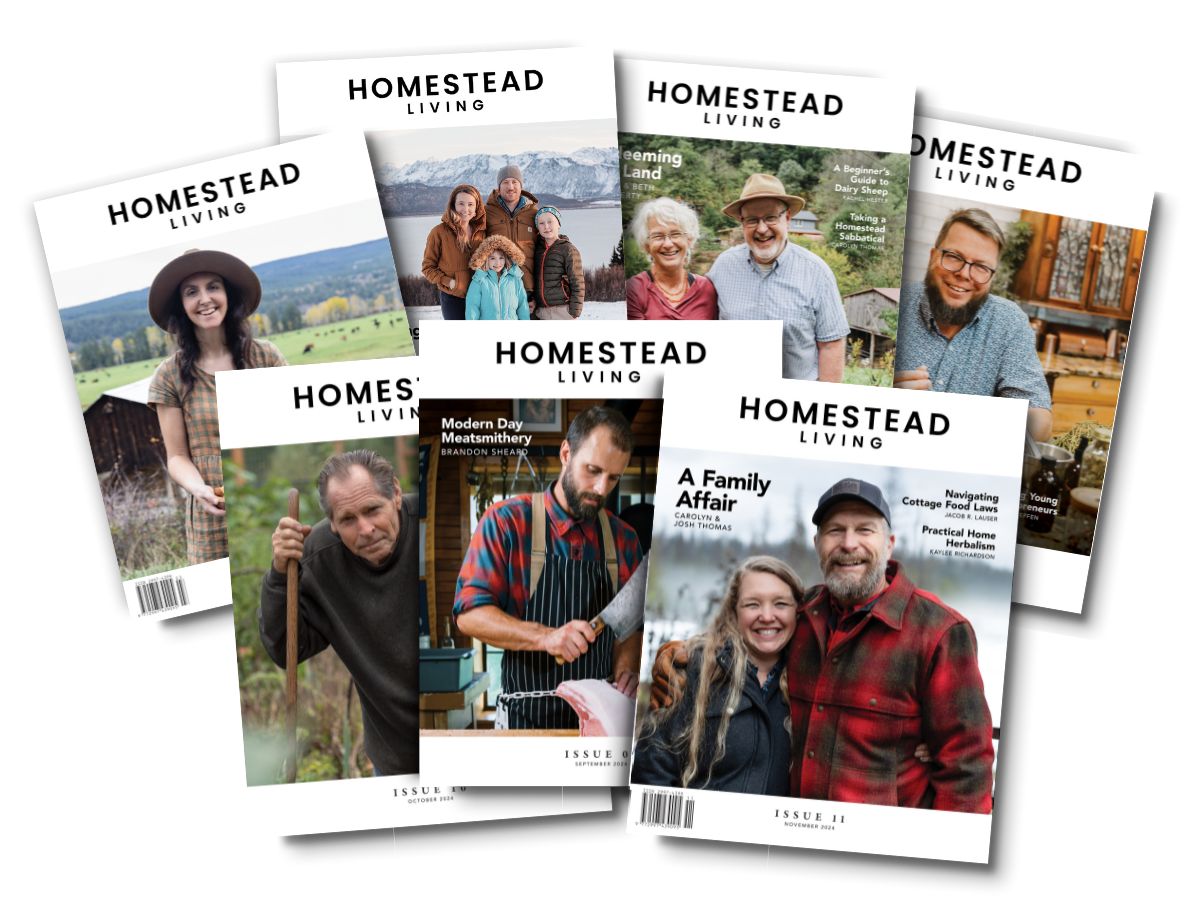
This Episode of The Coop is brought to you by Homestead Living Magazine
Homestead Living magazine sets the standard for inspiring wisdom-filled homesteading content: actionable tips for organic growing, food preservation, delicious recipes, and uplifting true stories that feed body and soul.
Learn more: https://homesteadliving.com/homestead-living-magazine



Leave a Reply