
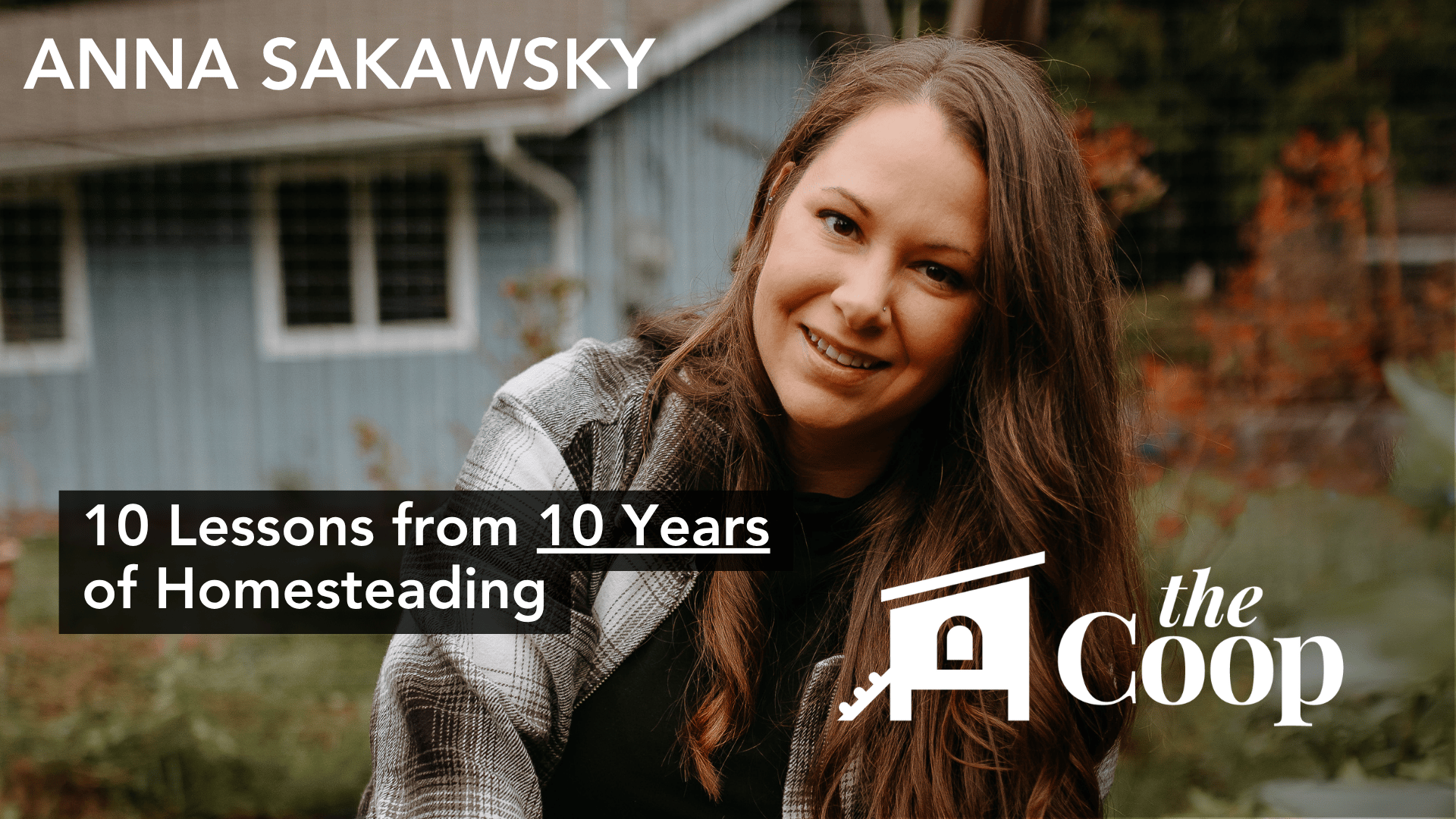



In this solo episode of The Coop, Homestead Living Editor-in-Chief Anna Sakawsky reflects on more than ten years of living this homesteading life and shares the 10 biggest lessons it has taught her.
Rather than focusing only on practical skills, Anna digs into the deeper truths that shape a sustainable, meaningful homesteading journey: why mindset matters more than acreage, why starting before you’re ready is essential, and why perfection is never the goal.
She talks about the dangers of taking on too much too soon, the value of treating “failures” as lessons, the myth of complete self-sufficiency, and the quiet power of regularly checking your actions against your real priorities.
If you’ve ever felt behind, overwhelmed, or unsure whether you’re doing this “right,” this honest conversation is for you.
In this episode, Anna discusses:
- Why homesteading is a mindset first and foremost
- The importance of starting before you’re ready
- Learning to walk before you run
- Why nothing on the homestead is permanent
- Reframing failure as lessons learned
- Just because you can doesn’t mean you should
- Which rules can be flexed (and which shouldn’t)
- The myth of total self-sufficiency and the role of community
- Never losing sight of your priorities and your “why”
- Accepting that no one gets out alive … and why that’s freeing
Listen to or watch the full episode right here:
The show notes …
0:00 – Introduction
5:02 – Lesson 1: Homesteading is a Mindset First
9:30 – Lesson 2: Start Before You’re Ready
12:24 – Lesson 3: Learn to Walk Before You Run
16:06 – Lesson 4: Nothing is Permanent
19:01 – Lesson 5: There is No Such Thing as Failure
22:37 – Lesson 6: Just Because You Can, Doesn’t Mean You Should
26:03 – Lesson 7: Learn the Rules Before You Break Them
35:26 – Lesson 8: 100% Self-Sufficiency is a Myth
40:16 – Lesson 9: Never Lose Sight of Your Priorities
46:58 – Lesson 10: No One Gets Out Alive
53:23 – You Don’t Have to Homestead Perfectly
Anna Sakawsky (00:00):
You don’t have to homestead perfectly to homestead well. Why did you want this life? What are you hoping to get out of it? And are you still on the right track or have you maybe veered off course somewhere? And do you need to course correct? So the number one lesson that I have learned over the past decade or so just over is that homesteading is a mindset first and foremost. You can be a homesteader in an apartment downtown if you want, if you have the right mindset. If the thought of raising chickens has ever intimidated you, consider this your sign to stop putting it off. Murray McMurray Hatchery has been helping first time chicken keepers succeed for over a hundred years. They offer the widest selection of day old chicks and poultry, super low minimum orders, sometimes as few as one bird, and the best guarantees in the business, live arrival, 48 hour livability, and 90% sexing accuracy.
(01:01):
Plus they’ve got everything you need to raise happy, healthy birds right from the start. Brooders, feed incubators, the works. It’s never been easier or safer to start your own flock, so visit mcmurrayhatchery.com and tell them the coop sent you. Again, that’s mcmurrayhatchery.com. Hello everyone, and welcome to episode number 27 of The Coop. I’m your host, Anna Sokovski, editor-in-chief of Homestead Living Magazine. And today I am bringing you another solo episode where I’m going to be sharing the top 10 lessons that I’ve learned from about a decade of homesteading, just over a decade. Really our journey started around, I don’t know, 13, 14 years ago now. And our real homesteading journey began just over a decade ago when we moved from the city out to Vancouver Island where we live now. And if you know my story, I’ve shared this in past episodes, but we kind of moved from a condo in the city or the suburbs of Vancouver and then moved on to our rental property out here on Vancouver Island.
(02:08):
And then now we’re on just over a quarter acre in a house that we own. And we do have dreams of maybe upgrading at some point, but I don’t know, with the economy, everything the way it is, this is where we’re staking our claim for now. But along the journey with each kind of progressive step, we have obviously made lots of mistakes and we have learned a lot of lessons along the way. And so at first I was going to share that the focus of this episode was going to be on the biggest mistakes that I’ve made, that we’ve made along the way. But when I really reflected on that, the more I realized that we haven’t actually made a ton of mistakes, and that’s not to say that we’ve done everything perfectly. We certainly have not, but it’s just more so that we, yes, we’ve had unfortunate things happen and we have made mistakes, a lot of little micro mistakes for sure along the way as we have been learning, but that’s just a natural part of homesteading.
(03:06):
It’s just a natural part of the journey. And I hesitate to even call them mistakes. We’ve had pests and diseases take our crops. We planted and built things and brought animals onto our property that were wrong for us or we’ve put things in the wrong place. We’ve let food rot on the vine or on the counter because we just didn’t have enough time. We’ve even jumped jars of food down the toilet because nobody wanted to eat them. But that’s all part of the learning process. And I don’t know too many homesteaders who haven’t made all of those mistakes and more along the way. So instead of focusing on the mistakes, which are inevitable, I decided to focus on the bigger lessons that homesteading has taught me, partially through the mistakes that we’ve made, but partially just through living this lifestyle over the course of the past 10 to 15 years or so.
(03:58):
So some of these lessons are more practical and then others are more philosophical, but every one of them has changed the way I see homesteading. And honestly, just the way I approach life in general. So whether you are just starting out or you’ve been homeseading for years, I hope, or maybe you’re not even homeseading, maybe it’s just you’re interested in it, maybe it’s something that you’re dreaming of maybe doing one day. But a lot of what I’m going to share today applies to life in general as well. No matter what we’re talking about, insert whatever type of lifestyle or goals you have or whatever here, replace it with homesteading. And a lot of them are going to apply to all aspects and areas of life as well. But above all, I hope something from today’s episode encourages you, saves you a little frustration when things don’t go according to plan or simply reminds you that homesetting is not about arriving at some grand final destination.
(04:54):
It’s about the journey itself and what a teacher teaches and offers us along the way. So let’s dive in. So the number one lesson that I have learned over the past decade or so just over is that homesteading is a mindset first and foremost. So what does this mean? This means it’s not about the size of your property. It’s not about how much experience you have or how much you’re producing or whether or not you’re completely self-sufficient or whether you’re churning your own butter and milking your cow and doing all the things. And I’ve seen this before where people have shared online, for example, something that they’re doing, maybe growing a little bit of food, making some sourdough bread, and they’re saying something about being a homeseater and people will jump in the comments or get on the boat. You’re not a real homesteader because you use a washing machine or you’re not line drying all your clothes or you’re not a homeseader because you don’t have multiple acres or you’re not producing all of your own food.
(05:53):
We tend to look at things in such black and white. And rarely, hardly anything is actually black and white in life. And homesetting is one of those things. So what is it then? At what point can you call yourself a homesteader? And that’s where I think really at any point, so long as the mindset shift is there. So it’s really about your mindset and the way that you see the world and the way that you kind of approach the world. You don’t have to be doing all the things. You can be a homesteader in an apartment downtown if you have the right mindset. So I always say that my definition of homesetting is being a producer rather than merely a consumer. So focused on how can I produce more of what I need rather than simply rely on others to produce it for me so that I can consume it rather than just relying on the grocery store or the system to provide for you.
(06:49):
You’re always thinking about how can I be more of a producer? And so again, that doesn’t mean that you’re not a consumer too or that you don’t go to the grocery store at all or that you’re producing everything you need. It just means that you’re always looking at things through the lens of how could I produce that thing myself or become more self-sufficient in this area or source more things locally and take more control over my food supply and ultimately my life. So again, you can be a homesteader in a city apartment by shifting your mindset towards a mindset of production and taking more control over providing for yourself and your family in whatever ways you can. Even if that just means figuring out where to source food locally again. So rather than just mindlessly consuming, going to the grocery store, going to the drive through, all that stuff, even if you can’t be producing it yourself, how could you be more intentional about that?
(07:40):
How could you build a little bit more self-reliance into the way that you provide for yourself and your family? And maybe that’s just learning where to source those things locally, getting to know your local farmers, learning. I mean, we started in an apartment and one of the first things I learned how to do was forage certain things, not even difficult things. Blackberries, I think was the first things I learned to forage because they were everywhere and I just never realized it. And then when I realized I could go out and actually collect food for free, everywhere I started looking, I started seeing food. I’d look up and see apples growing on an apple tree. And there were figs that were going right outside of our apartment balcony. We’d lived there for a couple years already and I’d never noticed them. I’d never looked past the leaves to see the figs.
(08:23):
I just had never noticed it. But just shifting my mindset towards how can I not just be reliant on the grocery store, for example, to provide for me. All of a sudden I saw the world through new eyes. And there’s lots you can do even on a small scale. In our apartment, for example, we have a kitchen. Almost everybody has a kitchen. So you could be making your own bread, sourdough, jam. Again, even if you’re not growing all the berries yourself, you can be sourcing them locally and making your own jam, canning your own food, cooking from scratch even, growing a few herbs on your counter. Every little bit counts towards this lifestyle. Again, you don’t have to have arrived at some grand destination. You don’t need to be doing all the things. You don’t need to be living like Ma Ingalls to be a homesteader.
(09:11):
It’s just more about a shift in your mindset and how you approach and see the world. So there is always something you can do wherever you are. I think the first step is really just to stop being a victim that’s just at the mercy of the system and the world around you and start taking action to produce and provide for yourself, which brings me to my next point, which is to start before you are ready. So that is my next big lesson learned. Start before you’re ready. So many people dream about homesteading, but I hear this a lot where it’s like, yeah, I really want to homestead one day. So someday the goal is to get a large parcel of land and then I’m going to put in gardens and I’m going to get animals and I’m going to learn to homestead. So they figure they’re going to buy the land first.
(09:56):
And then once they finally get that land, then they’ll get started. So not only does this lead to delaying your dream and sometimes indefinitely, right? Because even if we have that dream, you never know for sure if and when that’s going to happen. Even us, we thought we would probably be, this would be maybe around the time we’d be moving off of this property and hopefully onto a larger one. But that’s not the way things have worked out. And yes, there’s a piece of me that dreams about still moving onto a larger property and expanding the homestead and doing more at some point. But at the same time, we’re pretty happy where we are right now and we’ve got a pretty full plate where we are. But that’s also because we started before we were ready. If I waited till we had this big plot of land, we still wouldn’t be homesteading today.
(10:39):
We’d still just be like, okay, now, okay, we moved, we rented, now we’ve got the starter home. And hopefully someday we’ll get the big piece of land and then we’ll start homesteading. So don’t put it off just because you can’t do all the things, again, doesn’t mean you can’t do something where you are. And the thing is also, if you wait until you have the perfect property, then you’re going to waste valuable time in the meantime that you could be learning and acquiring skills that are then transferable if and when you do get that property.
(11:13):
And that’s the thing too, is that then if you get that bigger property and you haven’t done any of the learning, then you’re starting from scratch and now you’re facing a huge learning curve on a big piece of land and you can very easily overwhelm yourself. And to that point, I always recommend not biting off more than you can chew. And I know especially when you’re starting homesteading, it can be really tempting to dive in and want to learn all the things at once. I still recommend kind of just taking things slow, learning one new skill at a time, getting really comfortable with one thing and then moving on to the next. But I also think you need to take action as soon as possible because there’s really only so much book learning or learning from others, taking webinars, listening to podcasts, all these things.
(11:55):
That’s all great and super helpful at every step along the journey, I think. But there’s only so much of that you can do before you really just need to put your hand to something and start doing it. And that’s how you’re really going to learn. So even if you’re not in the ideal situation, just get started. Wherever you are, start doing what you can. You can always change course later, expand. Things can change, but start where you’re at. And then that being said, as I mentioned, the third lesson is to learn to walk before you run, which means just don’t dive in headfirst if you can avoid it. I know it’s tempting to, but probably the number one reason that I hear from people who decide to leave the homesteading lifestyle is because they try to do too much all at once or they try to do more than makes sense maybe in the current season of life they’re in.
(12:50):
They take on more than they’re ready for and just get overwhelmed and everything suffers. And I’ve actually started to see a bit of a trend online. And I’m not judging it one way or another, but I’ve started to see some homesteading accounts, for example, online going like, “We though we would be happier living this lifestyle. We did it for a few years and turns out we’re not happier and we’re moving back to the suburbs and we’ve never been happier. We’re closer to town and our kids can ride their bikes with other kids around the neighborhood. Again, we’re not so removed from everything and we don’t have all the stress and pressure of growing all our own food and we’re actually happier like that.” And all the power to you, if that is the path for you, right? That is part of it. Sometimes you get into this lifestyle or any lifestyle and just realize actually it’s not the right fit.
(13:37):
And that’s okay also. But I think a big reason why this happens sometimes is simply because people dive in, they buy the hundred acres out in the country and they’re super isolated and rural and then they’re trying to do all the things and they’re feeling stressed and feeling overwhelmed. And so then what they thought would give them a better life turns out to be more of an albatross on them. And then when they do move back to the suburbs or the city or whatever, they’re like, “Actually, this is much better.” Whereas again, it doesn’t have to be all or nothing. But before you take on too much, just start slow. Start where you are, but then start slow with one thing and then add another thing and then work up to it and don’t think that you need to dive in and do the full hundred acres on rural land either.
(14:27):
Like I said, we’re on a quarter acre. We’re on a cul-de-sac. So we’re kind of one foot in suburbia and then we are back onto a green belt and we’re zoned rurally. So we’re in this kind of interesting quagmire in between where we’re a little bit suburban, we’re a little bit rural, quarter acre property. We can’t have the huge farm, but we have our chickens and we have our garden and everything. And that can be enough too. You don’t always have to be taking on more. But we wouldn’t have known that if we hadn’t just started walking the path. And I think we’ve been pretty good about this over time. And I think it’s been one of the good things about not being able to afford necessarily a big property off the bat is we have been able to grow along with our properties without it ever feeling too overwhelming.
(15:12):
And again, it’s because we started before we were ready. We started dabbling in this, learning about it, doing a little bit of a lot of cooking and a little bit of preserving and foraging and sourcing locally and that sort of thing when we were in the city. And then we moved up to a rental where we were able to put in a little garden bed and I learned how to preserve because there was an apple tree that took us to that next step. And then now that we’re on this property, we’re doing a whole bunch more than that even, but we’re still limited because we only have a quarter acre. And then at some point, if we want to upgrade, then we can take all of that with us and then take that next step. To both of these points though, but starting before you’re ready and then taking things one thing at a time, learning to walk before you run, just remember that you can always scale up as I said, but you can also scale down if you realize that, hey, maybe I bit off more than I can chew.
(16:03):
You can always scale down, change something or do something differently, which brings me to my next point. And that is nothing is permanent. And part of that is to get over some cost fallacy, which I’ll address in a minute. But when I think back on my quote unquote mistakes, most of them pertain to what could be seen as wasted time, wasted money, or effort spent planting the wrong things in the wrong place, only to have them die or for us to have to rip them out or have to move them later on. I’ve done this with tons of perennials. Our raspberries, blueberries, strawberries, our original herb garden, even ornamental plants. We’ve planted so many perennial type things in the wrong place and then had to move them later. And yes, okay, it’s always best if you can not do that, put them in the right place to begin with.
(16:55):
But if you have to, you have to. If you have to move things, nothing is 100% set in stone. Or we’ve done things like spent time building something that didn’t work out in the end. We’ve done this with multiple compost bins where we just put them in the wrong place. We had weeds growing through them and issues like that or we built them wrong using the wrong materials that kind of degraded over time. Or my husband built a chicken tractor that turns out we didn’t actually have enough room for on our quarter acre property. So we got rid of that. We’ve had built garden beds that we’ve decided to tear out. We’ve had rabbits that didn’t work out. We’ve done a whole bunch of stuff that in hindsight, I’m like, that could have been seen as a mistake. It didn’t work out for us at the time.
(17:39):
But the thing is that if we didn’t try all those things and put them where we did and all that, we wouldn’t have learned the lessons that they taught us about what we should bring onto our property, what should go where, what’s necessary and what’s not, et cetera. So every mistake that we’ve made and thing that we’ve done wrong the first time, and sometimes even the second time or third time has gotten us one step closer to doing things the right way or at least finding a better way. So the other thing is to get over what I call this sunken cost fallacy or I don’t call it that. It’s called that. Someone else called it that. But sunken cost fallacy is the idea that we’ve put time or money into something. And so it’s a loss to let that thing go. But that doesn’t mean that the time or money we’ve put into that thing has been wasted, even if we have to get rid of it or move it or whatever.
(18:35):
Because even when you have to redo things or get rid of them or eat your losses in some way, you’ve still gained the wisdom and experience. And sometimes you’ve simply benefited from a temporary fix before being able to upgrade or move on to something better. So you shouldn’t let that stop you from doing things or stop you from redoing things if you find that that current thing or situation isn’t right. And that again, leads me to my next lesson, which is that there is no such thing as failure, only lessons learned. So one of the most valuable takeaways that homesteading can give you, I think is just the lessons that it teaches you. And one of the best ways to learn obviously is through failing and making mistakes. It can be really easy to get down on yourself for making what could be seen as mistakes on your homesteading journey or to fail at certain things.
(19:32):
Or I guess, again, perceived failures, which I don’t think that there’s really any such thing as failing if we’re doing things in good faith, but feeling like you failed at certain things, but there’s always a silver lining. And usually that is the lesson that you can take out of that failure or mistake. So as I mentioned in the intro, we’ve made more mistakes and had more what I would call micro failures. Nothing disastrous, I guess, but so many little mistakes along the way, so many more than I can count. Every year something goes wrong or we have a crop fail. And often it’s a crop that did amazing last year and all of a sudden it’s not doing so well this year. So some of it is just luck of a draw. You’re doing your best. There’s things out of your control. We’ve dealt with all sorts of different things and had to learn how to navigate all sorts of challenges.
(20:26):
But that is part of the journey. Mistakes are part of life. Failure is inevitable. And actually we recently added a new column to the magazine called Lessons from the Homestead just to highlight that this happens to everybody. Nobody, even the people that seem like they totally know what they’re doing and they’re seasoned homesteaders and everything, they’ve only got there because of a million mistakes they’ve made along the way and they’re still making mistakes. I mean, we just launched this column a few issues back. So we’ve only had a few contributors who have written for it so far, but the ones that have are all very, very well-known seasoned homesteaders. And it just goes to show that they fail and make mistakes too. And then they learn from them and they move on. And actually there’s a famous quote by Thomas Edison where he said, “I have not failed.
(21:15):
I have just found 10,000 ways that won’t work.” And of course that eventually led him to figuring out what does work. And he went down in history for his inventions, for inventing electricity and all sorts of amazing things that had changed the course of history. If he had given up after a failure, then who knows where we’d be. But the point is failure is an inescapable part of the road to success. So embrace it and try to reframe it as invaluable lessons that you couldn’t learn any other way. Like think about what you would pay to go to school or whatever, to go to some institution or pay for a course or whatever that’s going to teach you these things. And still, no matter how much money you pay for that, you’ll never learn better, I guess, than by doing things hands on. And then especially by making mistakes because those are the things that stick with you.
(22:11):
And especially when you make mistakes, and I think especially in the homesteading world where we’re trying to figure things out and get resourceful and creative and everything, that’s what really stretches us. That’s really what stretches our problem solving skills and everything else and really builds those qualities in us. So really failure and making mistakes is a gift again, so long as we have the right mindset about it. Okay. So my next lesson is just because you can doesn’t mean you should or that you have to. So one of the lessons that many homesitters learn from making mistakes and failing along the way is that just because you can do something doesn’t mean you should. Likewise, just because someone else is doing it, it doesn’t mean you have to do it too or that you have to do it the same way. And I was almost going to have that be a separate point, but I’ll kind of group it under here.
(23:07):
But the whole idea that comparison is the thief of joy. I know it’s easier said than done. And especially in the world that we live in with online influencers and there’s so many people, especially that are in the homesteading realm. And I’m one of them I understand where we’re sharing online or sharing through some medium. Even the magazine, you might see things and go like, “That’s really cool.” But maybe it doesn’t work for you or for your property or for your season of life.
(23:36):
We’re all unique and different too, and people are wired differently. It’s really easy to compare ourselves to our journey to somebody else’s. And it’s really easy to then feel inadequate or then try to emulate them. And just because somebody else is doing something doesn’t mean it’s the only way that things can be done. And as far as just because you can do something, just because you can keep goats or a dairy cow, for example, doesn’t mean you should. If that doesn’t suit your family, maybe you don’t even drink milk or you don’t want to keep goats or whatever. It doesn’t mean you have to because somebody else is doing it or because you have the available space to do it or whatever. Just because somebody else is filming their journey for YouTube or sharing it on Instagram or selling their food to the public or scaling a business or whatever doesn’t mean you have to do the same or that it makes sense for you and your goals.
(24:30):
And again, the season that you’re in just because somebody is spending their summers at home in the garden and preserving food and everything, which I’ve done that before, but our season of life has changed right now too where we’re busier with kids and extracurriculars and wanting to go camping and travel and do different things. And it’s something I constantly fight with a bit. There’s almost a bit of guilt that I’m like, well, I should be doing that. We’ve got the garden and I should be growing more. Food prices are high and I should be preserving more. But should I really? Why? Who says that I have to? That’s an arbitrary rule that I’m making for myself. What I should be doing is evaluating whether that makes sense for me right now, because when we say yes to something, we’re always saying no to something else.
(25:16):
And I’m going to get to that point later as well. But I think we just always have to just really reconsider what are our actual goals? What are we wanting to get out of this? And then are the actions that we’re taking aligned with those goals? Because as I mentioned, it can be really easy to go overboard and take on more than you can handle just because you can or you feel like you should for some reason or to get caught in the comparison trap. And again, think just because somebody else is doing something a certain way that that’s the way you need to do it too. But we all have unique situations and goals and commitments outside of home setting and personal lives to balance along the way. And so just make sure you consider all of these things before taking on things that don’t suit you or the season of life that you’re in.
(26:03):
So the next lesson is that, and kind of in the same vein, is that some rules, I was going to say rules are made to be broken, but that’s not always, always the case, but some rules are made to be broken or at least tampered with. So again, just because someone else says you need to do things a certain way or because they do things a certain way doesn’t mean that’s the only way you can do them or should do them. Likewise, just as you should learn to walk before you run, you should learn the rules behind certain things before you decide to break them. And two areas where this stands out for me is in the garden and in the kitchen, for example. So when I first started gardening, I learned everything I could. I learned all the rules behind gardening. I was learning everything I could about.
(26:51):
And I was so overwhelmed with all of those rules, like the rules of companion planting and what should be planted next to each other and what shouldn’t be planted next to each other and how you need to rotate your crops and doing soil testing and amending things and composting. And I didn’t even know where to start. And I got analysis paralysis and it felt like an impossible jigsaw puzzle to put together. But when I finally just began, I quickly learned that a lot of those rules are more like best practices. So one of the things was never to plant legumes, so beans and peas and stuff like that beside onions. And I remember the first year we were doing a garden or garlic and that sort of thing. And I had a really limited space. I’m like, but if I move that there, then that’s going to be there and that shouldn’t be planted with this.
(27:34):
But if I move that there, then that’s going to be. And finally I was like, well, I really don’t have any other space. And so I just planted a couple things together that weren’t supposed to go together. I think it was garlic and peas or something like that. And guess what? They did just fine. Or another one is that beans always need to. I don’t know why so much with bees and beans, but that’s just what’s coming to mind, but that beans need to be direct sewn. Yes, there are some. I mean, there’s definitely some crops that I would say I’ve learned also by trying different ways. They need to be direct sewn. You may have heard my story before, but the very first time we ever tried to plant carrots was, I think it was the first seeds we ever planted when we lived in our condo in the city and we planted them in little pots indoors.
(28:17):
I don’t even know where we thought we were going to transplant them to, but carrots are not one of those plants that you should transplant. Root vegetables don’t exactly transplant well. So there’s some that, yeah, I mean, the rules are there. Again, not necessarily because they’re rules, but because you’re probably going to struggle if you don’t follow them. Now, beans and peas I always learned needed to be direct sewn as well as a lot of squash plants. Although I’ve always started my squash inside, my pumpkins and my zucchini and that gives them a head start. I’ve actually never found that I’ve had any trouble transplanting those things. They’re kind of like either or. Well, beans and peas, it turns out peas, maybe not so much, although I do see pea starts for sale. So I’m sure you can transplant them. But beans, I had one year where I just kept direct sewing them and they kept being eaten by little pill bugs, little wood bugs.
(29:07):
And every time I plant them, the sprouts would come up and they’d get eaten. And I must have done like four or five plantings. And I was determined. I’m like, “I am not going to let this go. I want my bean harvest this year.” And so I finally was like, “Okay, I’m just going to try starting them in pots and transplanting them because what’s the worst that could happen? I lose one more round of beans.” And guess what? I got them to a point where they were woody enough that I could plant them and they weren’t going to get eaten. They weren’t really tender. And they grew and they were just fine. So this is an example of something that’s like, don’t hold yourself to something too rigidly. Compost tea is another one. I remember learning about that and people were putting aerators and they’re like, “You got to add oxygen so it doesn’t sit stagnant.
(29:47):
And there’s all these rules around it and all this fancy equipment you needed.” And I was like, “This is just too much for me.” And then I started, actually it was David the good that I started following, who’s one of our contributors. And he was like, “You can throw anything Going into a compost tea, stuff that he’s like, you can throw laughters in there. I throw animal bones in there. He’s like, it’s all organic material and I just let it sit there and fester and it smells awful. And then you throw it on your plants and they don’t have noses. And guess what? They all grow amazing. Now, I don’t quite compost the way he does, but I did learn that I can just cut up a bunch of comfy, for example, or make a compost tea and then you cover it all in water and just let it sit in a bucket.
(30:25):
And I’m not aerating it and doing all this fancy stuff or composting. Same thing. I don’t measure out all my carbon and nitrogen materials and turn it all perfectly. I kind of just throw everything in a pile. And yes, it takes longer to break down, but guess what? It does eventually break down. So I’ve learned that over the years that yes, there are best practices that if you can do things a certain way, that’s probably the better way to do them. But they’re not hard and fast rules in a lot of cases. And the kitchen is the same when it comes to cooking. So many people, homesteaders or not, are so used to following a recipe. And if you don’t have the exact ingredients in that recipe, you can’t make it. And there are certain with baking things, certain amounts, making sure that there’s a science behind some of it, but a lot of just cooking from scratch is improvising and substituting with things and omitting things and adding things.
(31:17):
And you can get so creative in the kitchen. So breaking out of that idea that you need to follow a recipe or a set of rules all the time in order to do something or that if you’re missing an ingredient, you have to go buy it. So much of homesetting is about that because it’s all about making use of what you have on hand and what’s in season and all that stuff. Now, there are obviously a couple, there are some instances where the rules really shouldn’t be broken and that’s why it’s important to learn them before you break them. So two cases that I can think of off the bat, again, one is baking and it doesn’t mean. There’s definitely, you can get creative with your baking, but there’s a science behind certain ingredients and the amounts that you’re using and that sort of thing to get the result that you’re looking for.
(32:04):
But more importantly even is canning. So preserving in general, but canning specifically is the one that can be dangerous if you don’t do it the right way and it’s not meant to scare anybody off. I love canning and I’m super confident with it now. I can all sorts of things. I pressure can, I can meats and vegetables and fruits and combination meals and stocks and soups. And I can basically do it with my eyes closed now 10 years later. But when I first started out, again, it was something I was really intimidated by. And because I was really intimidated by it, but I really wanted to learn, I learned everything I could about it to really understand the science behind it. Once I understood the science behind, for example, you have to pressure can low acid foods like meats and vegetables, unless you’re acidifying them, like making pickles.
(32:51):
We won’t get into it right now. And making sure that you’re following certain processing times. And we always say follow tested recipes, but again, this is when you start to understand the science behind it and what rules can’t be broken, then you also understand which ones can, where you can get a little creative, where you can omit something where you cannot, where you can add something, where you cannot, that sort of thing. So again, it’s like that whole learning to walk before you run. Learn the rules first, but then once you understand them, once you understand which ones are actually hard and fast rules and which ones are maybe like it’s not going to kill you to try something different, don’t be afraid to break some of those rules that are more just the best practices. If it’s like, what’s the worst that can happen?
(33:41):
And it’s like my whole family dies, then maybe don’t break that rule or don’t break it until you learn more about it and find out if you really can or not. If you’re just starting with canning and you don’t understand it yet, follow a tested recipe. But if it’s something like, well, what’s the worst that can happen? My beans don’t grow. Not the end of the world. Don’t be afraid to break some of those rules. If you’re a mom like me, then you probably know what it’s like to spend way too much time worrying about what’s in the everyday cleaners and body products we bring into our homes and use on and around our families. In fact, a few years ago, I completely overhauled our cleaning products and started making my own vinegar cleaner, baking soda, toilet scrub, and homemade laundry detergent. And while those have honestly worked pretty good, I don’t always have time to make my own cleaners.
(34:28):
And if I’m being honest, I don’t always want every surface of my home to smell like vinegar. And that is why I love Rustic Strength. Rustic Strength offers a full line of non-toxic laundry, home and body care products all made in small baptism by a family-owned company in Missouri. Their formulas are safe and effective for real, for real, and free from the junk you don’t want in your home, on your body, or near your kids. Clothes come out clean without overpowering scents. Surfaces shine without the lingering scent of vinegar or toxic chemicals, and you can sleep soundly knowing that you don’t have to worry about what’s in your cleaners and skincare products. So if you’ve been thinking about making the switch to cleaner, non-toxic home and body products, then consider this your sign. Head over to rusticstrength.com today and see why so many moms have already made the switch.
(35:21):
Again, that’s rusticstrength.com. Tell them the coop sent you. Okay. Lesson number eight already. This is a big one. There is no such thing as self-sufficiency. And it pains me to even say that because I talk about it so much and it’s something that I strive for. And really what I mean when I say that is that there is no such thing as 100% self-sufficiency, meaning doing everything yourself. Many people embark on this lifestyle because they want to become self-sufficient. But anyone who’s actually ever attempted to become self-sufficient learns pretty quickly that it doesn’t exist. There’s no such thing as 100% self-sufficiency. Real self-sufficiency comes from establishing a strong support system that includes family, friends, neighbors, and other members of your local and even your digital community. That’s one of the plus sides to social media and the digital world now is that we’re able to connect with people that are interested.
(36:27):
Maybe you don’t have anybody around you that’s into homesteading, but you can find a whole community online of people who are into homesetting or you can learn from people online or you can learn from media magazines and books and all those things.That’s part of your community, I think too. Especially because of the online world and being able to actually connect with a lot of these people in person nowadays or interact with them more is what I want to say, even if it’s not in person digitally. But all of that forms your community, the people that are helping, teaching you things that you can exchange with, whether it’s bartering, exchanging services, or even like I just think about it really starts in your own family and then it emanates out from there. And we did a past episode actually on building community and why it’s so important.
(37:14):
So if you haven’t listened to that one, go back and listen to it. But starting with your family, I even think about my husband and I, he has so many skills that I don’t have. And then I have certain skills that he doesn’t have or we do certain jobs rather than me trying to be able to do everything and then him trying to be able to do everything. We all kind of pitch in and do what we’re best at, right? Which is how society works. That’s why we’ve as a human species have been able to build the societies and civilizations that we have been able to, is by everybody kind of lending their area of expertise. But doing that on a smaller scale helps you build more self-sufficient communities so that you can therefore, because nobody can do everything themselves. It’s just not possible. Even if you could, even if you had the knowledge and the skillset, there’s not enough hours in the day to provide 100% of everything for yourself, especially if you have a family depending on you and everything else.
(38:14):
So it’s more so about building a resilient community so that you are less reliant on the larger system. That’s really what’s going to make you resilient because when you’re trying to do everything yourself, that actually benefits that system. It benefits what I call the beast system. I heard that recently actually from, I keep saying, I call it this, but I keep hearing these things from others. I think it was our friends at the Live Free Academy who coined the beast system, but it’s just this idea of the larger government, corporate, big egg, big farmland.That’s what I mean when I’m referring to the system, just so there’s no confusion. So what that takes then is building a system outside of that system. It’s not about trying to do everything yourself because if something goes wrong, if you get sick, if anything happens, then you are 100% susceptible to being dependent on that system again.
(39:14):
But if you build a strong community and you build like a network outside of that, safety net outside of the system, then you have a community to fall back on and you guys, we’re all stronger together. We are social beings. We are never meant to do everything ourselves. The idea of that kind of rugged individualist living alone in a cabin in the woods is largely a myth. I know some people have done it, but by and large for most of us, we’re not going to do and produce everything ourselves. And that doesn’t mean that you shouldn’t strive to be as capable and independent and self-sufficient as possible and learn as many skills as possible and do all those things. It’s just about realizing that no man is an island. We are social beings. As I said, no one can do and produce everything they need on their own.
(40:06):
So I think true self-sufficiency is inseparable from community sufficiency and building a strong network.
(40:17):
Lesson number nine is to never lose sight of your priorities. So this is one of those kind of bigger philosophical ones that can apply to any aspect of life. But with homesteading, it can be really easy to get bogged down in the daily chores and the never ending to-do list and get so hyper focused even on certain aspects of this lifestyle that you end up neglecting more important pieces. Or maybe you end up pursuing homesteading because you want more freedom, for example, and you want to take back more control over your time and your food supply and all these things, but you end up creating a whole different type of system that still robs you of your freedom and your time. Now you’re tied to the homestead and all the things you have to do there. So I call this, and I do call it this, I haven’t heard anybody else refer to it this way.
(41:08):
So I’ll take ownership for this one, but maybe somebody else has referred to it this way before, but I call it escaping the rat race only to find yourself on a hamster wheel. A lot of us are like, “I want to start homeseading because I want to get out of the city. I want to escape the rat race. I want more freedom.” And then we find ourselves on this hamster wheel of like, “Okay, put it in the garden again. And now I got all this food coming in and I got to preserve it. No, I can’t go away that weekend because I’m tied to having to do something here. And no, I can’t leave the cow.” And so again, it’s about getting really clear on what your goals and priorities are. But if it’s real freedom that you’re seeking and you want more time, freedom and anything else, maybe some aspects of this life are not what you want.
(41:50):
Whether we’re talking about homesteading or any other type of lifestyle, as I mentioned, or goal that you’re pursuing, it’s imperative that you always remember your why. You probably heard about this before, your why being really important. Your why is your reason for doing this in the first place. Why did you want this life? What are you hoping to get out of it? And are you still on the right track or have you maybe veered off course somewhere? And do you need to course correct? So everybody has slightly different goals and dreams for their homesteading journey. And again, this comes back to my point of just because you can, doesn’t mean you should and don’t compare yourself to others. And really, you need to get really clear on what are your goals with this? Why is this important to you and what do you want to get out of this for yourself and for your family and your loved ones and your legacy and all those different types of things?
(42:40):
So this is highly individual, but regardless, it is important to always be checking whatever you’re doing, the actions that you’re taking against your actual priorities. Again, looking at is what I’m actually doing is what I’ve taken on and is where this journey has led me actually where I wanted to go. So one example that I constantly have to check myself against is that one of the major reasons I wanted this lifestyle was to bring my children up in an environment where they understand where their food comes from, where they learn how to actually grow and prepare their own food and where home for them is a refuge from what can often be a crazy, chaotic and stressful world. So I want them to grow up loving this lifestyle. They don’t need to follow in my footsteps. They don’t need to be homesetters too, but I want them to have fond memories of it.
(43:37):
I want them to learn some of these skills, even if they choose not to learn them later or not to use them later. I want them to come away with that sort of thing. So that’s one of my big goals with homesetting. But if I’m being honest, I found myself doing things like just putting on a show for them to keep them busy while I work in the garden or the kitchen because honestly, it’s easier. If you’re a parent, you probably get this. It’s a nice thought to have your kids right there at your coattails learning alongside you and doing the things too. But it can be a fight sometimes. You might have kids that aren’t really into it. It’s slower. All these different reasons why, or you just need to get things done. And so I’ve really had to evaluate that because I’m like, what’s more important getting the thing done or slowing down and having my children learn alongside me?
(44:33):
What’s the better use of this time long term? Another example, sometimes I personally get so overwhelmed with everything there is to do. Everything that’s fabricated really. I don’t have to be doing any of these things. I’ve decided to take them on. But sometimes then I get so overwhelmed with it that then I project that outward and create a stressful environment at home, which is the opposite of what I’m trying to create. So I have to then reevaluate that and be like, what is more important here? And the truth is sometimes I really do just need to get things done. And sometimes I am overwhelmed, just like I’m sure you are overwhelmed at times. These are parts of life, just like mistakes are parts of life and everything else. And it’s creating that for my children is not my only goal with this lifestyle. I do have goals of becoming more as self-sufficient as possible and providing healthy food for my family and also giving my family other enriching experiences like extracurricular activities and traveling and seeing new places and spending summer days camping and swimming at the lake.
(45:37):
And not to mention, our priorities have evolved as a family over the years as well as our children have grown. So there’s a lot of competing priorities too. Sometimes you’ll get some that can overlap, but sometimes they can compete with each other. And the truth is that, as I said earlier, when you say yes to something, you’re almost always saying no to something else. So the important part is just to be constantly reevaluating your goals and priorities and making sure that your actions align with your priorities in the current season that you’re in. So it doesn’t mean that whatever your priority was when you set out, like I want to become more self-sufficient. I want to grow all my own food, whatever it was, that doesn’t mean that that can’t change and evolve over time. It just means that you’re constantly checking in with yourself and checking like, what is my big priority right now?
(46:27):
And are the actions that I’m taking therefore aligned with my priorities or am I just getting caught in the cycle of again, of feeling like I have to be doing something or I should be doing something or I’ve created this never ending to-do list that is causing stress and issues that that’s not what I wanted out of this lifestyle. So I think it just really comes back to taking time regularly to check in with yourself and make sure that you’re still on the track that you actually want to be on. And if you’re not, again, don’t be afraid to change course a little bit. Okay. So my last big lesson is that no one gets out alive. And I know this one sounds a bit ominous, but it’s actually really freeing when you embrace the basic truth behind it. And that is that you can’t take any of this with you when you’re gone, right?
(47:18):
Nor can you guarantee that anyone else will want to take it on. And it also means that you can do everything in your power to build a fully functioning, independent homestead that you can pass on to your children someday, but that still doesn’t guarantee that it will be the thing that saves you or that it’s strong enough to withstand forces that are just beyond your control. So there’s a story, I feel like I’ve shared it on the podcast before, but I heard it when I was listening to another podcast and they were talking about preparedness, for example. They were talking about prepping and how much is enough and how should we be preparing for whatever might be coming and all these things. And then somebody shared a story about a woman who prepared her whole life and she did the homesteading thing and she had a pantry full of food and all these jars of home canned food and 25 year shelf life food and all the things that you do when you’re preparing for something major that may happen, may or may not happen.
(48:15):
And then she died of like cancer. And all of those things that she had spent years doing and accumulating and all that stuff, who knows? It was gone. It got divided up or people threw it out or whatever. And just the idea was that you can do everything in your power to prepare for a certain thing and you still can’t guarantee the outcome. You still can’t guarantee her. All her preps could not save her from cancer in the end. And I think, I want to say the story was actually that her disease manifested from other unhealthy lifestyle choices. So where she was so focused on preparing for this thing here to try to make sure that she could save herself or her family in case something beyond her control happened. She was neglecting another part of her life, which actually was the thing that got her in the end.
(49:07):
But the idea is just that you can do everything in your power and you still can’t necessarily control the outcome. And that’s also true for things like acts of God or of man or whatever, whether it’s like a fire that comes through and destroys your place. There’s a homesteading account I follow online that recently had their entire homestead wiped out completely by fire. Everything they’ve spent years building. And then there’s how many others have had gardens destroyed by windstorms and tornadoes and hail storms. And recently, actually this summer, there seems to be an increase in cases that I’ve heard about anyway of homesteaders getting hit with herbicide drift from neighboring conventional farms, which has taken out their entire garden and everything. So the idea again is just that like just because you can do everything in your power, but sometimes things beyond your control, things just don’t work out the way you thought they would.
(50:07):
And the fact is that we’re all just mere mortals here on this material, on the earth, in this material world. And homesteading is part of the material world over which we only have so much control. No matter how much you try, you’re never going to achieve, again, I want to say what I call, but somebody else coined this, but escape a velocity where you kind of get to a point where now you’re almost untouchable. You’ve escaped this system. It’s like we’re all talking about we want to escape the system, but really it’s impossible to ever fully escape it. It’s kind of like death in taxes.You’re never going to actually fully escape those things. So that doesn’t mean you just lay down and give up, that you shouldn’t do it anyway. Of course you should. That would be like saying that there’s no point in living because you’re only going to die in the end or there’s no point in working because you’re just going to have to pay the taxes.
(51:01):
Of course, there is value in doing things even if you can’t take them with you. Even if there’s a risk that it won’t work out or that nobody’s going to want it when you pass it on or that a fire might come through and destroy everything. We’re at risk of a wildfire. We’re back onto a forest and we live in British Columbia where we are getting worse droughts all the time. And there’s a real possibility that could happen at some point. And it terrifies me. I’m not going to lie. And yes, we try to be as prepared as possible in the material world to deal with those types of things or any other thing. So again, I’m not saying don’t do those things. I think there is value in all of that. But it just means that you kind of let go of the outcome in a sense, right?
(51:48):
That you just understand and come to terms with and are okay with the fact that this might not be the end all and be all or the thing that saves you and that you can’t take it with you when you go. So of course you should still do the things, you should still plant trees for the future. You should still work hard to build something that you’re proud of and hopefully even do it with the end goal of being able to pass it down to future generations, but you can’t guarantee the outcome or prevent it from being taken from you in some form or another at some point. So all you can do is make the best of it while you’re here to enjoy it, pass on the skills and knowledge to the next generation while letting go of any expectations of them following in your footsteps.
(52:32):
And then live a life that’s true to your values and your priorities at every stage of life. Because again, the goal isn’t to arrive as a homesteader to achieve this escape velocity. It’s just to live a life that you’re proud of and that you can look back on someday with hopefully as few regrets as possible. So those are the 10 biggest lessons that homesteading has taught me over the past decade or so. I’m sure if I recorded this in, again, in five years, 10 years from now, the list would probably look a little different or there may be more lessons. I’m sure there’ll be more lessons added to the list or that each of these 10 will be expanded on and I’ll have different examples to share because that’s what life is all about. We’re always growing, we’re always learning, we’re all evolving. And that’s one of the beautiful things about homesteading too, is that it never stops teaching you.
(53:24):
Every season brings new challenges, new successes too. We didn’t really mention successes, but there’s a lot of things that we can be celebrating. A lot of successes along the way as well. And we learn from those things too and new opportunities to grow and not just as a gardener or a homesteader, but as a person. So if there’s one thing that I do hope you take away from today’s episode, it’s this and that you don’t have to homestead perfectly to homestead well. You don’t have to know everything before you begin. You don’t have to grow all of your own food, keep every type of livestock or have the perfect property. Your homestead and your journey doesn’t have to look the same as someone else’s and you don’t ever need to arrive at some fictional endpoint in order to call yourself a homesteader or feel like you’ve made it.
(54:17):
All you have to do is just keep showing up. Keep putting one foot in front of the other. Keep evaluating your lifestyle against your bigger goals and priorities and course correct when needed. Keep being willing to learn, to fail, to make mistakes and to get back up again and keep going. Because ultimately, homesteading isn’t about becoming completely self-sufficient or feeding your family only organic homegrown food or making all of your own herbal medicine and never having to see a doctor or surviving the apocalypse even or any number of other reasons that people often associate with this lifestyle. In the end, it’s about developing your character, living a life that’s aligned with your values, building something that you can be proud of and looking back with as few major regrets anyway as possible. All of those little mistakes that you’re inevitably going to make along the way in homesteading as well as in life will be long forgotten when you’re sitting in your rocker on your front porch at the end of your life.
(55:16):
But the bigger lessons, the memories you’re going to make and the satisfaction of a life well lived will remain and will keep your soul nourished to the end of your days and perhaps even beyond. So that’s the way I see things anyway. I would love to hear your thoughts too. What lessons has homesteading taught you? What is your why? Have you ever realized you were trying to do things a certain way because someone else was doing it that way or because that’s what you thought you had to do only to realize that that wasn’t actually serving you? Have you ever stopped to evaluate, reevaluate where you’re at and change course? Have you decided to stop homesteading or scale down or scale up? I’d love to hear what your journey has looked like and the lessons that you’ve learned along the way. So if you’re listening on YouTube or Spotify, leave a comment below and let’s learn from each other too.
(56:09):
Again, this goes back to community. I love being able to hop on with a microphone and share my thoughts with you, but I also love to hear from you and learn from you. And I hope that we can start creating a community here as well where we’re learning from each other. I always love to do that. If I’m listening to a podcast I enjoy is to hop into the comments and see what other people have to say and share and learn from them as well. So leave a comment below, let me know what you thought of this episode. And if you enjoyed it, I’d really appreciate if you’re not actually subscribed to subscribe to The Coop wherever you’re listening. And if you feel so inclined to leave a rating or review and/or pass this on, forward it to somebody that you think could benefit from it.
(56:51):
Also, if you are subscribed to Homestead Living Magazine, you probably notice, as I mentioned, we recently started publishing a column in every issue called Lessons from the Homestead where our contributors share insights into their own past mistakes and failures and the lessons they learned along the way. So I mean, first off, it’s a good reminder that no matter how seasoned you are or how much experience you have, failure isn’t final. Challenges are to be expected and true meaning often lies on the other side of hardship and the lessons we learn along the way. But for now, right now we’ve just started, we launched this recently and we’ve just been sharing from some of our bigger contributors. So Joel Salaton has shared some of the mistakes that he made along the way. David the good. So these are some folks that have been on our covers recently.
(57:34):
He shared in the last issue and now our upcoming issue, Jason Contreras of Sow the Land has shared one of the big mistakes that he made and the lesson that it taught him. So that’s been fantastic. And I think it’s been really good to see that these more seasoned homesteaders and people that seem like they’ve got it all figured out are not immune to mistakes. But I would also like to start sharing some of our reader stories, mistakes, failures, lessons, and successes. So again, leave a comment below, but if you have a story you’d like to share, feel free to email [email protected] and share your story. Share your homesteading journey. What does it look like for you? And what are some takeaways that maybe you could share with other people who are starting out or looking to take the next step? Again, this is about building community and I would love to hear more from you.
(58:23):
And you never know. Maybe we’ll just publish your story in an upcoming issue. And of course, if you’re not subscribed, as I always tell you to on every episode, but if you’re still not subscribed, then make sure to head over to homesteadliving.com/subscribe to start your subscription for just $49 a year. You get six gorgeous issues packed with practical advice and inspiring stories to help you keep putting one foot in front of the other on your homesteading journey no matter where you’re at. So again, that is homesteadliving.com/subscribe. Thanks again for tuning into this episode, friends. Until next time, keep learning, living with intention and growing what matters. And I’ll see you back here next time on The Coop. Bye for now.
Resources/Links
- Download Episode Audio File
- Subscribe to Homestead Living Magazine
Brought to you by
This Episode of The Coop is brought to you by Murray McMurray
Trusted since 1917, this Iowa family operation hatches premium poultry for homesteaders and enthusiasts, delivering healthy, hand-packed birds and all the supplies you need to start your flock right …
This Episode of The Coop is brought to you by Rustic Strength
Family-owned in the Ozarks, Rustic Strength creates powerfully clean laundry, home, and body care products using high-purity, toxin-free ingredients …
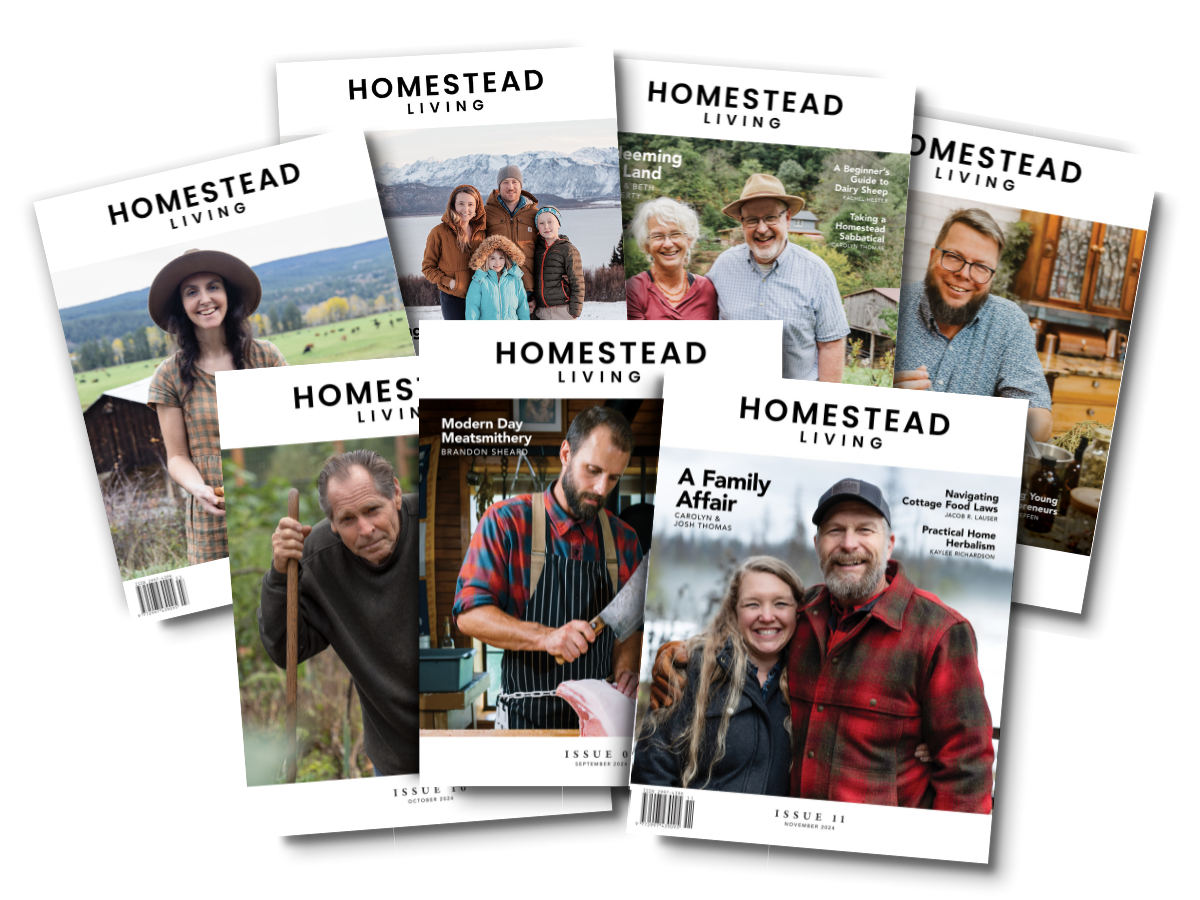
This Episode of The Coop is brought to you by Homestead Living Magazine
Homestead Living magazine sets the standard for inspiring wisdom-filled homesteading content: actionable tips for organic growing, food preservation, delicious recipes, and uplifting true stories that feed body and soul.

Leave a Reply